





Shoebox LED Street Light 60W to 300W LE Series
60W–300W AC shoebox LED street lights with Type III optics and 180–220 lm/W for municipal roads, parking areas and EPC projects.
- 60W–300W range supports 4–15m mounting heights for roads and parking areas
- 10,800–66,000 lm across eight power options at 180–220 lm/W
- AC100–277V, 50/60Hz input with Ø70–76mm pole interface
- 2700–6500K CCT with optional photocell, PIR and microwave controls
- IP66 aluminum and PC housing for −40°C to +65°C outdoor use
60W–300W Shoebox LED Street Light for Parking Lots
The LE Series is a grid-powered shoebox LED street light platform covering 60W–300W across eight models. It delivers 10,800–66,000 lm at 180–220 lm/W and uses Type III optics to distribute light along municipal roadways, commercial parking lots, logistics yards and other outdoor areas. Wattage is only one part of the selection; site layout and optical distribution also affect coverage and uniformity.
Recommended mounting heights range from 4–15m, while preliminary pole spacing should be checked against road width, pole positions, target illuminance, uniformity and nearby property boundaries. AC100–277V, 50/60Hz input, customizable 2700–6500K CCT, and optional photocell, PIR or microwave controls support different project requirements. The aluminum and PC housing is rated IP66 and designed for outdoor operation from −40°C to +65°C, subject to the selected configuration and site conditions.
Shoebox LED Street Light 60W to 300W LE Series Technical Specifications & Datasheet
| Model | LE | |||||||
| Watts(w) | 60W | 80W | 100W | 120W | 150W | 200W | 250W | 300W |
| Lumens(Lumens) | 10800-13200LM | 14400-17600LM | 18000-22000LM | 21600-26400LM | 27000-33000LM | 36000-44000LM | 45000-55000LM | 54000-66000LM |
| Voltage(V) | AC 100-277V | AC 100-277V | AC 100-277V | AC 100-277V | AC 100-277V | AC 100-277V | AC 100-277V | AC 100-277V |
| Frequency | 50/60Hz | 50/60Hz | 50/60Hz | 50/60Hz | 50/60Hz | 50/60Hz | 50/60Hz | 50/60Hz |
| LED Chip | Philips/Osram/USA Bridgelux | |||||||
| Beam Angle | Type III | |||||||
| Power factor | >0.95 | |||||||
| CCT(K) | 2700-6500K(customized) | |||||||
| CRI | >80 | |||||||
| Lighting Efficiency | 180-220lm/w | |||||||
| Work Temperature | -40℃-+65℃ | |||||||
| Photocell | An optional photocell allows for security and energy saving | |||||||
| Motion Sensor | PIR Sensor and plug-in and play Microwave Sensor optional. | |||||||
| Power and CCT controller | The wattage and CCT can be changed by switching selection on the controller | |||||||
| Material | Aluminum+PC | |||||||
| Install Pole Diameter | φ70-φ76mm | |||||||
| IP Rating | IP66 | |||||||
| Mounting Height(Recommend) | 4-6m | 4-6m | 6-8m | 6-8m | 8-10m | 8-10m | 10-15m | 10-15m |
| Space between Poles(Recommend) | 15-25m | 15-25m | 25-35m | 25-35m | 25-35m | 25-35m | 35-50m | 35-50m |
| Warranty | 5 Years | |||||||
Get Your 60W–300W LE Series Quote
10,800–66,000 lm | 180–220 lm/W | Type III Optics for Municipal Roadways and Commercial Parking Projects
LE Series 60W–300W AC Shoebox LED Street Light for Municipal Roadways and Commercial Parking Lots
Shoebox LED Street Light 60W to 300W LE Series Project & Application
The LE Series is an AC-powered shoebox light range for municipal roadways, commercial parking areas, logistics yards, and other outdoor sites with grid power. The configurations below are preliminary planning references based on the published model outputs and recommended mounting ranges. They are engineering examples, not records of completed installations or guaranteed lighting layouts.
| Planning reference | LE Series models and light output | Mounting height | Preliminary pole spacing | Estimated energy per light for 12 hours |
|---|---|---|---|---|
| Residential streets, community roads, and small parking areas | 60W–100W / 10,800–22,000 lm | 4–8 m | 15–35 m | 0.72–1.20 kWh |
| Commercial parking lots, industrial areas, and logistics roads | 120W–200W / 21,600–44,000 lm | 6–10 m | 25–35 m | 1.44–2.40 kWh |
| Wide roads and large outdoor commercial areas | 250W–300W / 45,000–66,000 lm | 10–15 m | 35–50 m | 3.00–3.60 kWh |
The 12-hour energy figures are calculated at full rated power per light. Actual use depends on the selected wattage, dimming level, control settings, and operating schedule.
These mounting heights and pole spacings are starting points for project planning. Final selection depends on road or site dimensions, pole positions, target maintained illuminance, uniformity, glare, light trespass, and the model’s photometric distribution. Type III optics can suit directional roadway or perimeter layouts, but the layout should be checked for entrances, pedestrian routes, loading areas, turning zones, and nearby property boundaries. Confirm the selected model’s IES file in DIALux or equivalent lighting-design software before finalizing fixture quantity and spacing.
Before approval, confirm that the site supply is within AC100–277V, 50/60Hz, and that the selected fixture’s Ø70–76 mm mounting interface, color temperature, and control options match the project requirements. Photocell, PIR, and microwave controls are optional configurations. Voltage compatibility alone does not confirm local certification or compliance with roadway lighting rules.
For teams comparing a different mains-powered fixture format, the LA Series 30W–200W AC LED street light is a separate product option. Compare its model-specific output, optics, mounting interface, controls, and IES file; do not treat it as an LE Series configuration or assume a direct replacement based on wattage alone.
For a project review, provide the site plan, road or parking-area dimensions, pole locations and heights, target illuminance and uniformity, supply voltage, required controls, and applicable local requirements. This information helps the project team assess a suitable LE Series configuration before confirming the bill of quantities.


Shoebox LED Street Light 60W to 300W LE Series Production Process
Production starts with an approved configuration sheet identifying the selected wattage—60W, 80W, 100W, 120W, 150W, 200W, 250W or 300W—along with the LED brand, AC100–277V driver, Type III optics, CCT and ordered control options. Confirming these details before assembly helps prevent mixed wattages, incorrect sensors and inconsistent labels in bulk orders.
The LED board, driver, wiring, sealing parts, aluminum housing, PC optical component and Ø70–76 mm mounting interface are matched to the selected model and approved component list. Before the housing is closed, wiring routes, connectors and sealing surfaces are checked for loose connections, obstructions or assembly conditions that could affect installation or enclosure performance.
Final inspection verifies lighting operation, selected wattage, CCT, ordered control functions, mounting interface, model label and accessories against the approved order. CRI and other electrical or photometric checks follow the agreed inspection plan.
Any batch-specific aging, waterproofing or test-report requirement should be agreed and recorded before production. The IP66 rating describes the product’s specified protection level; it does not by itself mean that every unit receives an identical laboratory test. If surge protection is included in the approved configuration, record it separately in the configuration sheet and inspection plan. The LED street light surge protection guide explains the difference between fixture-level and project-level protection.


Shoebox LED Street Light 60W to 300W LE Series Overview & Details
The LE Series is a family of eight AC shoebox LED street light models, not a single fixture with one fixed output. The range covers 60W to 300W, with luminous flux from 10,800 to 66,000 lm. This gives procurement teams a consistent product family for municipal roadways, residential streets, parking areas, industrial sites and larger commercial zones. The highest wattage is not automatically the right choice.
Model selection should consider mounting height, pole spacing, road width, target illuminance, uniformity and light distribution. Recommended mounting heights and spacing are preliminary references; the final layout should be checked using the IES file for the selected model in DIALux.
All models use AC100–277V, 50/60Hz input and Type III optics, with a power factor above 0.95 and CRI above 80. The aluminum and polycarbonate (PC) housing is rated IP66 for outdoor applications. CCT can be customized from 2700K to 6500K, with optional photocell, PIR or plug-in microwave controls. Wattage and CCT selector switches are available only when included in the confirmed model configuration.
Before production, confirm that the Ø70–76 mm mounting interface matches the existing arm or proposed pole. The customizable 4–12 m Q235B street-light pole is a separate component option. Its listed top diameters range from 60 to 76 mm, so confirm the selected pole height, top diameter and bracket against the LE Series interface before ordering; its 4–12 m range does not cover every recommended LE mounting height. For retrofit projects, also verify the supply voltage, mounting dimensions, pole condition and model-specific photometric performance rather than assuming a one-for-one replacement or choosing a higher wattage by default.


Shoebox LED Street Light 60W to 300W LE Series Packaging & Delivery
The LE Series fixtures are packed in reinforced export cartons with internal cushioning to help protect the aluminum housing, PC optical component, driver compartment, and the 70–76 mm mounting interface during handling and transit. Optional photocells, PIR sensors, microwave sensors, and mounting hardware are packed separately or secured according to the approved order. Pallets, wooden cases, or additional outer protection can be arranged when required by the order quantity, shipping route, carrier, or site handling conditions.
For mixed orders covering 60W to 300W models, each carton and pallet should be marked with the model, wattage, CCT, input voltage, control configuration, quantity, and project or destination reference. This helps importers, distributors, and EPC teams identify the correct product during unloading, storage, and delivery to different installation areas.
Before dispatch, Sungreat Energy checks the carton count, model mix, accessories, labels, and packing list against the approved order. The shipment plan also confirms pallet condition, package dimensions, gross weight, CBM, and loading arrangement. LCL or FCL shipping, when applicable, is selected according to the order volume, packaging configuration, destination, carrier, route, and customs requirements. Any required commercial invoice, packing list, shipping marks, or other transport documents are prepared according to the agreed shipment plan.
Production time, transit time, customs clearance, and inland delivery are confirmed separately. Final delivery timing depends on the destination, shipping route, carrier schedule, transport method, port conditions, and customs process, so it is confirmed for each order rather than presented as a fixed standard timeframe.


FAQ of Shoebox LED Street Light 60W to 300W LE Series
Not necessarily. A 300W fixture provides higher output and may reduce the number of poles, but poles that are spaced too far apart can create bright areas directly below the fixtures and weaker illumination between them. Several lower-wattage lights may provide better uniformity when the parking area has irregular boundaries, shorter pole spacing, or multiple access and pedestrian zones.
The comparison should consider pole height, spacing, mounting position, target illuminance, uniformity, optic distribution, and the selected fixture’s IES file. A DIALux calculation can show whether one high-output fixture or several lower-output fixtures provides the better layout for the site. The LED street light quality guide also explains why lumens, photometric data and optical distribution matter when evaluating street-light performance.
Type III optics can be used in some layouts, but they generally project light forward and toward the sides, making them more suitable for poles placed along a roadway or at the edge of a parking area. A pole in the middle of a parking lot may require a more symmetrical distribution, such as Type V, to light the surrounding area more evenly.
The final choice should be checked against the pole location, mounting height, spacing, target illuminance, uniformity, glare requirements, and the selected optic’s IES file. Type V is not automatically the right choice for every central pole, so the layout should be verified in DIALux.
Usually not, if the central timer or contactor is designed to control the entire lighting circuit. Adding individual photocells at the same time can create conflicting switching signals, especially when the two systems respond differently to daylight, timing, or temporary shadows.
Before ordering, confirm the control architecture, wiring method, and selected LE configuration. The project can use central control, individual photocells, or a coordinated combination when the control logic specifically supports both. The photocell, PIR, or microwave option should be included in the bill of quantities only after the site control method is confirmed.
An entire row flickering together usually points to a shared power or control issue rather than simultaneous failure of every fixture. Possible causes include voltage instability under load, loose neutral or wiring connections, a faulty contactor, photocell or timer problem, or incompatibility between the existing dimming system and the new LED drivers.
Check the branch-circuit voltage, control path, contactor, and connections from the panel to the lighting row. If only one fixture flickers, inspect its driver, connectors, and local wiring separately. The cause should be confirmed by a qualified electrician, as one inspection cannot guarantee that the issue will be resolved.
For sites close to residential properties, 3000K is often considered when a warmer appearance is preferred, while 4000K can provide a more neutral balance between visibility and visual comfort. However, color temperature alone does not determine glare, light pollution, or resident complaints.
The final result also depends on optic type, aiming direction, mounting height, lumen output, shielding, dimming, and light trespass toward nearby properties. Confirm the selected CCT and photometric layout against local lighting requirements, target illuminance, and the sensitivity of surrounding areas.
Some LE Series configurations include selector switches for wattage or CCT, allowing the setting to be changed after installation when the driver, switch, and approved product configuration support it. Fixed-output fixtures normally cannot be adjusted through a switch without replacing or reconfiguring components.
Any change should be made with the power isolated and by a qualified technician. Changing the wattage or CCT may affect power consumption, light output, uniformity, product labels, and the approved IES or DIALux calculation. Confirm the available adjustment options before ordering and update the project records when the original lighting design changes.
Related Products




Related News
LED street lighting has transformed urban landscapes globally, promising massive energy savings, reduced maintenance, and superior light quality. For urban […]
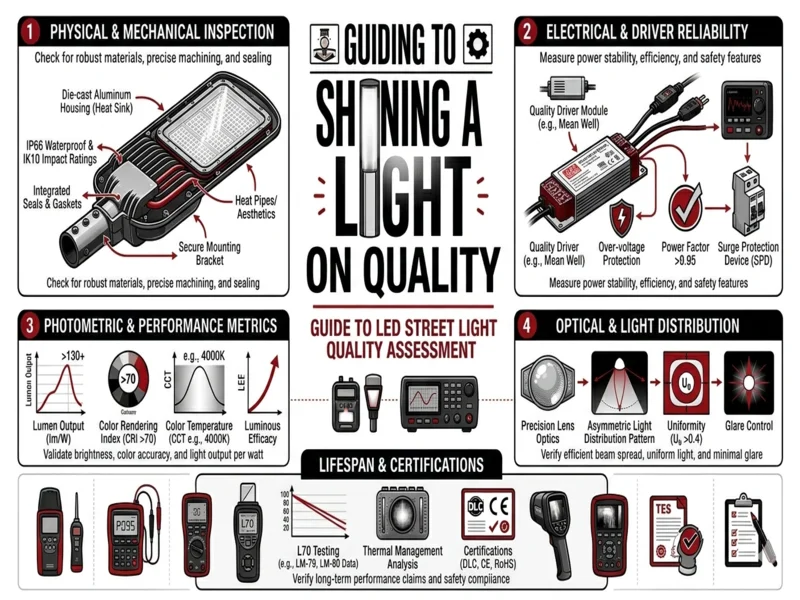
Upgrading to LED street lights is one of the smartest investments a municipality, real estate developer, or business can make. […]
Solar street lights can be a daunting task for municipal engineers, property developers, and sustainability officers alike. On the surface, […]