





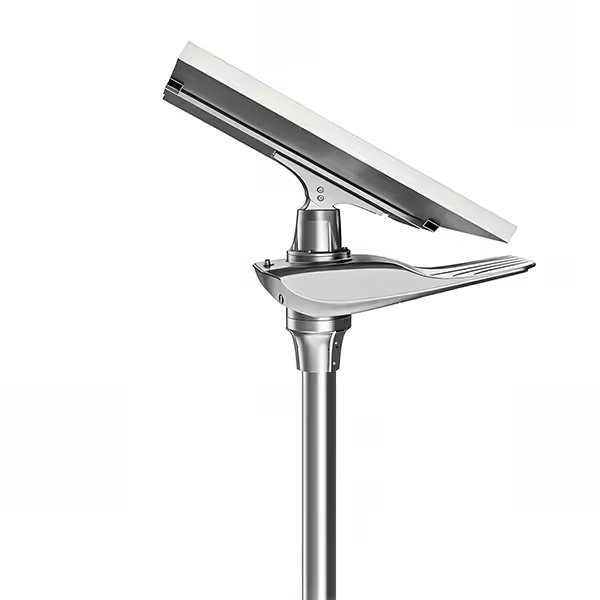


All in Two Solar Street Light FT Series 15000 Lumens
Dual-adjustable FT all-in-two solar street light allows independent panel and luminaire positioning for municipal and EPC road-lighting projects.
- 30–80 W models deliver 5,400–17,600 lm for road-lighting selection
- Model-matched 12.8 V 24–42 Ah LiFePO₄ batteries pair with 80–150 W monocrystalline panels
- Asymmetric road optics and IES files support DIALux layout and lux verification
- MPPT charging, timed dimming and optional motion sensing manage nighttime energy use
- Independent panel and luminaire aiming balances solar exposure and road-lighting needs
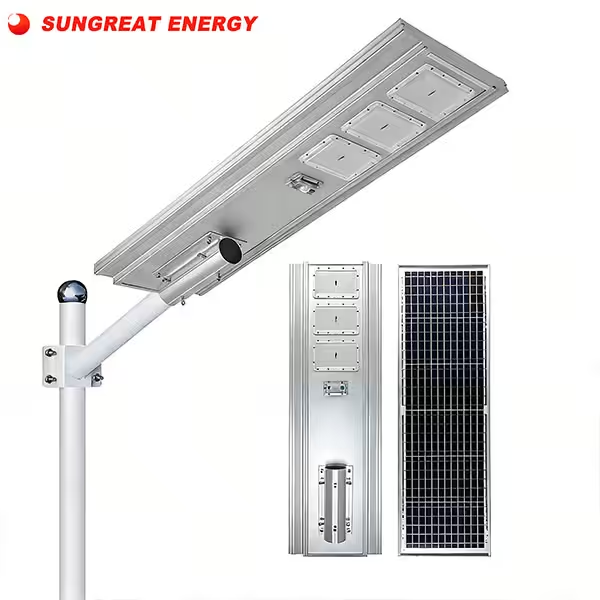
FT Series 30W–80W All-in-Two Solar Street Light with Dual Adjustable Design
The FT Series 30–80 W all-in-two solar street light allows the solar panel and LED luminaire to be adjusted independently. Installers can set the panel for better solar exposure while aiming the luminaire along the road, which is useful when the best charging direction does not match the required lighting direction.
Four configurations deliver 5,400–17,600 lm at 180–220 lm/W, with model-matched 12.8 V, 24–42 Ah LiFePO₄ batteries and 80–150 W monocrystalline solar panels. Before confirming a model, review how to choose a bright solar street light by comparing battery quality, solar-panel efficiency, LED efficacy and controller type.
MPPT charging and programmable time dimming help balance daily solar input with nighttime energy use. When the battery, solar panel and lighting schedule are matched to local conditions, the system can be configured for approximately 5–7 cloudy or rainy days; actual backup depends on local solar conditions and the programmed power schedule. With IP66/IK09 protection, the FT Series is suitable for municipal roads, residential communities, industrial access roads and EPC lighting projects.
All in Two Solar Street Light FT Series 15000 Lumens Technical Specifications & Datasheet
| Model | FT | |||
| Watts(w) | 30W | 40W | 60W | 80W |
| Lumens(Lumens) | 5400-6600LM | 7200-8800LM | 10800-13200LM | 14400-17600LM |
| Lifepo4 Battery(AH) | 12.8V 24AH | 12.8V 30AH | 12.8V 36AH | 12.8V 42AH |
| Mono-crystalline Solar Panel | 18V 80W | 18V 100W | 18V 120W | 18V 150W |
| LED Chip | Philips/Osram/USA Bridgelux | |||
| CCT(K) | 2700-6500K(customized) | |||
| CRI | >70 | |||
| Lighting Efficiency | 180-220lm/w | |||
| Rainy Days | 5-7 cloudy/ rainy days | |||
| Work Temperature | -25℃-+65℃ | |||
| Work Mode | Auto ON/OFF, Time Dimming, Motion Sensor (Can be modified based on requirement, with or without sensor) | |||
| Material | Aluminium alloy | |||
| Pole Upper Diameter | φ70-φ76mm | |||
| Controller | MPPT | |||
| IP Rating/IK Class | IP65/IK09 | |||
| Mounting Height(Recommend) | 6-8m | 9-10m | 9-11m | 10-12m |
| Space between Poles(Recommend) | 20-30m | 35-40m | 35-40m | 40-50m |
| Warranty | 5 Years | |||
Get a Free Quote for FT All-in-Two Solar Street Lights
30W–80W + 5,400–17,600 lm + Independent Solar Panel & LED Adjustment–Designed for Use on Municipal Roads, Communities, Industrial Areas, and EPC Lighting Projects.
FT Series 30W–80W All-in-Two Solar Street Light | Dual Adjustable Design
All in Two Solar Street Light FT Series 15000 Lumens Project & Application Cases
The FT Series is intended for off-grid roads where the best angle for the solar panel is not the same as the required lighting direction. It can be considered for village streets, residential communities, municipal access roads, industrial areas and parking areas. The four 30–80 W models provide 5,400–17,600 lm for different road and lighting requirements.
For village roads, community streets and market access roads in Kenya, Tanzania, Uganda, Ghana and Nigeria, extending the grid may be difficult or costly. The separate solar panel gives installers more freedom to use the available sunlight while keeping the luminaire aimed along the road.
Hot and dusty sites in Saudi Arabia, Oman, the UAE, Kuwait and Jordan need more than strong sunlight. Panel direction, battery and solar-panel sizing, and access for cleaning all affect long-term operation. With the FT design, the panel can face the charging direction while the luminaire stays aligned with the road. Where panel cleaning is the main concern, the QS self-cleaning solar street light is another option to compare.
Rainy seasons, cloud cover, vegetation and partial shading are more important for projects in the Philippines, Indonesia, Laos and Thailand. The 12.8 V 24–42 Ah LiFePO₄ battery range, 80–150 W solar panels and programmable dimming should be checked together against local sunlight, required lighting hours and backup expectations.
Independent adjustment is also useful on curved roads, intersections and roads with changing directions in Peru, Colombia, Chile and Ecuador. The luminaire can follow the road while the solar panel is set for better exposure, instead of forcing both parts to share one angle.
For an EPC or municipal project, the final model should be chosen from the actual road width, pole height, target lux and uniformity, nightly operating schedule, shading and local solar data. The IES/DIALux file for the selected luminaire should be checked before the pole layout is finalized.


All in Two Solar Street Light FT Series 15000 Lumens Production Process
FT Series production starts with a review of the approved model, bill of materials (BOM) and order configuration. The stages below cover component verification, assembly, functional testing and final packing checks for 30W–80W project orders.
| Production stage | Main work and checks | Why it matters for project orders |
|---|---|---|
| Incoming inspection and order verification | The aluminum housing, LED module, optical lens, LiFePO₄ battery, MPPT controller, solar panel, cables and adjustable brackets are checked against the approved BOM and production order. | Helps prevent the wrong component or configuration from entering production. |
| Housing and internal assembly | The housing is checked for forming quality and surface finish before the LED module, battery, controller and internal wiring are installed according to the approved layout. | Keeps the internal build consistent with the selected FT model. |
| Bracket trial fitting | The independent solar-panel and luminaire brackets are trial-fitted to check their adjustment range, fastening-point alignment and installation compatibility. | Helps reduce bracket and mounting mismatches during site installation. |
| Electrical and control checks | Technicians check wiring polarity, connector sealing, charging and discharging, automatic ON/OFF operation, time dimming and optional motion-sensor settings. | Identifies wiring and controller-setting issues before final inspection. |
| Optical and reliability checks | Optical verification is carried out according to the inspection plan. Integrating-sphere testing measures lumen output, luminous efficacy, correlated color temperature (CCT) and color rendering index (CRI). The inspection process also covers aging, sealing, electrical function and appearance. | Verifies the approved optical and functional requirements and helps identify early assembly issues. |
| Order matching and packing release | Before packing, the FT model, power, 12.8V 24–42Ah battery, 80–150W solar panel and installation accessories are checked against the production order. | Helps reduce mixed configurations, missing accessories and avoidable errors during EPC installation. |
The final packing check is based on the complete FT configuration rather than wattage alone. This gives EPC teams a clearer basis for delivery inspection and site installation.


All in Two Solar Street Light FT Series 15000 Lumens Overview & Details
The FT Series uses an all-in-two design in which the solar panel and LED luminaire are mounted as separate, adjustable sections of the same lighting system. Installers can position the panel for better solar exposure while keeping the luminaire aimed along the road. This is useful when the best charging direction does not follow the road alignment.
Available from 30W to 80W, the series delivers approximately 5,400–17,600 lumens at 180–220 lm/W. Its asymmetric Bat-Wing optics distribute useful light along the roadway instead of creating an overly bright area directly below the pole. This produces a smoother transition between lighting points while limiting unnecessary spill light outside the intended area.
The photometric curve shown on this page is one reference distribution for the FT Series and should not be treated as the IES data for every model. For road-width, pole-spacing, lux and uniformity calculations, use the IES file for the selected wattage and optical configuration. This is particularly important when preparing EPC or municipal road-lighting layouts.
Programmable time dimming allows the lighting output to be adjusted around expected traffic levels and available battery energy. One possible 12-hour program is shown below:
| Operating period | Light output |
|---|---|
| First 2 hours | 100% |
| Next 2 hours | 70% |
| Next 3 hours | 50% |
| Next 4 hours | 30% |
| Final 1 hour | 70% |
This schedule is an example rather than a fixed setting. The operating periods and output levels can be changed according to traffic patterns, required lighting hours and backup targets. Where early-morning traffic increases, the final-hour output can also be raised as needed.
For each FT model, the 12.8V 24–42Ah LiFePO₄ battery, 80–150W monocrystalline solar panel and MPPT controller are matched as one off-grid lighting system. With IP66 and IK09 protection, independent panel and luminaire adjustment, and programmable energy management, the FT Series can be configured for municipal roads, village streets, streets, residential communities, industrial sites and EPC road-lighting projects.


All in Two Solar Street Light FT Series 15000 Lumens Packaging & Delivery
Export packing for the 30W–80W FT Series combines four protective elements: EPE foam, reinforced cartons, internal dividers and corner protection. These materials help limit movement and direct contact between the LED luminaire, solar panel and adjustable bracket assemblies during handling and sea transport.
Cables, bolts, connectors and other installation accessories are grouped separately and marked by model, project batch or installation area. For orders containing several FT configurations or installation zones, this makes it easier for the project team to check and distribute the correct parts after arrival.
Packing can be adjusted for LCL, FCL and long-distance sea freight. Pallets, wooden cases and moisture-resistant protection can be selected according to the order quantity, loading method and shipping route. Before dispatch, five shipment details are checked against the order: carton condition, product quantity, accessory packages, shipping marks and packing list. Loading photos and relevant export documents are then provided for customer confirmation.
Estimated Sea Freight Transit Time from Shenzhen
The reference table covers 10 destinations across 6 regions. For the routes listed below, estimated port-to-port transit time is 4–8 days within Southeast Asia and 20–45 days for the listed destinations in the Middle East, Africa, Europe and South America.
| Region | Country | Destination Port | Estimated Port-to-Port Time |
|---|---|---|---|
| Southeast Asia | Vietnam | Ho Chi Minh City | 4–7 days |
| Southeast Asia | Thailand | Bangkok / Laem Chabang | 5–8 days |
| Southeast Asia | Singapore | Singapore Port | 5–7 days |
| Middle East | United Arab Emirates | Jebel Ali Port | 20–30 days |
| East Africa | Kenya | Mombasa Port | 30–35 days |
| West Africa | Nigeria | Lagos / Apapa Port | 30–40 days |
| Europe | Germany | Hamburg Port | 30–40 days |
| Europe | Netherlands | Rotterdam Port | 30–45 days |
| South America | Brazil | Santos Port | 30–40 days |
| South America | Peru | Callao Port | 23–30 days |
The figures are general port-to-port estimates for shipments departing from Shenzhen ports such as Yantian. They are intended for preliminary planning and are not fixed delivery dates.
Production lead time, export customs clearance, import clearance at the destination and inland transportation are not included. The final schedule depends on the selected shipping line, direct or transshipment routing, vessel availability, port congestion and destination requirements.


FAQ of All in Two Solar Street Light FT Series 15000 Lumens
The battery and solar panel are matched to the LED load as one complete energy system. The standard FT configurations are:
| Model | Light Output | LiFePO₄ Battery | Monocrystalline Solar Panel |
|---|---|---|---|
| 30W | 5,400–6,600 lm | 12.8V 24Ah, about 307Wh | 18V 80W |
| 40W | 7,200–8,800 lm | 12.8V 30Ah, about 384Wh | 18V 100W |
| 60W | 10,800–13,200 lm | 12.8V 36Ah, about 461Wh | 18V 120W |
| 80W | 14,400–17,600 lm | 12.8V 42Ah, about 538Wh | 18V 150W |
The nominal battery energy is calculated from voltage × amp-hours. It is not the same as the usable nighttime energy after controller losses, battery reserve and temperature conditions are considered.
MPPT charging is used across the FT range. These combinations provide a standard starting point, but panel wattage alone cannot guarantee a full recharge on days with limited solar input. Peak-sun hours, seasonal weather, shading, the 12-hour lighting program and the required backup period should be reviewed before confirming the final model. For a project targeting approximately 5–7 cloudy or rainy days, the dimming schedule becomes part of the system calculation.
The published FT working-temperature range is −25°C to +65°C, so an ambient temperature of 60°C is within the stated range. However, 60°C should be treated as a high-temperature design condition, not as a promise that battery life and charging performance will remain unchanged during continuous exposure.
For desert or high-temperature projects, it is important to confirm the maximum daytime temperature, direct solar exposure, required full-power hours and nighttime dimming program. A larger battery alone does not solve a heat-related problem. The solar panel, LiFePO₄ battery, MPPT controller and lighting schedule still need to be considered together.
Start with the required road-lighting result rather than wattage alone. The current FT planning references are:
- 30W: 5,400–6,600 lm, normally considered for 6–8m mounting heights and 20–30m pole spacing
- 40W: 7,200–8,800 lm, with reference mounting heights of 9–10m and 35–40m pole spacing
- 60W: 10,800–13,200 lm, with reference mounting heights of 9–11m and 35–40m pole spacing
- 80W: 14,400–17,600 lm, with reference mounting heights of 10–12m and 40–50m pole spacing
These figures are useful for initial selection but should not replace a lighting layout. Road width, pole position, required lux, uniformity, curves and intersections can change the result. For an EPC or municipal project, use the IES file for the selected FT model to check the layout before fixing the wattage and pole spacing.
The solar panel should normally face toward the geographic equator: true south in the Northern Hemisphere and true north in the Southern Hemisphere. The road direction does not have to determine the panel direction.
Local latitude is a practical starting point for the tilt angle. For example, a project near 20° latitude can begin its assessment around a 20° tilt, but this is not an automatic final setting. The weaker solar season, rainy or winter weather, nearby trees and buildings, dust, wind load and maintenance access should also be checked.
The FT design allows the panel and LED luminaire to be adjusted separately. The panel can therefore be positioned for solar charging while the luminaire remains aimed along the road.
A shorter runtime does not automatically mean that the LiFePO₄ battery needs replacement. The problem may begin on the charging side.
A 2025 IEA PVPS fact sheet reports that soiling causes an average global PV energy loss of about 4%–7%, although the result varies considerably by climate and cleaning conditions. Dust on the panel, new tree growth, nearby buildings or a shifted panel angle can all reduce the energy reaching the 12.8V battery.
A practical inspection sequence is:
- Clean the solar-panel glass and check for new morning or afternoon shading.
- Confirm that the panel angle and adjustable bracket have not moved.
- Inspect the solar cable, connectors and controller charging status.
- Compare the current dimming program with the original setting. More hours at 100% output will use more battery energy.
- Test the remaining battery capacity after the charging side has been confirmed.
Checking in this order avoids replacing the battery before the actual cause has been found.
For a standard FT installation, the recommended one-way cable distance from the solar panel to the charge controller is normally within 3–5m. The supplied cable should preferably not be extended beyond 5m unless the cable size and voltage drop have been recalculated.
The FT panels operate at 18V and range from 80W to 150W, so the charging current is roughly 4.4–8.3A at rated power. At this relatively low voltage, cable length has a noticeable effect. A practical target is to keep voltage drop close to 2.5% and below 3%.
For example, a 120W, 18V panel supplies about 6.7A at rated power:
- With a 2.5mm² copper cable and a 5m one-way run, the calculated voltage drop is close to 3%.
- Using the same cable over a 10m one-way run can raise the loss above 5%.
Distances beyond 5m may require a larger cable cross-section. Runs approaching 8–10m should be checked using the selected panel current, cable material, connector losses and complete return-circuit length. Extending a standard low-voltage cable beyond 10m is not recommended unless the electrical design has been verified.
Outdoor UV-resistant solar cable, waterproof connectors and as few cable joints as possible should be used. For a longer run, provide the selected FT model and one-way distance so the cable size can be confirmed before production.
IES of All in Two Solar Street Light FT Series
Manual of All in Two Solar Street Light FT Series 15000 Lumens
Related Products




Related News
Choosing between solar street lights and grid-powered LED street lights is one of the most important decisions in outdoor lighting […]

Before canton fair we should know As the global energy transition accelerates, thousands of international EPC contractors, importers, and renewable […]
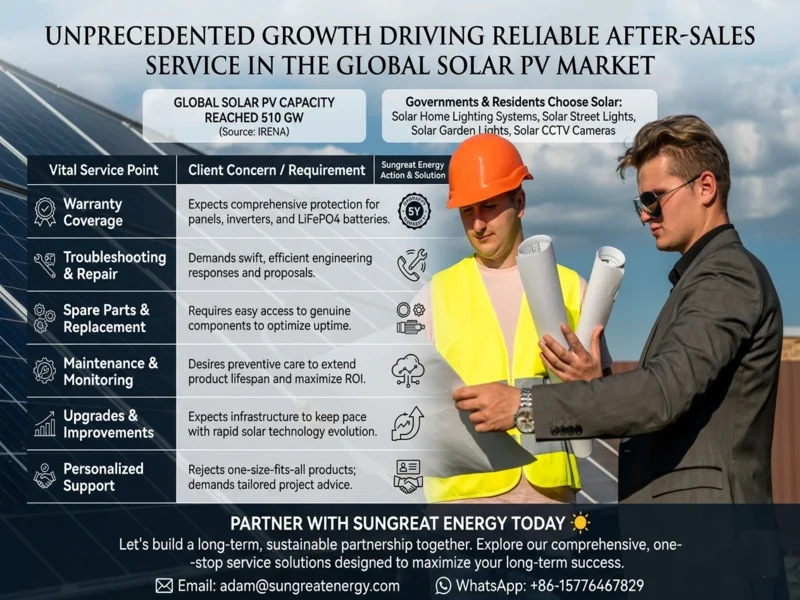
As the global shift towards Solar energy gains momentum, the solar power industry has experienced unprecedented growth. Data from the […]
As cities and communities worldwide embrace sustainable energy solutions, integrated solar streetlights have become a cornerstone of green urban infrastructure. […]
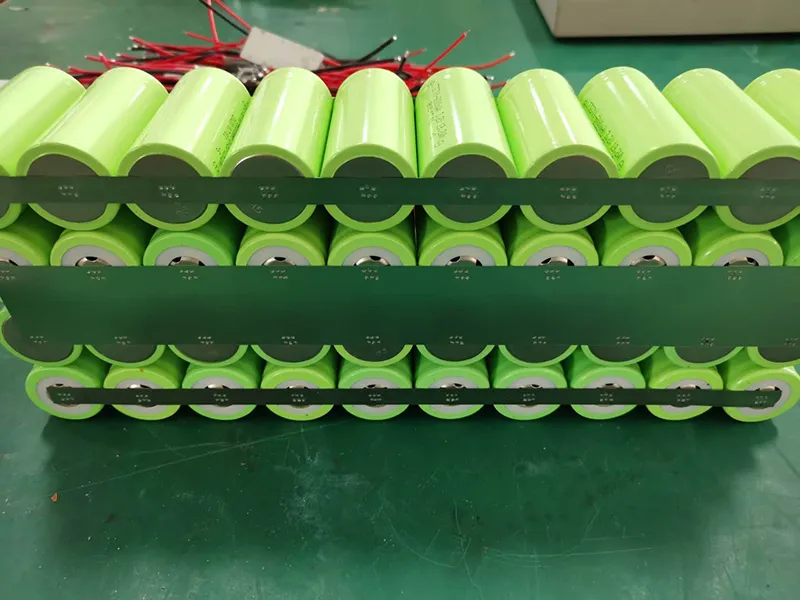
Selecting the right battery for solar street LED lights is crucial to ensuring reliable performance and longevity. Drawing from over […]