






Portable ETFE Foldable Solar Panel Bag for Power Station FP Model
Portable ETFE foldable solar panel bags from 100W to 400W help distributors match outdoor charging kits to power station PV input limits.
- 21%–23% monocrystalline cell efficiency supports compact field charging
- 100W, 200W and 400W options help match different power station input needs
- Adjustable kickstands help aim 100W–400W panels toward direct sunlight
- 3 connector options—MC4, DC or Anderson—simplify OEM kit configuration
-
IP67 protection covers the laminated panel section; keep connectors dry
FP Model 21–23% ETFE Foldable Solar Panel Bag
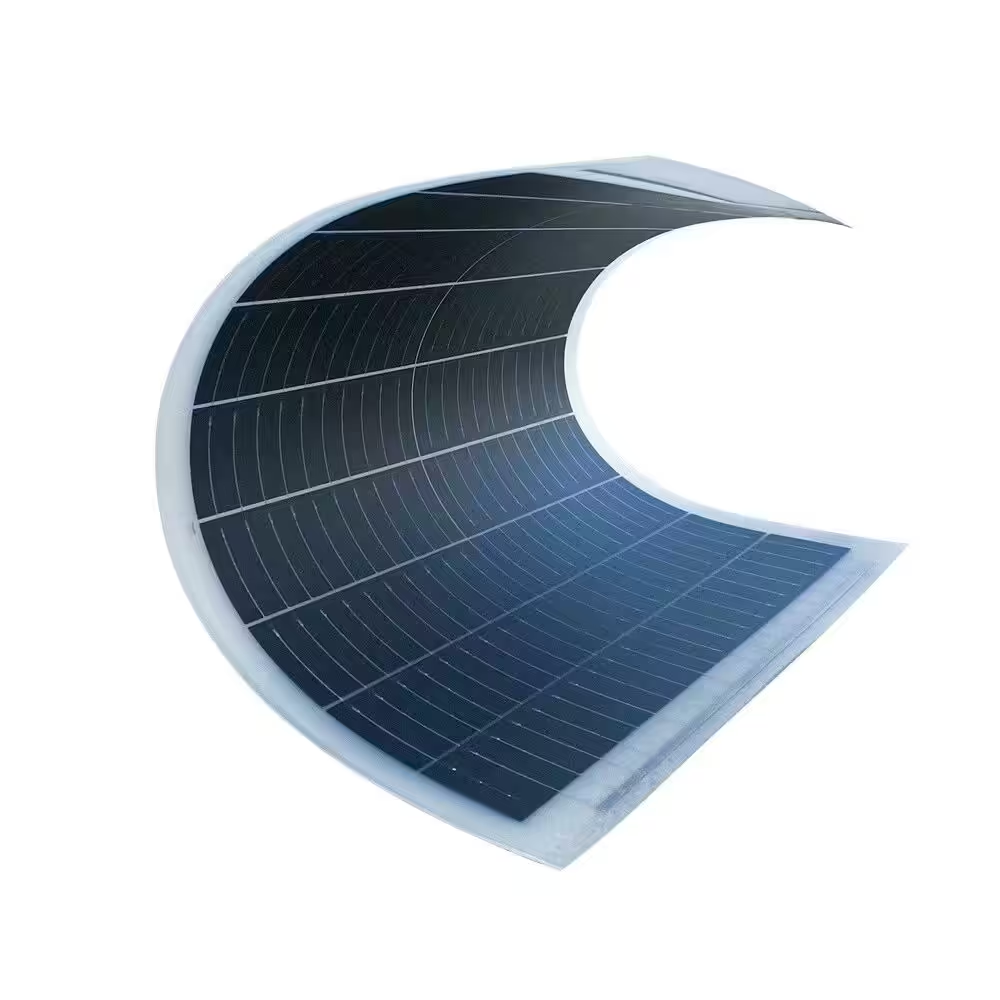
Sungreat Energy’s FP Model is a portable ETFE foldable solar panel bag for power stations, outdoor energy kits and field equipment. It uses Grade-A monocrystalline cells with a cell conversion efficiency of 21%–23%, helping make effective use of the available fold-out area. The multi-fold briefcase design, reinforced carrying handle and adjustable kickstands make the panel easier to transport, position toward sunlight and store after use.
Available in 100W, 200W and 400W options, the FP Model can be configured with MC4, DC or Anderson connectors for different charging kits. Final connector type, polarity, cable length and controller or USB-port requirements should be matched with the target power station before order approval.
Portable ETFE Foldable Solar Panel Bag for Power Station FP Model Technical Specifications & Datasheet
Get an FP Model Wholesale Quote
100W–400W foldable panels with 21%–23% cell efficiency and MC4, DC or Anderson options for power station brands and outdoor kit distributors.
FP Model 100W–400W ETFE Foldable Solar Panel Bag Video
Portable ETFE Foldable Solar Panel Bag for Power Station FP Model Project & Application Cases
Sungreat Energy’s FP Model offers 100W, 200W and 400W options with 21–23% monocrystalline cell efficiency, adjustable kickstands, and MC4, DC or Anderson connector configurations. The examples below are reference sizing scenarios, not completed FP Model installations.
All appliances in these examples are treated as AC loads connected through a portable power station. Solar estimates use the stated peak sun hours, a PV-side planning factor for sunlight variation, panel angle, temperature, dust and charging losses, and an assumed 85% inverter efficiency. Battery estimates use 85% inverter efficiency and 80% usable battery capacity.
Philippines / Southeast Asia: Emergency Kit
A 60W television operating for 4 hours and a 10W router operating for 8 hours require:
(60W × 4h) + (10W × 8h) = 320Wh per day
Using 4.5 reference peak sun hours, a 75% PV-side planning factor and 85% inverter efficiency, the estimated usable AC energy is:
100W × 4.5h × 75% × 85% ≈ 287Wh per day
200W × 4.5h × 75% × 85% ≈ 574Wh per day
Under these assumptions, the 100W model does not fully cover the 320Wh daily load. A 200W FP Model provides more practical charging margin for changing weather, panel angle and daytime interruptions.
Estimated nominal power-station capacity:
320Wh ÷ (85% × 80%) ≈ 471Wh
A 0.5kWh station is close to the theoretical one-day minimum, while approximately 0.7kWh provides more reserve. These figures do not include multi-day cloudy-weather autonomy.
Kenya / East Africa: Field Communications
A 60W laptop operating for 6 hours and 20W communications equipment operating for 8 hours require:
(60W × 6h) + (20W × 8h) = 520Wh per day
Using 5.5 reference peak sun hours, a 75% PV-side planning factor and 85% inverter efficiency:
200W × 5.5h × 75% × 85% ≈ 701Wh per day
Estimated nominal power-station capacity:
520Wh ÷ (85% × 80%) ≈ 765Wh
A 0.8kWh station is close to the theoretical one-day requirement, while 1.0kWh provides additional reserve for field surveys, temporary communications and variable charging conditions.
UAE / GCC: Mobile Worksite
An 80W field laptop operating for 6 hours and a 50W work light operating for 8 hours require:
(80W × 6h) + (50W × 8h) = 880Wh per day
Using 5.5 reference peak sun hours, a more conservative 70% PV-side planning factor and 85% inverter efficiency:
400W × 5.5h × 70% × 85% ≈ 1,309Wh per day
Estimated nominal power-station capacity:
880Wh ÷ (85% × 80%) ≈ 1,294Wh
A 1.3kWh station is close to the theoretical one-day minimum, while approximately 1.5kWh provides more reserve. Hot panel surfaces, dust accumulation and cable exposure should be included in the inspection and charging plan.
Before confirming a configuration, verify the exact city and season, appliance nameplate loads, startup demand, required backup period, power-station continuous AC output, PV input limits, connector polarity and ordered FP Model. Actual results vary with weather, shading, temperature, panel angle and equipment efficiency.
For compatible storage and AC output options, compare the DL Series LiFePO₄ portable power stations. DL models use a 12V–28V solar-input range with model-dependent 100W–300W maximum input, so confirm Voc, Vmp, current and wattage before pairing; a 400W panel may exceed the selected station’s input limit.


Portable ETFE Foldable Solar Panel Bag for Power Station FP Model Production Process
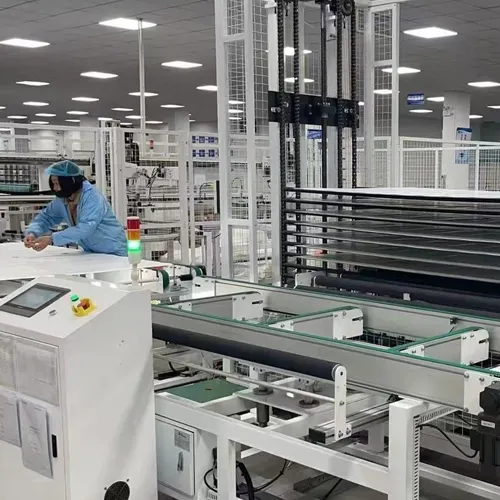
FP Model production follows three quality-control checkpoints: material and order verification, ETFE lamination and foldable assembly, and final electrical and configuration checks.
Before lamination, the selected Grade-A monocrystalline cells are inspected and matched to the approved panel layout. The specified cell conversion efficiency is 21–23%. The cell matrix, encapsulation films, backing board, and textured ETFE surface are then vacuum-laminated.
After lamination, the fabric body, reinforced seams, handle, kickstands, and output cable are assembled. Visual and functional checks cover laminate alignment, surface condition, seam quality, folding movement, and cable strain relief. These checks help reduce the risk of delamination, loose connections, and damage during handling or transport.
Final electrical checks compare output, voltage, polarity, and connector configuration with the approved model and order documents. Batch checks verify cable type, logo, accessories, and packing information to reduce configuration mix-ups. Compatibility with the selected power station should still be checked against its PV voltage, current, and power limits, as well as connector type and polarity.
The IP67 rating applies to the laminated panel construction only. Junction boxes, controllers, and exposed connectors should be kept dry. If a project requires documented fold-endurance or UV-aging tests, specify the test method, required cycle count or exposure duration, and acceptance criteria in the RFQ before production starts.


Portable ETFE Foldable Solar Panel Bag for Power Station FP Model Overview & Details
The FP Model is a foldable ETFE solar panel bag for portable power stations, OEM charging kits and mobile field equipment. It uses Grade-A monocrystalline cells rated at 21–23% conversion efficiency. Its briefcase-style structure combines a textured ETFE surface, reinforced fabric body, carrying handle and adjustable kickstands for transport, temporary deployment and storage.
Model selection should begin with the target power station rather than panel wattage alone. Compare the panel’s open-circuit voltage (Voc), maximum-power voltage (Vmp), operating current, short-circuit current and polarity with the station’s PV voltage, current and wattage limits. Confirm the required MC4, DC or Anderson connector, cable length and adapter configuration. Direct USB-A or Type-C charging requires a version fitted with the corresponding controller and ports.
A higher-wattage panel may not charge faster when the station limits solar input, while excessive Voc can prevent charging or damage the input circuit. Before ordering, confirm the station model, daily energy demand, folded-size limit, connector, polarity, cable configuration and OEM requirements. For a broader comparison of portable and fixed module structures, review the solar panel types, components and applications guide.


Portable ETFE Foldable Solar Panel Bag for Power Station FP Model Packaging & Delivery
The standard FP Model export pack uses three layers: a scratch-resistant sleeve, EPE edge cushioning, and an individual export carton. For bulk orders, cartons can be palletized, stretch-wrapped, and strapped to help limit shifting and surface abrasion during handling and transport. The packing configuration depends on the selected model and shipping requirements.
Carton dimensions, weight, and pallet quantity vary with panel wattage, folded size, order quantity, and packing layout. Carton and pallet marks can show the model, power class, connector type, cable version, quantity, batch number, destination, and OEM logo when specified. Accessories, connector leads, adapters, manuals and optional controllers should be identified by kit and checked against the approved order and packing list to reduce missing or mixed items.
Container loading is planned around carton and pallet dimensions, pallet limits, and destination handling requirements. Production lead time and transit estimates vary with customization, order quantity, shipping method, route, carrier, and customs clearance. Confirm final package details and schedule during order review.


FAQ of Portable ETFE Foldable Solar Panel Bag for Power Station FP Model
The FP Model is worth considering when a solar panel needs to be folded, carried, stored and repeatedly deployed with a portable power station. Its Grade-A monocrystalline cells provide 21%–23% conversion efficiency, while the briefcase-style structure, carrying handle and adjustable kickstands support mobile charging without a permanent mounting system.
The 100W, 200W and 400W options can support different portable charging requirements, but panel wattage must still be matched with the station’s PV voltage, input current and maximum solar power. A larger panel does not automatically reduce charging time when the power station limits the accepted input.
For permanent rooftop use, long-term unattended installation or projects where cost per watt is the main priority, compare the foldable design with fixed SP Series N-Type TOPCon solar PV modules.
Start with the appliance’s daily AC energy use, local peak sun hours and the power station’s PV input limits. A 60W television operating for 5 hours requires:
60W × 5h = 300Wh per day
For a reference location with 4.5 peak sun hours, a 75% PV-side planning factor and 85% inverter efficiency, the theoretical panel requirement is:
300Wh ÷ (4.5h × 75% × 85%) ≈ 105W
A 100W FP Model falls slightly below this calculated requirement, while a 200W model provides more practical recovery margin. Under the same assumptions, a 200W panel could provide approximately:
200W × 4.5h × 75% × 85% ≈ 574Wh of usable AC energy per clear day
At a reference site with 5.5 peak sun hours, the same 300Wh load requires approximately 86W, so a 100W panel may cover the theoretical clear-day demand. This difference shows why the project location and season must be included in the calculation.
The power station must also accept the selected panel’s Voc, Vmp, current and wattage. Connecting a 200W or 400W panel to a station with a 100W PV input limit will not make it accept more than its rated input, and excessive voltage must be avoided. Confirm the station model, daily load, location, charging time and connector before selecting the FP configuration.
A connector that physically fits does not confirm electrical compatibility. Compare the FP Model label with the power-station manual before connection:
- Voc must remain below the station’s maximum PV input voltage, including under the lowest expected operating temperature
- Vmp must fall within the station’s MPPT or permitted solar-input range
- Imp must remain within the operating input-current limit, while Isc must not exceed any maximum short-circuit-current limit stated in the manual
- Panel wattage, connector type, polarity and cable rating must match the selected charging configuration
- For AC appliances, compare continuous running power and startup demand with the station’s rated and peak AC output
For illustration, consider a power station rated for 12–30V PV input, 10A maximum operating current, 10A maximum short-circuit current and 200W maximum solar input. Assume one hypothetical 100W panel is rated at Voc 24V, Vmp 20V, Imp 5A and Isc 5.5A. One panel remains within these reference limits.
Two panels in series would reach approximately 48V Voc and exceed the 30V input limit. Two panels in parallel would remain near 24V Voc and 20V Vmp, but Imp would increase to approximately 10A and Isc to approximately 11A. Although operating current and rated power would reach 10A and 200W, the 11A Isc would exceed the hypothetical 10A short-circuit-current limit. The parallel connection should therefore not be approved for that station.
Appliance compatibility must also be checked separately. A 60W television requires at least 60W of continuous AC output, while a 60W refrigerator with an assumed three-times startup surge may briefly require approximately 180W. Actual refrigerator surge must be confirmed from its label or manufacturer information.
For order approval, provide the selected FP Model label, the power station’s solar-input label or manual page, appliance nameplates, connector photos, polarity and required cable length. These figures explain the checking method and are not FP Model specifications.
The FP Model can support temporary outdoor charging, but rated panel wattage does not represent fixed daily energy production. Consider a reference AC load consisting of a 60W television operating for 5 hours and a 60W refrigerator operating at an assumed 40% compressor duty cycle:
Television: 60W × 5h = 300Wh per day
Refrigerator: 60W × 24h × 40% = 576Wh per day
Combined demand: 300Wh + 576Wh = 876Wh per day
With 5 effective peak sun hours, a 75% PV-side planning factor and 85% inverter efficiency, a 400W FP Model could theoretically provide:
400W × 5h × 75% × 85% ≈ 1,275Wh of usable AC energy per day
If cloud, shade or poor orientation reduces effective sun to 2.5 hours, the same estimate falls to:
400W × 2.5h × 75% × 85% ≈ 638Wh per day
That would be approximately 238Wh below the 876Wh reference load. Refrigerator operating cycles and startup demand vary by model, so the appliance label and the power station’s surge output must still be checked.
Position the panel in unobstructed sunlight and use the adjustable kickstands to improve orientation. High panel temperature, haze, dust and partial shade may reduce charging input. The current FP information does not provide one confirmed maximum operating temperature or temperature coefficient for every configuration, so verify the selected model before use in very hot locations.
IP67 protection applies only to the ETFE-laminated panel section. Keep the junction box, controller and exposed connectors dry. Do not submerge the product or leave electrical components exposed during heavy rain. For rainy-season or heavily shaded applications, provide additional panel and battery margin instead of relying on rated wattage alone.
Disconnect the panel from the power station and let it cool before cleaning. Wipe off dust with a soft, dry cloth. For stubborn dirt, use a lightly damp, non-abrasive cloth on the panel surface. Keep the junction box, controller and connectors dry. Let the panel and fabric backing dry completely before folding so moisture is not trapped inside.
Fold along the built-in folds, keeping cables clear. Avoid pressing on the cells, forcing the corners, sharply bending cables, dragging the panel or placing heavy items on it. Before each use, inspect the cables, connector pins, polarity marks, stitching, handle and kickstands. Store the folded panel in a clean, cool, dry place away from direct sunlight.
Include the power station’s brand and exact model, together with a clear photo of its solar-input label or the relevant manual page. State the preferred FP Model class—100W, 200W or 400W—and provide the daily energy requirement in Wh, or list each appliance, its rated power, expected starting demand where applicable, and hours of use.
Provide the station’s permitted PV operating-voltage range, maximum PV voltage, maximum input current, maximum solar-input power, and any maximum PV short-circuit current stated in the manual. Ask the supplier to confirm the selected FP configuration’s Voc, Vmp, Imp, Isc and polarity from the approved technical data. The temperature-adjusted Voc at the lowest expected site temperature must remain below the station’s maximum PV voltage; Vmp must remain within the permitted operating range; Imp must not exceed the station’s operating-current limit; and Isc must remain below any stated PV short-circuit-current limit. If the manual does not state an Isc limit or permitted PV oversizing rule, confirm it with the power station manufacturer before approval.
Also specify the connector type—MC4, DC or Anderson—cable length, cable rating, quantity and any required adapters. A connector that fits does not by itself confirm electrical compatibility. Request a controller with USB-A or Type-C only if direct USB charging is required. For bulk or OEM orders, provide the quantity by wattage and kit, folded-size limit, logo or color requirements, carton marks, manual language, destination and target delivery date.
For example, write “50 kits, each with one 200W FP panel, the approved connector and a specified cable length” rather than only “10kW of panels.” Require the quotation or order confirmation to identify the exact FP version and the power station model used for the compatibility check. If fold-endurance or UV-aging tests are required, include the test method, duration or cycle count, and pass/fail criteria in the RFQ.
Related Products


Related News
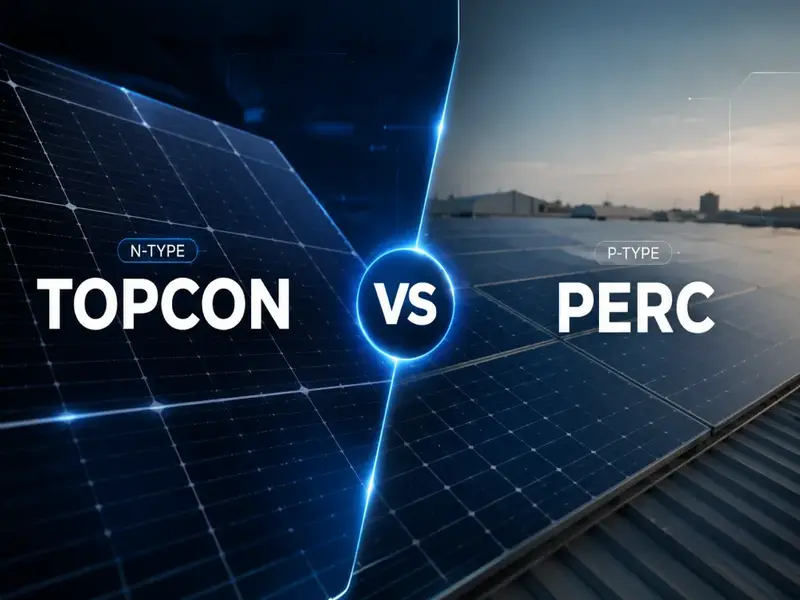
The global solar photovoltaic (PV) market is experiencing a massive technological shift. For over a decade, P-Type Passivated Emitter and […]
If you’ve ever stood inside a utility-scale solar farm at mid-day, you’ve likely noticed something striking: the ground underneath the […]

The global energy landscape is undergoing a profound and irreversible transformation. For over a century, modern civilization has relied heavily […]
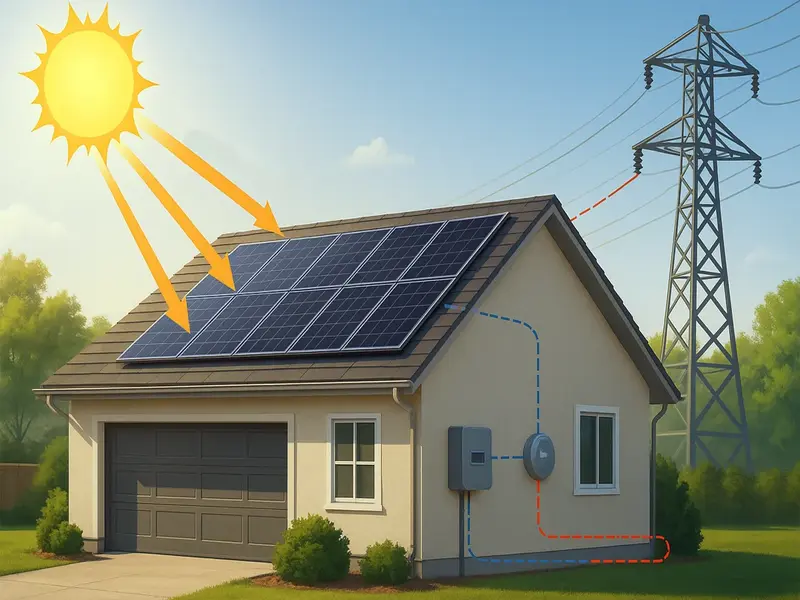
The global transition to solar clean energy is accelerating at an unprecedented pace, and at the heart of this revolution […]
Solar energy isn’t just a new idea; it has been around for thousands of years. Long before the advent of […]