Sungreat Energy TL Series solar-powered red and blue LED strobe warning light with integrated photovoltaic panel for road safety and traffic control applications
Sungreat Energy 60W-300W shoebox LED area light with adjustable slip fitter mount, die-cast aluminum heat sink housing, IP65 waterproof rating, high-lumen outdoor lighting for parking lots roadways and commercial spaces, CE RoHS certified
Sungreat Energy FN Series integrated solar street light featuring a rear mounted solar panel and multi module LED roadway lighting design
Sungreat Energy SF Series solar freezer system with PV panels, MPPT controller, and gel batteries for off-grid cooling
Sungreat Energy SDR Series solar refrigerator factory case, complete with solar panels and battery setup for off-grid cooling solutions
Off-grid solar air conditioner system by Sungreat Energy, featuring indoor unit, outdoor condenser, Lifepo4 battery, and three photovoltaic panels for independent, eco-friendly cooling without grid dependency.
Complete 10 kW Solar Energy System with All Accessories
Sungreat Energy LiFePO4 battery range showing wall mounted and floor standing models with digital displays
Sungreat Energy all in one battery and inverter units in three different sizes=
Sungreat Energy Monocrystalline Solar Panel
700W portable foldable solar panel in black showing partially unfolded view with solar cells
SunGreat Energy SP Series monocrystalline solar panel, high-efficiency photovoltaic module with front and back structure view

What Is a Bifacial Double-Glass Solar Panel?

Table of Contents

What Is a Bifacial Double-Glass Solar Panel blog image

If you’ve ever stood inside a utility-scale solar farm at mid-day, you’ve likely noticed something striking: the ground underneath the panels isn’t pitch black — it is brightly illuminated. Sunlight bounces off sand, gravel, concrete, white roofs, and grass.

A conventional monofacial solar panel ignores every photon of that reflected ground light because its rear face is opaque. A bifacial double-glass panel turns that reflected light into extra kilowatt-hours.

1. The Short Answer

A bifacial double-glass solar panel generates power from both sides. The front side absorbs direct sunlight coming from the sky, while the rear side captures reflected and scattered light (albedo) from the ground or mounting surface.
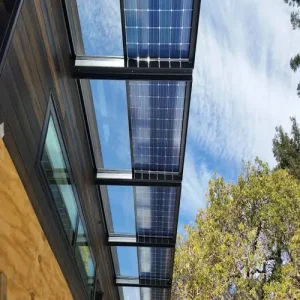
What Is a Bifacial Double-Glass Solar Panel blog extra effieciency

Instead of using a traditional polymer plastic backsheet (like TPT or PET), the rear of the module is sealed with a second sheet of tempered glass.

Key Concept: Bifacial (2 Active Generating Faces) + Double-Glass (Glass Sandwich Construction)

2. How It’s Built

When you strip away marketing buzzwords, a double-glass bifacial solar module is designed for maximum light exposure and extreme environmental endurance:
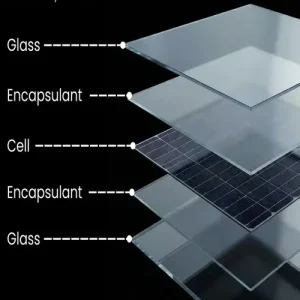
What Is a Bifacial Double-Glass Solar Panel blog How It's Actually Built

2.1. Front Glass

High-transmittance, anti-reflective tempered solar glass designed to maximize light penetration to the primary cell face.

2.2. Bifacial Solar Cells

High-efficiency N-Type cells (such as TOPCon or Heterojunction / HJT) featuring symmetrically grid-patterned contacts that generate power when struck by light from either direction.

2.3. Rear Glass

A second sheet of heat-strengthened glass replaces the opaque plastic backsheet. This protects the rear cell face while allowing incoming ground reflection to enter the cells.

2.4. Frame / Frameless

Available with lightweight aluminum alloy framing or as frameless modules. Frameless variants eliminate dirt accumulation along the edges and minimize Potential Induced Degradation (PID).

By replacing plastic backsheets with tempered glass, the panel loses the primary component prone to UV degradation, thermal cracking, and moisture intrusion over time.

3. Extra Power Comes From?

The amount of extra energy a bifacial panel produces — known as the bifacial gain — is not a fixed static number. It depends heavily on two engineering factors: Ground Albedo (reflectivity ratio) and Mounting Elevation.
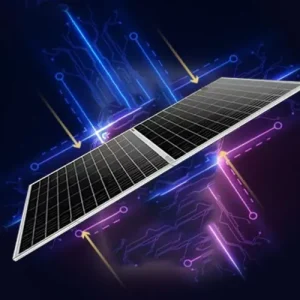
What Is a Bifacial Double-Glass Solar Panel blog dubble power

According to field studies published by the National Renewable Energy Laboratory (NREL) and research from the Fraunhofer Institute for Solar Energy Systems (ISE), surface reflectivity directly dictates rear-side yield:

Surface Material Below Array Typical Surface Albedo Average Rear-Side Bifacial Yield Gain
Dark Asphalt / Dark Roofing 0.05 – 0.10 2% – 5%
Dark Soil / Bare Earth 0.15 – 0.20 5% – 10%
Green Grass / Vegetation 0.20 – 0.25 8% – 12%
Light Concrete / Weathered Gravel 0.25 – 0.40 12% – 18%
White Gravel / Light Sand (Desert) 0.40 – 0.60 18% – 25%
Reflective TPO Roof / Snow Cover 0.60 – 0.85+ 25% – 30%+

3.1 Why Racking Height Matters

NREL Performance Modeling demonstrates that elevating the panel array by 1.0 to 1.5 meters off the ground allows reflected light from a broader area to spread evenly across the rear cells, avoiding self-shading bottlenecks under the array.

4. Advantages

For engineering procurement contractors (EPCs) and equipment distributors, bifacial double-glass technology has shifted from a niche specification to the industry standard for commercial and utility applications.
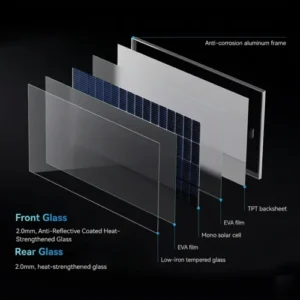
Exploded view diagram of bifacial double glass mono solar panel showing front glass solar cells EVA films TPT backsheet rear glass and aluminum frame layers

4.1. Higher Lifetime Energy Density

Yielding 10% to 25% more energy from the exact same physical footprint significantly reduces balance-of-system (BOS) costs per watt (racking, cabling, inverters, and land lease expenses). Explore how this applies to complete turn-key builds on our Solar Power System page.

4.2. Extended Service Life

Bifacial double-glass modules routinely offer 30-year linear performance warranties. They pass rigorous environmental qualification testing defined by the International Electrotechnical Commission (IEC), specifically IEC 61215 for design qualification and IEC 61730 for safety standards.

4.3. Superior Resilience

Double-glass modules withstand high humidity, salt spray, ammonia exposure, and extreme desert temperatures far better than plastic backsheets. This makes them ideal for coastal, agricultural, and high-ambient-heat solar installations.

4.4. Reduced Levelized COE

Generating more kilowatt-hours over a 30-year operational period directly lowers the financial payback window and boosts internal rate of return (IRR) for project developers.

5. When NOT to Choose Bifacial

Bifacial double-glass panels are not a universal fit for every project. Understanding where they don’t pay off helps avoid wasted capital:

5.1. Key System Limitations

  • Flush Pitch Residential Roofs: A panel installed flush against a dark shingle or dark tile roof has virtually zero rear ground clearance and negligible reflectivity (~0.05 albedo). In these cases, standard monofacial modules are much more cost-effective.
  • Higher Module Weight: Dual-layer glass increases panel weight compared to single-glass modules. Roof structural loading must be verified before deploying on commercial roofs.
  • Slightly Higher Initial Module Price: Racking structure elevation and glass-glass materials carry a small upfront premium that requires reflective ground or carport settings to yield a rapid return on investment.

If you are unsure whether your project site supports viable bifacial gains, reach out to our engineering team via the Engineering & Technical Support page for customized irradiance modeling.

6. Bifacial vs. Monofacial Panel

Feature / Metric Standard Monofacial Panel Bifacial Double-Glass Panel
Power Generation Sides Front face only Front face + Rear reflective capture
Rear Encapsulation Opaque plastic backsheet Heat-strengthened glass
Standard Performance Warranty 25 Years 30 Years (Linear)
Annual Degradation Rate ~0.55% per year ~0.40% – 0.45% per year
Best Suited Application Residential pitched roofs Ground-mount, carports, flat commercial roofs
International Testing Compliance IEC 61215 Standards IEC 61215 & IEC 61730 Standards
Resistance to UV / Humidity Moderate (backsheet age risk) Superior (dual glass hermetic seal)

7. The Bottom Line

A bifacial double-glass panel turns wasted ground reflections into usable clean energy. For ground-mount installations, desert projects, carports, and elevated commercial flat roofs, it offers one of the highest returns on investment in modern solar technology.

Curious to see how bifacial modules perform in active commercial solar deployments? Browse our real-world site data in our Project Case Studies.
YouTube video player

Ready to Spec Bifacial Double-Glass Panels for Your Next Project?

At SunGreat Energy, we supply high-efficiency TOPCon and PERC bifacial double-glass panels engineered for maximum yield and long-term durability.

Request Full Specifications & Wholesale Quotes from SunGreat Energy Today →

Picture of SungreatenergyAdmin

SungreatenergyAdmin

Welcome To Share This Page:
Product Categories
Get A Free Quote Now !
Contact Form
Related Products
Related News
What Is a Bifacial Double-Glass Solar Panel blog image

If you’ve ever stood inside a utility-scale solar farm at mid-day, you’ve likely noticed something striking: the ground underneath the […]

How Does a Solar Battery Work with Solar Panels and an Inverter complete blog article by sungreat energy

Solar panels generate electricity when sunlight is available, but solar energy production does not always match when electricity is needed. […]

100Ah 48V LiFePO4 Energy Storage Deployment in Philippines main

Before study of lifepo4 battery we should know as the global shift toward renewable energy accelerates, reliable electricity cannot always […]

Topcon n type solar panels main picture also instaaled different project by sungreat energy

Before learn Topcon n types solar panel we should know the global solar industry is undergoing a massive technology shift. […]

As global demand for clean energy continues to surge, renewable infrastructure has shifted from an environmental alternative to a core economic strategy

What is a solar panel and how does it work? Learn what is a photovoltaic module, explore main PV panel […]

High-Capacity Power Infrastructure Deployment (5000 units of LB-200AH Project ) in Bangladesh client received

Addressing chronic grid fluctuations and operational downtime for heavy commercial assets via a high-density 10.24kWh LiFePO4 battery array by Sungreat […]

Scroll to Top

Get A Free Quote Now !

Contact Form
If you have any questions, please do not hesitate to contact us.
sungreat energy contact us