
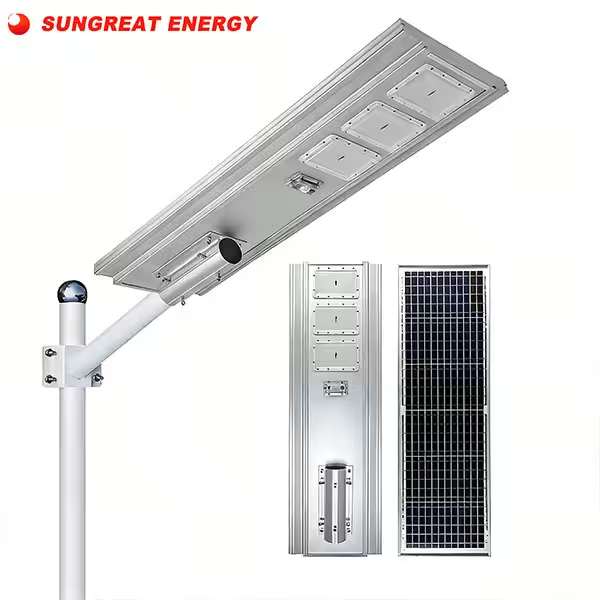




All in Two Solar Street Light ZC Series 40W–120W
40W–120W all-in-two solar street light with separate panel placement, 7,200–26,400 lm output and MPPT charging for complex EPC road projects
- 40W–120W output delivers 7,200–26,400 lm for typical 5–12m pole installations
- Two-part layout enables independent solar-panel and light positioning on site
- 18V, 60W–170W panel paired with a 12.8V, 15–60Ah LiFePO₄ battery
- MPPT, time-based dimming and motion sensors help target 5–7 days of backup
- IP66/IK09 housing plus optional IoT fault alerts simplify remote maintenance
ZC Series 40W–120W All-in-Two Solar Street Light with Flexible Solar Panel Installation
The ZC Series uses an all-in-two layout that separates the solar panel from the LED light. Installers can direct the panel toward the best available sunlight while aiming the light where illumination is needed on the road. This flexibility is useful when trees, buildings, road direction, or pole positions make a fixed all-in-one arrangement less practical.
Six power options from 40W to 120W deliver 7,200–26,400 lm and support typical mounting heights of 5–12 m. The range gives EPC contractors and municipal project teams more room to match lighting output with road width, pole spacing, mounting height, and required brightness.
Available configurations combine an 18V monocrystalline solar panel rated from 60W to 170W, a 12.8V LiFePO₄ battery rated from 15Ah to 60Ah, and an MPPT charge controller. With an appropriate battery configuration and dimming schedule, the system can be specified for 5–7 days of backup during cloudy or rainy periods. Actual autonomy depends on local solar conditions, lighting load, and operating hours. Time-based dimming and optional motion sensing can help reduce energy consumption during low-traffic hours.
The aluminum housing is rated IP66 and IK09, helping protect the LED, battery, and control components from rain, dust, and routine outdoor impact. Optional smart monitoring and automatic fault alerts help maintenance teams check system status remotely on larger or distributed projects. Since the panel and light housing are separate, technicians can inspect or service the relevant component with less disruption to the lighting installation.
All in Two Solar Street Light ZC Series 40W–120W Technical Specifications & Datasheet
| Model | ZC | |||||
| Watts(w) | 40W | 50W | 60W | 80W | 100W | 120W |
| Lumens(Lumens) | 7200-8800LM | 9000-11000LM | 10800-13200LM | 14400-17600LM | 18000-22000LM | 21600-26400LM |
| Lifepo4 Battery(AH) | 12.8V 15AH | 12.8V 30AH | 12.8V 30AH | 12.8V 45AH | 12.8V 45AH | 12.8V 60AH |
| Solar Panel | 18V 60W | 18V 60W | 18V 60W | 18V 60W | 18V 130W | 18V 170W |
| LED Chip | Philips/Osram/USA Bridgelux | |||||
| CCT(K) | 2700-6500K(customized) | |||||
| CRI | >70 | |||||
| Lighting Efficiency | 180-220lm/w | |||||
| Rainy Days | 5-7 cloudy/ rainy days | |||||
| Work Temperature | -25℃-+65℃ | |||||
| Work Mode | Auto ON/OFF, Time Dimming, Motion Sensor (Can be modified based on requirement, with or without sensor) | |||||
| Material | Aluminium alloy | |||||
| Pole Upper Diameter | φ70-φ76mm | |||||
| Controller | MPPT | |||||
| IP Rating/IK Class | IP66/IK09 | |||||
| Mounting Height(Recommend) | 5-7m | 6-8m | 7-9m | 8-10m | 9-12m | 10-12m |
| Space between Poles(Recommend) | 15-25m | 20-30m | 20-30m | 25-35m | 30-40m | 30-40m |
| Warranty | 5 Years | |||||
Get Your ZC Road Lighting Quote
Need flexible panel positioning? 40W–120W | 7,200–26,400 lm | Separate Panel + MPPT for your road project.
ZC All-in-Two Solar Street Light 40W–120W | Structure & Installation Overview Video
All in Two Solar Street Light ZC Series 40W–120W Project & Application Cases
The ZC Series is a practical fit for municipal roads, industrial access roads, logistics parks, campuses and other off-grid public-lighting projects where the solar panel and luminaire need separate positioning. Six models from 40W to 120W provide approximately 7,200–26,400 lm.
For preliminary market screening, the same planning approach can be considered for high-sunlight projects in the Middle East, municipal and industrial roads in East Africa, and off-grid public-lighting projects in Southeast Asia. These regional references do not mean that every ZC model has been installed or approved in each market.
Road & Municipal Lighting
Planning references from the ZC technical table:
- 40W–120W output range: approximately 7,200–26,400 lm
- Recommended mounting height: about 5–12m
- Recommended pole spacing: approximately 15–40m
As a starting example, the 40W model is listed for about 5–7m mounting height and 15–25m pole spacing. The 100W and 120W models are listed around 9–12m mounting height and 30–40m pole spacing.
These figures are preliminary references only. Final wattage, pole spacing and optical distribution should be checked against road width, lane arrangement, target illuminance and lighting uniformity.
Flexible Solar Installation
The separate panel is useful when the best solar direction does not match the road direction. It can be positioned toward suitable sunlight while the luminaire is aimed independently toward the road.
This layout is particularly helpful near trees, buildings, industrial structures and curved roads. A same-product-line reference is a 60W semi-integrated solar street-light project supplied for a government project in Tema, Ghana. The lights were installed at approximately 6m mounting height with LiFePO₄ battery systems.
For a new ZC project, panel orientation, shading, cable routing, bracket position and energy configuration should still be confirmed according to the actual site.
Smart Infrastructure Projects
For projects with many lighting points, optional IoT monitoring can provide operating-status checks, remote dimming adjustment and fault alerts through a remote interface, depending on the selected communication configuration.
Project Reference — Saudi Arabia, NM Series
Sungreat Energy completed a 1,200-set NM Series solar street-light installation for an industrial access-road and perimeter-lighting project in Saudi Arabia. The project used 120W luminaires producing approximately 25,000–28,000 lm, 9m poles, 32m spacing, 36V 220W solar panels and 25.6V 45Ah LiFePO₄ batteries. The project page records a DIALux result of 27.4 lux with a U0 uniformity of 0.44.
View the Saudi Aramco project reference
Project Reference — Oman, VS Series
A separate Oman urban-road project used 300 VS Series solar street lights. The published configuration was 40W, installed on 5m poles with 20–25m spacing, 120W solar modules and 12.8V 40Ah LiFePO₄ batteries. The DIALux reference recorded average illuminance above 15 lux and U0 above 0.40.
View the Oman urban-road project reference
These cases are same-product-line references. They demonstrate how quantity, power, energy storage, pole layout and lighting calculations are matched for different countries and project conditions; they are not claims that the exact ZC model was used in both projects.
Custom Project Configuration
Before preparing a quotation, the project team should confirm:
- Country, city and local solar conditions
- Road width, lane arrangement, pole height and pole spacing
- Target illuminance, uniformity and optical distribution
- Nightly operating hours, dimming profile and backup requirement
- Shading, dust or salt exposure, temperature and wind conditions
- Target quantity, model mix, communication requirements and delivery phases
Sungreat Energy can then match the ZC model, 18V 60–170W solar panel, 12.8V 15–60Ah LiFePO₄ battery, lighting schedule and installation layout. The corresponding IES file can be used in DIALux to verify the lighting layout, while panel and battery sizing should be checked separately against the site’s solar resource and operating demand.


All in Two Solar Street Light ZC Series 40W–120W Production Process
Production starts with the approved BOM and project configuration. The team confirms the ZC model, LED power, optical option, 12.8V LiFePO₄ battery, 18V panel, MPPT controller, lighting schedule and ordered sensor or IoT functions. Examples from the current specification include 40W + 15Ah battery/60W panel, 80W + 45Ah/60W, and 120W + 60Ah/170W.
Regional conditions are recorded before production: heat and dust in Saudi Arabia or Oman, humidity and coastal exposure in the Philippines or Indonesia, and off-grid conditions for East African roads. These are site checks, not fixed country presets.
Incoming LED modules, batteries, panels, controllers, housings, connectors and brackets are checked and matched to the BOM before mechanical and electrical assembly. Polarity, wiring, fasteners and sealing areas are checked during installation.
The controller is programmed to the approved schedule. Every finished light is inspected for LED operation, charging, battery response, PV connection, automatic ON/OFF, time dimming and ordered motion or IoT functions. Integrating-sphere measurement, sealing inspection and 48-hour aging are completed before release. Model labels, panel/battery pairing, accessories, carton marks, quantities and packing-list details are checked again.


All in Two Solar Street Light ZC Series 40W–120W Overview & Details
If the solar panel and street light need to face different directions, the ZC Series gives installers more flexibility for municipal roads, industrial roads, logistics parks, residential streets and other off-grid projects. Six models from 40W to 120W use a separate solar panel and a semi-integrated lighting unit, so each part can be positioned for its own job.
Smart Semi-Integrated Design
The solar panel is installed separately, while the LED module, 12.8V LiFePO₄ battery, MPPT controller and control electronics are integrated inside one compact aluminium luminaire. The panel can be oriented toward suitable sunlight while the luminaire is aimed independently toward the road.
Road Lighting Output and Optics
The six models provide approximately 7,200–26,400 lm, with LED lighting efficiency of 180–220 lm/W and recommended mounting heights of about 5–12m. Optical distribution should be selected according to road width, pole spacing, mounting height and target illuminance. When a project requires a formal lighting layout, the matching IES file can be used in DIALux to review illuminance and uniformity.
Solar and Battery Matching
ZC configurations use 18V solar panels from 60W to 170W and 12.8V LiFePO₄ batteries from 15Ah to 60Ah. The panel, battery capacity, LED load and lighting schedule should be selected together with local solar conditions and required operating hours. MPPT charging manages the available solar input during the day, while programmed dimming controls energy use at night.
Smart Control and Monitoring
Automatic ON/OFF, programmable time dimming and optional motion sensing are available according to project requirements. For distributed municipal or industrial lighting networks, optional IoT functions can provide operating-status checks, remote dimming adjustment and fault alerts, depending on the selected communication configuration.
Serviceable Outdoor Design
The aluminium-alloy housing provides IP66 and IK09 protection for outdoor installations. Because the solar panel and luminaire are separate, teams can inspect or service the relevant component separately when required, which can simplify maintenance.
Project Configuration Checks
- Lighting layout: Road width, pole height, pole spacing, target illuminance and uniformity guide the model and optic selection
- Energy balance: Local solar conditions, operating hours, dimming profile and backup requirement guide panel and battery matching
- Site conditions: Shading, dust or soiling, road direction and nearby structures affect panel positioning and maintenance planning
- Mechanical fit: Pole interface, bracket, cable routing and service access should be confirmed before installation


All in Two Solar Street Light ZC Series 40W–120W Packaging & Delivery
Getting solar street lights and separate panels to an international project site safely requires careful packing and clear order control. Because the ZC Series uses an all-in-two structure, the luminaire and solar panel are prepared as separate packages, with protection and labeling matched to the order.
Protected Packing for Separate Components
The luminaire and solar panel are packed separately to suit their different shapes and handling needs. Internal cushioning and reinforced export cartons help protect the panel surface, aluminium frame and electronic components from shocks, scratches and movement during long-distance transport.
Clear Labels for EPC and Municipal Orders
For orders with different wattages or configurations, each carton is marked with the model number, solar-panel specification and order details. These marks are checked against the packing list, helping installers sort components more quickly on site and reducing the risk of mixing parts between different models.
Production and Shipping Arrangement
Sample orders can typically be ready for shipment in 3–5 days. Bulk project orders are generally prepared within about 12–18 days, depending on the quantity, IoT options and other customization requirements. Courier or air freight is commonly used for samples and urgent shipments, while LCL or FCL sea freight is normally more practical for larger quantities. Final delivery timing also depends on the destination and freight schedule.
Final Check Before Dispatch
Before loading, our team checks the quantities, model numbers, solar-panel specifications, mounting brackets, connectors and shipping marks against the confirmed order. Packing lists, commercial invoices, warranty documents and other agreed paperwork can also be prepared to support customs clearance and site receiving.


FAQ of All in Two Solar Street Light ZC Series 40W–120W
The main difference is how the components can be positioned. The ZC Series keeps the LED luminaire, LiFePO₄ battery and MPPT controller together, while the solar panel is mounted separately. This allows installers to place the panel where sunlight is more available and aim the light independently toward the road. In practice, the main extra installation step is securing the panel and connecting its PV cable, while the battery remains inside the luminaire.
This layout is useful when trees, buildings, curved roads or industrial structures affect sunlight, or when the road direction does not match the panel orientation. The range includes 40W–120W models with approximately 7,200–26,400 lm and recommended mounting heights of about 5–12m. Final selection still depends on road width, pole spacing, target lux, operating hours and local solar conditions. If a single compact unit is a better fit, compare the BK Series Integrated Solar LED Street Light.
Commission the ZC Series as a complete lighting and solar-energy system, rather than only checking whether the lamp turns on.
During commissioning, verify the solar-panel orientation, luminaire aiming angle, brackets, fasteners, PV cables, connectors and sealing points. Then check solar charging, MPPT operation, battery response, automatic ON/OFF and the programmed dimming schedule against the approved project configuration. If IoT is included in the order, also check unit identification, communication status, remote switching or dimming, operating-status feedback and fault alerts.
For handover, keep the installation photos, lighting test results, programmed settings, model or unit identification and available IES/DIALux files in the project records. After handover, inspect the solar panel for dust, shading or damage, and review the brackets, connectors, sealing areas, lighting operation and battery/controller status. The inspection interval should follow the site conditions: a yearly check may be a starting point for a clean location, while dusty or shaded sites may need more frequent attention.
Yes, but the 5–7-day figure should be treated as a project design target, not a fixed result for every site. The ZC Series can be configured for approximately 5–7 cloudy or rainy days when the solar-panel capacity, 12.8V 15–60Ah LiFePO₄ battery, LED load and lighting schedule are matched to the project. The MPPT controller manages solar charging, while programmed dimming helps reduce energy use during the night.
Actual backup time depends on local solar conditions, the number of consecutive low-sun days, nightly operating hours, brightness settings and the selected panel and battery configuration. For locations with long rainy seasons or limited daily sunlight, the solar panel, battery capacity and lighting program can be adjusted according to the site conditions and required operating hours.
Start with the road layout and target lighting level, not wattage alone. The following figures are preliminary references from the ZC technical table:
| Model | Approx. lumen output | Recommended mounting height | Preliminary pole spacing |
|---|---|---|---|
| 40W | 7,200–8,800 lm | 5–7m | 15–25m |
| 50W | 9,000–11,000 lm | 6–8m | 20–30m |
| 60W | 10,800–13,200 lm | 7–9m | 20–30m |
| 80W | 14,400–17,600 lm | 8–10m | 25–35m |
| 100W | 18,000–22,000 lm | 9–12m | 30–40m |
| 120W | 21,600–26,400 lm | 10–12m | 30–40m |
These figures are starting points, not a substitute for the lighting design. The final model should be checked against road width, pole arrangement, optical distribution, target lux and uniformity using the matching IES file in DIALux when required. Nightly operating hours, local solar conditions and the required cloudy-day backup then determine the appropriate battery, solar-panel and dimming configuration. EPC teams can also review the Sungreat Energy project case studies when comparing similar road layouts and project requirements.
Yes. The ZC Series has a specified working temperature range of -25°C to +65°C. It combines a LiFePO₄ battery, MPPT charging and an aluminium-alloy luminaire housing for outdoor road-lighting projects in hot climates, including many locations in the Middle East and Africa.
The separate solar panel is useful on high-sunlight sites because its position and angle can be adjusted independently from the luminaire. For very hot locations, final configuration should still consider daytime ambient temperature, direct solar exposure, battery temperature, nightly operating hours and the lighting schedule.
The ZC Series fits projects where the solar panel and luminaire need to be aimed in different directions. Typical applications include:
- Municipal and residential roads
- Industrial roads, factory areas and logistics parks
- Campuses and off-grid public-lighting networks
- Curved or partially shaded roads affected by trees, buildings or other structures
The 40W–120W range provides approximately 7,200–26,400 lm, with preliminary mounting references of about 5–12m and pole spacing of about 15–40m. Final model selection should be based on road width, pole height, optical distribution, target lux and uniformity, local solar conditions, nightly operating hours and the required lighting schedule. IES files and DIALux simulation can support a formal layout when required.
If a project needs more than 120W per luminaire, compare the NM Series High-Power Solar Street Light.
IES Report of All in Two Solar Street Light ZC Series
Related Products




Related News

Before canton fair we should know As the global energy transition accelerates, thousands of international EPC contractors, importers, and renewable […]
Solar street lighting has been a revolutionary product worldwide since 2008. In the Philippines—from the bustling streets of Manila and […]
As cities and communities worldwide strive to adopt sustainable and cost-effective infrastructure, solar street lights have emerged as a leading […]
As the world increasingly turns its attention to sustainable energy solutions, solar street lights are emerging as a beacon of […]