Integrated Solar Street Light High Power NM Series 40W-400W
High-power 40W–400W integrated solar street lights for urban roads, highways and EPC projects, backed by a 5-year warranty.
- Bridgelux 3030 LEDs deliver up to 220 lm/W for efficient road lighting
- Grade A LiFePO4 batteries store solar energy, with MPPT-controlled charging
- Monocrystalline solar panels provide 21%–23% conversion efficiency
- IP66/IK09 aluminum housing; rated operating temperature from −25°C to +65°C
- Optional microwave sensing up to 12m; 4-level LED indicator for status checks
NM Series 40W–400W Integrated Solar Street Light for Urban and Highway Projects
The NM Series offers ten power options from 40W to 400W for urban roads, highways, industrial areas, logistics centers and large public lighting projects. Depending on the model, it combines 180–220 lm/W LED modules, 12.8V or 25.6V LiFePO4 batteries, 60W–430W monocrystalline solar panels and an MPPT controller. The aluminum housing provides IP66 protection against dust and water ingress, along with IK09 impact resistance.
When choosing a model, compare lumens rather than wattage alone and check how the light spreads across the road. Recommended mounting heights range from 5m to 12m, with preliminary pole spacing of 15–40m depending on the model and road layout. The lights switch on at dusk and off at dawn, while programmable time dimming and optional microwave sensing help manage energy use through the night.
For municipal and EPC projects, the final model, pole height and spacing should be checked against road width, lighting arrangement, required light levels and uniformity. Local sunlight, nightly operating hours and required backup days also affect the configuration. IES files matching the selected model and optics, together with lighting calculations, are available before order confirmation to help check the proposed layout.
Integrated Solar Street Light High Power NM Series 40W-400W Technical Specifications & Datasheet
| Model | NM | |||||||||
| Watts(w) | 40W | 60W | 80W | 100W | 120W | 150W | 200W | 250W | 300W | 400W |
| Lumens(Lumens) | 7200-8800LM | 10800-13200LM | 14400-17600LM | 18000-22000LM | 21600-26400LM | 27000-33000LM | 36000-44000LM | >30000LM | >30000LM | >30000LM |
| Battery(AH) | 12.8V 15AH | 12.8V 30AH | 12.8V 45AH | 12.8V 45AH | 12.8V 60AH | 12.8V 75AH | 25.6V 45AH | 25.6V 60AH | 25.6V 75AH | 25.6V 90AH |
| Solar Panel | 18V 60W | 18V 80W | 18V 100W | 18V 130W | 18V 170W | 18V 200W | 36V 220W | 36V 270W | 36V 330W | 36V 430W |
| LED Chip | Philips/Osram/USA Bridgelux | |||||||||
| CCT(K) | 2700-6500K(customized) | |||||||||
| CRI | >70 | |||||||||
| Lighting Efficiency | 180-220lm/w | |||||||||
| Rainy Days | 5-7 cloudy/ rainy days | |||||||||
| Work Temperature | -25℃-+65℃ | |||||||||
| Work Mode | Auto ON/OFF, Time Dimming, Motion Sensor (Can be modified based on requirement, with or without sensor) | |||||||||
| Material | Aluminium alloy | |||||||||
| Pole Upper Diameter | φ70-φ76mm | |||||||||
| Controller | MPPT | |||||||||
| IP Rating/IK Class | IP66/IK09 | |||||||||
| Mounting Height(Recommend) | 5-6m | 6-7m | 7-8m | 8-9m | 9-10m | 10-12m | 10-12m | 10-12m | 10-12m | 10-12m |
| Space between Poles(Recommend) | 15-20m | 20-25m | 25-30m | 25-30m | 30-35m | 35-40m | 35-40m | 35-40m | 35-40m | 35-40m |
| Warranty | 5 Years | |||||||||
Get Your NM Solar Street Light Project Quote
Different road widths in one project? Compare ten NM models from 40W to 400W, with a 5-year warranty, and find the right mix for your road lighting plan.
Integrated Solar Street Light High Power NM Series 40W-400W Video
Integrated Solar Street Light High Power NM Series 40W-400W Project & Application Cases
The NM Series is made for projects that need different lighting levels within one product range. Models from 40 W to 400 W can be configured for community roads, city streets, highways, industrial and mining roads, logistics areas, port and airport access roads, and parking lots. Lower-output models can serve sidewalks and smaller roads, while higher-output versions can be considered for wider roads and taller poles after the lighting layout has been checked.
Saudi Aramco Project Reference: The NM Series was used at a Saudi Aramco facility in KSA for access-road and perimeter lighting. The project used a 36 V, 220 W monocrystalline solar panel, a 25.6 V, 45 Ah LiFePO4 battery and an installation height of approximately 8–10 m. The lighting program was set around the site’s operating needs, with time dimming used to manage energy consumption through the night.
Regional Applications: For hot and dusty locations such as Saudi Arabia, the UAE, Oman, Qatar and Kuwait, the configuration needs to account for high temperatures and dust buildup. The NM Series can also be considered for infrastructure projects in Southeast Asia and Africa where grid extension is difficult or independent solar lighting is preferred. Solar panel size, battery storage, lighting settings and corrosion protection are selected according to local sunlight, rainy-season conditions and site exposure.
Project Configuration: For EPC, municipal and tender projects, model selection starts with road width, pole height, pole spacing and the lighting layout. Target illuminance, uniformity, nightly operating hours and required backup days then help determine the light output and solar configuration. IES files matching the selected model and optics can be used in DIALux to check the proposed layout before order confirmation.


Integrated Solar Street Light High Power NM Series 40W-400W Production Process
The NM Series comes in 10 configurations ranging from 40 W to 400 W. Production starts with an approved parts list and project requirements, so the components and operating settings match the models ordered.
Component Inspection & Configuration Matching
Before assembly, we check the LED modules, LiFePO4 batteries, monocrystalline solar panels, MPPT controllers, aluminum housings and mounting parts. Battery voltage and capacity, solar panel voltage and wattage, LED configuration and the required controller settings are compared with the approved order to avoid component or model mix-ups.
Electrical & Mechanical Assembly
The LED module, battery, MPPT controller, status indicator and internal wiring are fitted inside the aluminum housing. The microwave sensor is installed when included in the order. During assembly, we check wiring polarity, connectors, cable routing, component fixing, sealing points and mounting connections to confirm that the parts are securely fitted and correctly connected.
Programming, Aging & Functional Testing
The controller is programmed for the agreed operating mode, including automatic dusk-to-dawn switching, time dimming and optional microwave sensing. Battery performance is checked through aging and charge-discharge tests. The assembled system also undergoes aging and functional testing to help identify faults before shipment.
Functional checks cover solar charging, LED operation, dimming response and the four-level status indicator. Sensor response is checked on units fitted with the microwave option.
100% Final Inspection & Traceability
Finished NM Series units receive 100% functional and visual inspection before packing. We check the model, configuration, lighting program, housing, mounting parts, labels and accessories against the production order. For EPC projects and orders containing different wattages, model identification and production records help keep the units traceable through manufacturing, packing and delivery.


Integrated Solar Street Light High Power NM Series 40W-400W Overview & Details
Integrated Solar Street Light High Power NM Series 40W–400W Overview & Details
The NM Series has a modular design that makes its main components accessible for servicing. The LED module, LiFePO4 battery, MPPT controller and status indicator are housed inside a strong aluminum body. Components and control settings can be selected to suit different road conditions, climates and EPC project needs. For more information on materials, heat dissipation and weather protection, read about why street light housing matters in long-term road projects.
LED & Optical System: We can use Philips, Osram or Bridgelux LED chips with roadway optics to distribute light across the road. The optics are selected according to pole height, road width and installation layout. The matching IES file helps check coverage and uniformity for the proposed layout.
Battery & Energy Management: The LiFePO4 battery stores solar energy for nighttime lighting. The built-in MPPT controller manages solar charging and power supplied to the LED module, while the dimming program helps control energy use through the night.
Smart Control & Status Monitoring: An optional microwave sensor detects movement from up to about 12 m, depending on installation conditions. It works with programmable time dimming to reduce energy use during quieter periods. A four-level LED indicator helps installers check charging, battery and operating status during setup and maintenance.
Modular Maintenance: The housing provides IP66 protection against dust and water ingress, along with IK09 impact resistance. The battery, controller and LED module can be inspected, serviced or replaced individually, without replacing the whole light unit.


Integrated Solar Street Light High Power NM Series 40W-400W Packaging & Delivery
Protective Packaging: NM lamp bodies are wrapped in high-density EPE foam and placed inside strong export cartons to protect the solar panels, LED lenses, housing edges and mounting parts during shipping. Brackets and other accessories are packed separately when needed. For large orders or orders with different lamp wattages, cartons can be labeled with the model and quantity to make sorting easier on site. Pallets and stretch wrap help keep the packages stable during container loading.
Project Delivery: After final inspection, estimated shipping times are around 9–13 days by air and 30–45 days by sea, depending on the destination, carrier schedule and customs clearance. The estimate is confirmed for the selected route and delivery service, with production lead time quoted separately.
Before dispatch, we check the shipment against the packing list. Inspection reports, product drawings, IES files and spare parts can be included as agreed for the order. These packing and dispatch checks help EPC contractors receive the correct lamps and accessories in good condition, reducing the risk of transport damage, missing parts, model mix-ups and installation delays.


FAQ of Integrated Solar Street Light High Power NM Series 40W-400W
Yes. Different NM models can be combined in one order to serve access roads, parking areas and pedestrian routes. Choose the lighting requirement for each area first, then select the appropriate models from the 40 W–400 W range.
For a mixed order, list the model, quantity and operating program by installation area. Agree on carton markings so the site team can identify the correct units without opening and sorting the entire shipment. Spare batteries and controllers should also be matched to the selected models, since components are not necessarily interchangeable across the range.
Start with the road width, pole height and distance between poles. The following NM configurations provide a starting point for selection:
| NM model | Recommended pole height | Preliminary pole spacing |
|---|---|---|
| 40 W | 5–6 m | 15–20 m |
| 80 W | 7–8 m | 25–30 m |
| 100 W | 8–9 m | 25–30 m |
| 200 W | 10–12 m | 35–40 m |
For example, 8 m poles spaced 25 m apart put both the 80 W and 100 W models within the listed ranges. Road width, light distribution and the required illuminance and uniformity will determine which configuration is suitable.
Before confirming the model, check the proposed layout using an IES file that matches the selected luminaire and optics. The solar panel, battery and nightly operating program also need to suit the project location, particularly during the season with the least sunlight.
For urban-road projects within 60 W–150 W, the DM all-in-one solar street light is another option to compare.
The NM Series switches on automatically at dusk. Motion sensing and time dimming then control how the brightness changes during the night.
- Motion sensing: With the optional microwave sensor, the light increases brightness when movement is detected and returns to a preset lower level after the area becomes inactive. Detection reaches up to approximately 12 m, depending on installation conditions.
- Time dimming: The controller follows a programmed schedule, such as higher output during busy evening hours and reduced output later at night.
The two modes can work together on roads with intermittent traffic. Where continuous lighting is required, the lower brightness setting still needs to meet the project’s minimum lighting requirement. Frequent sensor activation also increases energy use, so the settings should reflect actual traffic conditions. Check and record the agreed schedule and sensor response during nighttime commissioning.
The NM Series combines LiFePO4 battery storage, solar charging through an MPPT controller and a planned dimming program. Its stated 5–7 cloudy or rainy days of backup depend on the starting battery charge, available sunlight and nightly energy use.
For example, the NM100 has an 18 V, 130 W solar panel and a 12.8 V, 45 Ah battery. A simple battery-only planning example, assuming a full charge and no solar charging during five nights, gives:
12.8 V × 45 Ah = 576 Wh nominal battery energy
576 Wh ÷ 5 nights = 115.2 Wh per night before losses
The usable nightly allowance is lower after discharge limits and system losses. This calculation explains the energy budget; it does not verify five nights of operation at full rated power.
Cloudy days may still provide some charging, but the amount varies with local conditions and shading. For a rainy-season project, check that expected solar input and usable battery storage can support the required lighting hours and brightness before confirming the configuration.
Routine maintenance mainly involves cleaning the solar panel and checking the mounting bolts, housing seals and electrical connections. Cleaning frequency depends on local dust, bird droppings and salt deposits, with additional inspections after sandstorms or severe weather. If the light starts running for fewer hours, check panel shading, charging status and the dimming program before assuming the battery needs replacement. The built-in four-level indicator helps with initial checks of charging, battery and operating status.
The modular design allows the LiFePO4 battery, LED module and controller to be replaced separately. A technician should identify the fault and confirm the correct replacement part, then check the cover seals and cable entries after servicing. For larger projects, agreeing on spare parts and maintenance access before installation can reduce repeat visits and time spent waiting for repairs.
Yes, with the configuration and mounting system matched to the site. The NM Series has an IP66/IK09 housing and a published operating temperature range of −25°C to +65°C. The main checks differ by environment:
| Environment | What to check before ordering |
|---|---|
| Desert | Review peak temperatures, dust accumulation and access for panel cleaning. For sustained extreme heat, confirm the battery’s charging limits and thermal protection for the proposed configuration. |
| Coastal | Specify corrosion protection for the housing, brackets and fasteners according to salt exposure. IP66 addresses dust and water ingress; resistance to salt corrosion needs separate assessment. |
| High wind | Check the pole, bracket, anchor bolts and foundation against the local design wind speed, using the selected luminaire’s weight and wind-loading data. |
A coastal road may face heat, salt and strong winds together. Include the installation location, distance from the coast and proposed pole height when reviewing the configuration, so these requirements can be agreed before production.
Drawing of Integrated Solar Street Light High Power NM Series
Drawing of Integrated Solar Street Light High Power NM Series 40w
Drawing of Integrated Solar Street Light High Power NM Series 60w
Drawing of Integrated Solar Street Light High Power NM Series 80w
Drawing of Integrated Solar Street Light High Power NM Series 100w
Drawing of Integrated Solar Street Light High Power NM Series 120w
Drawing of Integrated Solar Street Light High Power NM Series 150w
Drawing of Integrated Solar Street Light High Power NM Series 200w
Drawing of Integrated Solar Street Light High Power NM Series 250w
Drawing of Integrated Solar Street Light High Power NM Series 300w
Drawing of Integrated Solar Street Light High Power NM Series 400w
IES Report of Integrated Solar Street Light High Power NM Series
IES Report of Integrated Solar Street Light High Power NM Series 40w
IES Report of Integrated Solar Street Light High Power NM Series 60w
IES Report of Integrated Solar Street Light High Power NM Series 80w
IES Report of Integrated Solar Street Light High Power NM Series 100w
IES Report of Integrated Solar Street Light High Power NM Series 120w
IES Report of Integrated Solar Street Light High Power NM Series 150w
IES Report of Integrated Solar Street Light High Power NM Series 200w
IES Report of Integrated Solar Street Light High Power NM Series 250w
IES Report of Integrated Solar Street Light High Power NM Series 300w
IES Report of Integrated Solar Street Light High Power NM Series 400w
Related Products



Related News
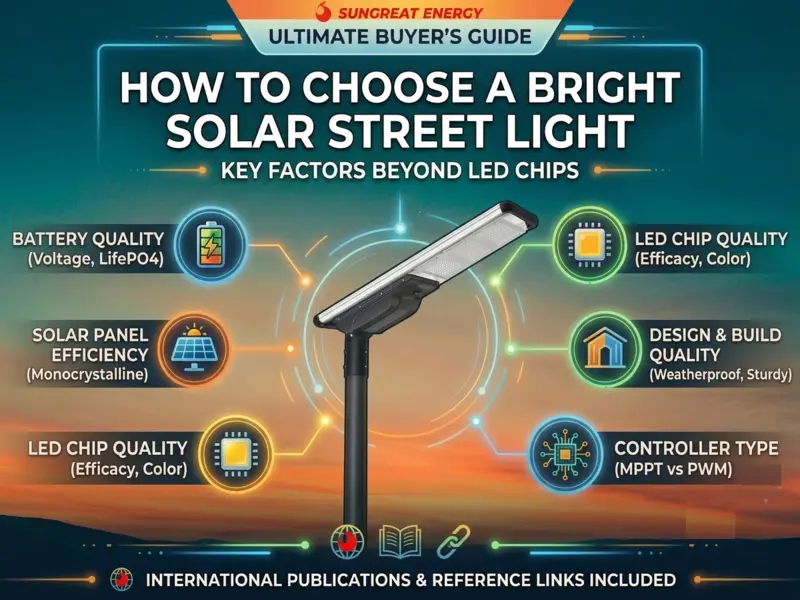
When selecting a solar street light, many people assume that more LED chips equate to brighter lighting. Some manufacturers even […]

The global solar street lighting market is expanding rapidly, with smart municipal grids and urban developments driving a compound annual […]

In a landmark achievement for sustainable industrial infrastructure, Sungreat Energy has successfully completed the installation of the high-performance NM Series […]