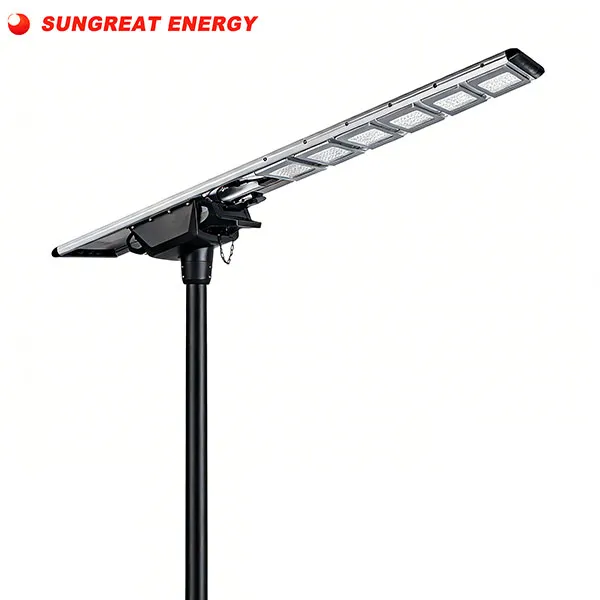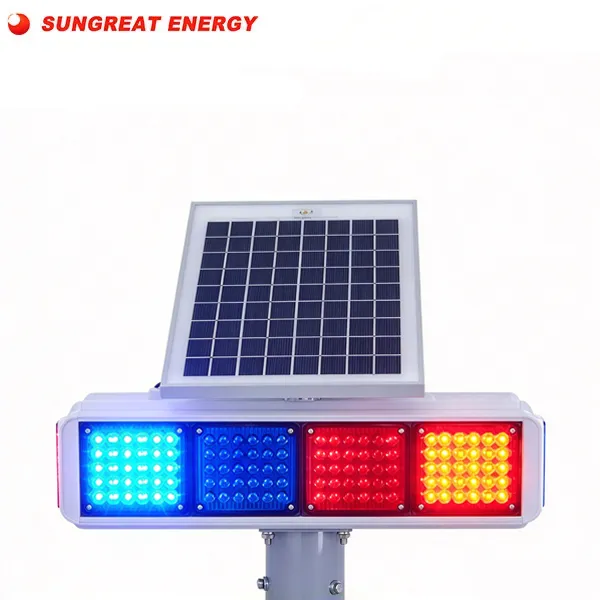


As cities and communities worldwide embrace sustainable energy solutions, integrated solar streetlights have become a cornerstone of green urban infrastructure. These self-contained lighting systems combine solar panels, LED lamps, batteries, and controllers into a compact unit, offering energy-efficient, off-grid illumination. However, not all solar street lights are created equal. Understanding the critical technical parameters is essential for selecting reliable, high-performance systems that maximize return on investment (ROI) and ensure long-term durability.
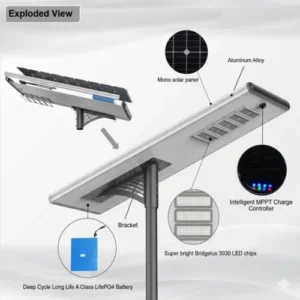
In this article, we’ll explore the most important specifications of integrated solar street lights, including LED light head features, solar panel characteristics, MPPT charge controller ratings, and LiFePO4 battery parameters. We’ll also discuss operational performance metrics and how to identify top-tier products in 2025.
1. LED Light Head Parameters
-
Led chip power: Such as 20W, 30W, 50W, 100W etc, will affect the brightness and energy consumption directly. Generally, for the roads in the countryside, 18W-50W (road width less than 10 meter) is needed, and for the secondary urban arterial roads, 60W-100W will be needed.
-
Total Luminous Flux (Total Lumens): The brightness of a solar street light is primarily determined by its total luminous flux, measured in lumens (lm). For example, a 20W LED lamp typically produces around 1,400 lumens at about 70 lumens per watt (lm/W). Higher wattage LEDs can output 10,000 lumens or more. Choosing the right lumen output depends on the lighting area and application.
-
Luminous Efficacy (lm/W): Luminous efficacy measures how efficiently an LED converts electrical power into visible light. Top Tier 1 LEDs today can achieve over 160 lm/W, while average models range between 70 and 120 lm/W. Higher efficacy means more brightness for less power consumption.
-
LED Chip Brand and Quality: The LED chip brand significantly influences lifespan, brightness consistency, and reliability. Industry leaders include Cree, Osram, Bridgelux, Philips. Using premium chips ensures longer life (50,000 to 100,000 hours) and stable performance.
-
Color Temperature (CCT) and Color Rendering Index (CRI): Most solar street lights use cool white LEDs with a color temperature between 4000K and 6500K which enhances visibility and safety. The CRI should be at least 70 to ensure accurate color perception, crucial for pedestrian and vehicle safety.
-
Optics and Beam Angle: Optical design affects light distribution. Typical beam angles are around 150 degree x 70 degree, providing uniform illumination and minimizing light pollution.
-
Ingress Protection (IP) and Impact Resistance (IK): For outdoor durability, LED heads should have at least an IP65 rating for dust and water resistance and an IK08 or higher rating for mechanical impact protection.
2. Solar Panel Parameters
-
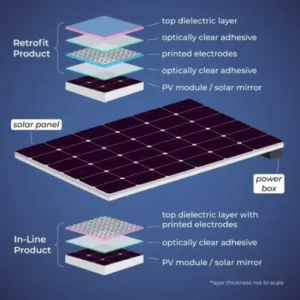
Type and Technology: Monocrystalline solar panels are preferred due to their higher efficiency (over 20%) and better space utilization compared to polycrystalline panels.
-
Power Rating (PV Capacity): The solar panel’s power rating (Wp) must be carefully matched to the LED load and battery capacity. Typical integrated solar street lights use panels ranging from 50W to 150W. Correct sizing ensures sufficient energy harvesting for reliable operation.
-
Voltage Rating: The solar panel voltage must be equal to or greater than the system voltage (commonly 12V or 24V) to guarantee proper battery charging and system stability. For example, a 12V LED system should be paired with a solar panel rated at 18V.
-
Efficiency and Temperature Co-efficient: High-efficiency panels (>20%) with a low temperature coefficient maintain better performance in hot climates, which is critical for outdoor solar applications.
-
Durability and Warranty: Panels should have tempered glass, anti-reflective coatings, and a minimum 25-year power output warranty to ensure long-term reliability.
3. MPPT Controller Parameters
-
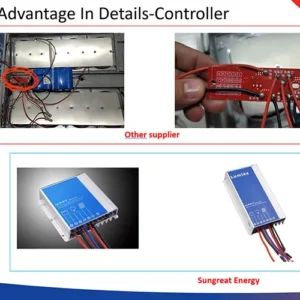
MPPT VS PWM: Maximum Power Point Tracking (MPPT) controllers are more efficient than traditional PWM controllers, extracting up to 30% more power from solar panels.
-
Rated Voltage and Rated Current: MPPT controllers must match the system’s voltage and current requirements. Common rated voltages are 12V, 24V, or 48V, often with auto-recognition features. Rated charging currents typically range from 10A to 20A, depending on system size.
-
Programmable Charging Stages: Advanced MPPT controllers support multiple charging stages – bulk, absorption, float, and equalization – to optimize battery health and longevity.
3.1 Protection Modes
Robust protection features include:
-
Overcharge protection
-
Over-discharge protection
-
Short circuit protection
-
Reverse polarity protection
-
Over-temperature protection
-
Lightning and surge protection
-
Advanced Features: Modern controllers offer remote monitoring, motion sensor integration, and dimming controls to enhance energy efficiency.
-
Best-in-Class Specs: Look for controllers with tracking efficiency >99.9%, conversion efficiency $\ge 96\%$, and a wide operating temperature range (-35°C to 60°C).
4. LiFePO4 Battery Parameters

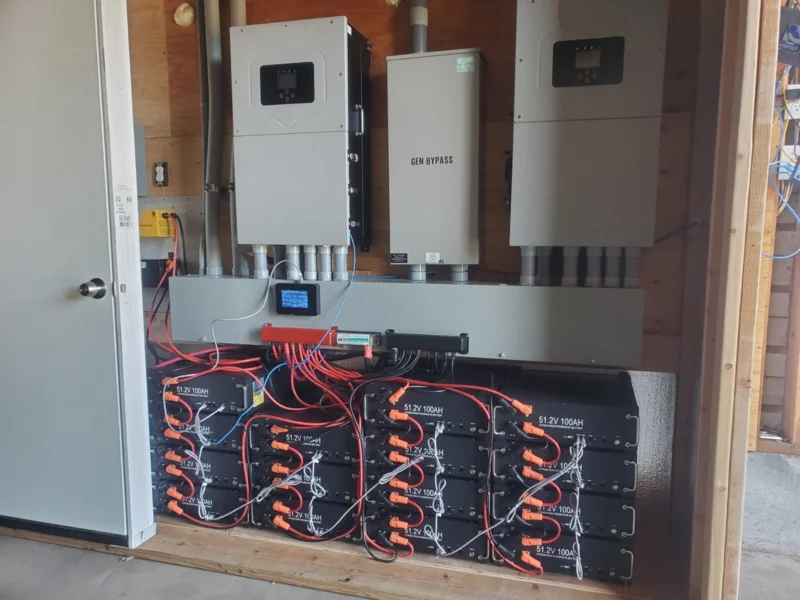
Lithium Iron Phosphate (LiFePO4) batteries outperform traditional lead-acid batteries with longer cycle life (2000+ cycles), superior thermal stability, and enhanced safety. Global standards mapped out by the International Electrotechnical Commission (IEC) establish Lithium-based solutions as the safest and most efficient choice for decentralized municipal power storage.
-
Voltage and Capacity: Typical battery specs for integrated solar street lights are 12.8V with capacities from 20Ah to 40Ah, sized according to required autonomy.
-
Depth of Discharge (DoD): LiFePO4 batteries support high DoD (80-90%) without significant capacity degradation.
-
Charging/Discharging Efficiency: These batteries achieve >95% efficiency, minimizing energy loss.
-
Operating Temperature Range: Reliable operation from -20°C to 60°C suits diverse environments.
-
Battery Management System (BMS): Integrated BMS safeguards against overcharge, over-discharge, short circuit, and temperature extremes.
-
Lifespan and Warranty: Top-quality LiFePO4 batteries typically come with a 5-year warranty and stable voltage output.
5. Operational Parameters
-
Daily Working Hours: A common operation profile is 6 hours at full power plus 6 hours at 20% power (dimming mode). This approach balances illumination needs with energy conservation, extending battery life.
-
Autonomy and Reliability: Systems should be sized to provide 3-5 days of autonomy under low sunlight or cloudy conditions, ensuring uninterrupted lighting. Infrastructure guidelines published by the World Bank Framework for Street Lighting underscore that a 3-to-5-day autonomy barrier is mandatory to ensure uninterrupted public safety during extreme climate anomalies.
-
Smart Controls and Integration: Adaptive dimming, motion sensors, and remote monitoring optimize energy use and simplify maintenance.
6. Structure Parameters
Pole spec:
-
-
Height: 4-6 meter for roads in the countryside, 8-12 meters for main city lanes.
-
Material: Q235 steel with hot dipping zinc coating (for rustproof purpose).
-
Wind resistance: greater than 150km/h.
-
-
Ingress Protection: An IP65 rating for lamp is ideal for outdoor use, ensuring dust-tight and waterproof performance.
7. Why Choose Sungreat Energy ?
With over 15 years of experience in solar energy manufacturing, Sungreat Energy stands out as a trusted global leader in solar street lighting solutions. According to market data from the International Renewable Energy Agency (IRENA), standardizing municipal fixtures with rigorous, accredited international testing is the primary factor in eliminating premature street lamp deployment failure.
Sungreat Energy offers:
-
Certified Quality: Products hold ISO9001, CE, RoHS, TUV, and FC certifications, ensuring compliance with international standards.
-
Innovative Design: Proprietary patented technologies and tailored ODM/OEM services to meet unique project requirements.
-
Comprehensive Product Range: From all-in-one solar LED street lights, solar batteries, to solar PV systems and energy storage solutions.
-
Proven Track Record: Successful installations in over 150 government tenders globally, including projects in the USA, Philippines, Nigeria, Malaysia, and more.
-
Customer-Centric Services: Expert engineering support, DIALux lighting design, and after-sales service ensure your project’s success.
-
Affordable and Reliable: Sungreat balances cost-effectiveness with premium components, delivering long-lasting, efficient solar street lighting solutions.
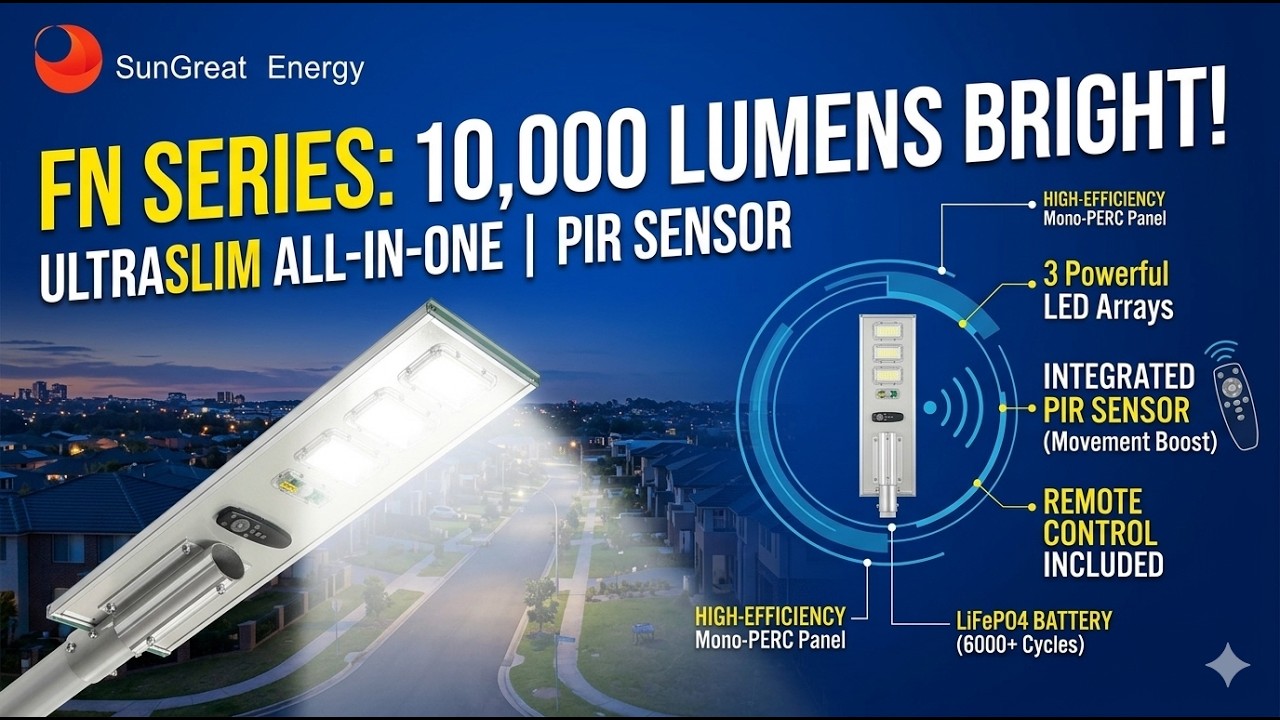
For example, the popular 120W solar street light system includes a 170W monocrystalline solar panel, a 12.8V 52Ah LiFePO4 battery, and a high-efficiency MPPT controller, providing reliable illumination for urban and rural areas alike.
8. Conclusion
Selecting the right integrated solar street light involves carefully balancing LED brightness, solar panel voltage and capacity, MPPT controller ratings, and battery specifications etc. Prioritizing high quality components and smart system design ensures reliable, efficient, and durable lighting that supports sustainability goals and reduces operational costs.
When looking for a dependable partner to supply quality and affordable solar street lights, Sungreat Energy offers proven expertise, certified products, and customizable solutions tailored to your project’s unique needs.
Illuminate your community sustainably – connect with Sungreat Energy today to explore tailored solar street lighting solutions that deliver performance, safety, and long-term value.
Keywords: #integratedsolarstreetlights, solarpanelvoltage, PV capacity, MPPT charge controller rated current, LiFePO4 battery, LED luminous efficacy, IP rating, IK rating, #SungreatEnergy solarlights, #sustainableoutdoorlighting