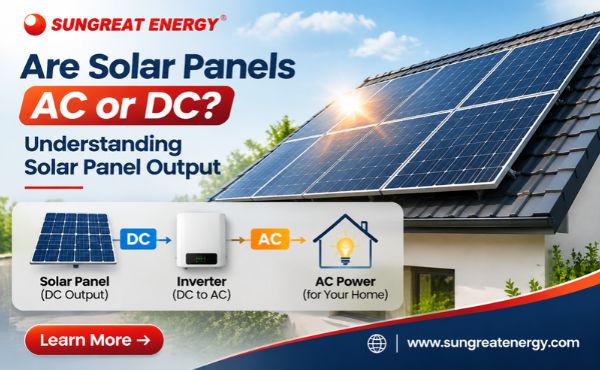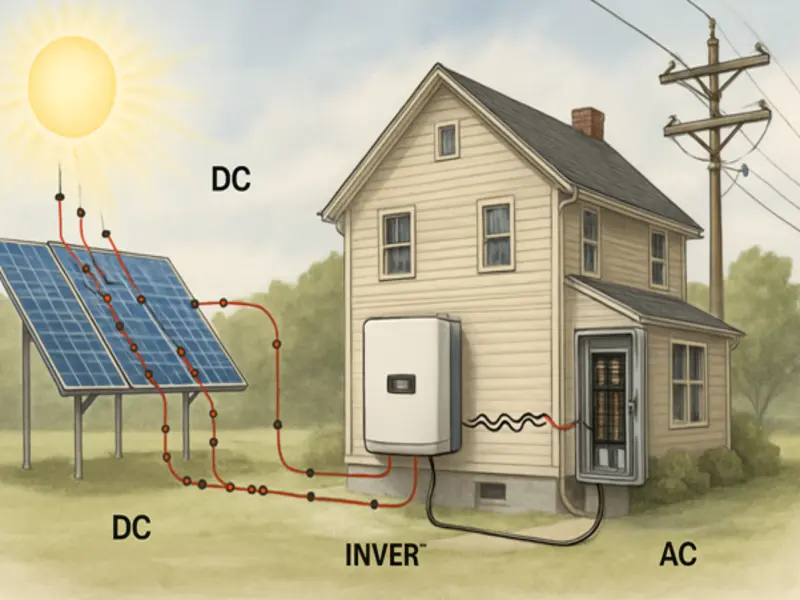



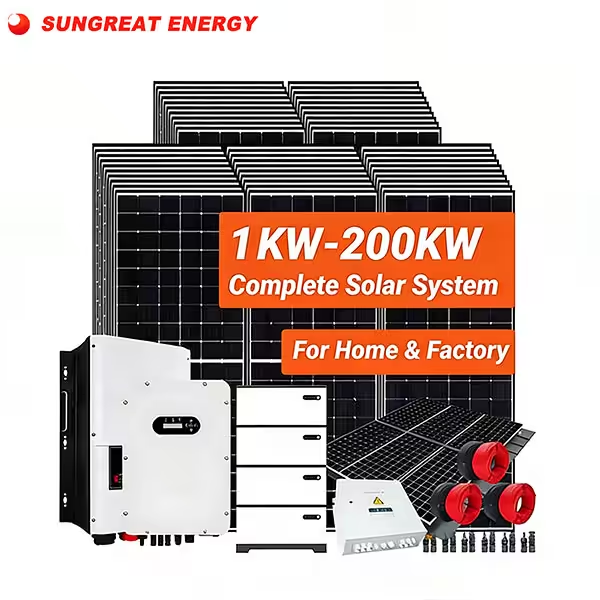


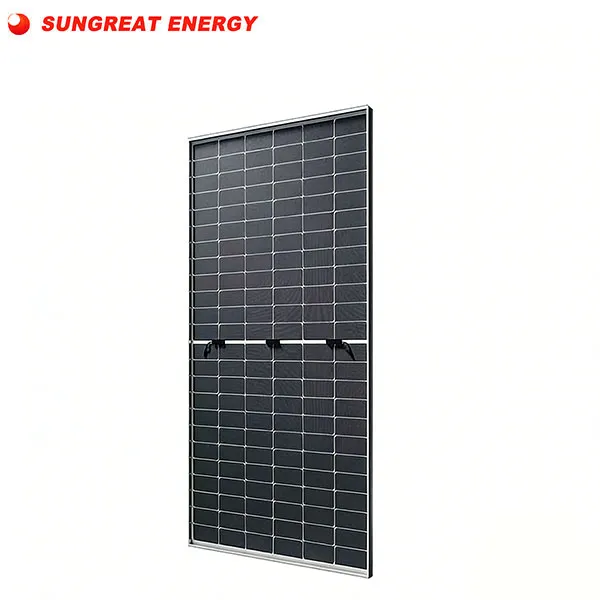

Solar panels produce DC (direct current) electricity. Photovoltaic cells inside the panels generate DC power when sunlight reaches the semiconductor material. An inverter then converts this DC electricity into AC (alternating current) for use by household appliances, commercial equipment, or the electrical grid.
The basic power flow in a typical solar system is:
Sunlight → Solar panels → DC electricity → Inverter → AC electricity → Loads or grid
Understanding this process makes it easier to see where DC and AC power appear in a solar energy system and why an inverter plays an important role.
Do Solar Panels Produce AC or DC Power?
Solar panels produce DC power.
A solar panel contains multiple photovoltaic cells connected together to generate electrical power. When sunlight reaches the cells, the photovoltaic effect creates an electrical current that flows through the circuit in one direction. This produces direct current.
The electrical output from the panel travels through the DC side of the solar system toward the inverter. The inverter converts the DC power into AC power for the building’s electrical system or the utility grid.
A typical grid-connected solar system therefore follows this sequence:
Solar panels → DC output → Inverter → AC output → Electrical loads or grid
The panel generates the DC electricity, while the inverter handles the conversion to AC.
Why Do Solar Panels Produce DC Electricity?
The reason solar panels produce DC electricity comes from how photovoltaic cells generate electrical current.
How the photovoltaic effect creates electricity
Photovoltaic cells use semiconductor materials, commonly silicon-based materials, to convert sunlight into electrical energy.
When sunlight reaches a photovoltaic cell, photons transfer energy to electrons in the semiconductor. This energy allows electrons to move and creates separated electrical charges within the cell.
The cell contains an internal electric field that directs these charges toward the electrical contacts. When the contacts are connected through an external circuit, electrons move through the circuit and create an electrical current.
The resulting current has a consistent direction of flow, which gives the photovoltaic cell its DC electrical output.
How multiple cells increase solar panel output
Individual photovoltaic cells generate relatively small amounts of electrical power. Solar panels connect many cells together to produce a higher voltage and usable power output.
Multiple panels can also be connected into strings and arrays. The entire solar array continues to provide DC electricity on the input side of the inverter.
The amount of electricity produced varies with factors such as sunlight intensity, panel characteristics, temperature, orientation, and system design.
How Does Solar Power Change From DC to AC?
Solar power changes from DC to AC through an inverter.
The inverter is a power-electronics device that takes the DC electricity from the solar array and produces AC electricity. It controls the electrical switching process to create an AC waveform suitable for the connected electrical system.
The basic conversion process is:
Solar panel DC output → Inverter → AC output
For a grid-connected system, the inverter also synchronizes its AC output with the electrical grid. This allows solar-generated electricity to work with the building’s electrical system and grid supply.
Different solar installations can use different inverter configurations, including string inverters, central inverters, and microinverters. Their physical arrangement differs, while their core function remains the same: converting solar-generated DC power into usable AC power.
Why Do Solar Systems Use AC Power?
Most buildings and utility grids use AC electricity as their standard electrical supply.
Household and commercial equipment such as air conditioners, refrigerators, pumps, motors, lighting systems, and other electrical loads commonly receive AC power through the building’s electrical distribution system.
Solar panels therefore connect to this electrical environment through an inverter.
The process looks like this:
PV generation → DC power → DC wiring → Inverter → AC power → Building electrical system
Once the electricity reaches the AC side, it can supply electrical loads according to the system’s operating conditions. In a grid-connected system, excess generation can also flow toward the utility grid when the system and local rules allow it.
Can Solar Panels Be Used With DC Loads or Batteries?
Yes. Solar panels produce DC electricity, which makes them suitable for systems that operate on the DC side.
Solar panels and batteries
Batteries store electrical energy as DC. Solar systems can therefore use DC power from the PV array to charge batteries through appropriate charge-control and power-conversion equipment.
The exact configuration depends on the system architecture.
In a DC-coupled system, solar panels and batteries share the DC side before power reaches an inverter. This arrangement can provide an efficient path for solar energy to enter battery storage.
In an AC-coupled system, solar generation and battery storage use separate power-conversion equipment and connect through the AC side of the system.
Solar panels and DC equipment
Some equipment can operate directly from DC electricity when its voltage and electrical requirements match the solar system.
Examples can include certain DC pumps, ventilation equipment, telecommunications equipment, and other specialized loads.
These applications can use the natural DC output of photovoltaic panels with suitable system controls and voltage regulation.

What Is the Difference Between Solar Panel DC Output and AC Output?
Solar panel DC output and solar system AC output describe different points in the power-conversion process.
| System stage | Electricity type | Main function |
|---|---|---|
| Photovoltaic cells | DC | Generate electricity from sunlight |
| Solar panels | DC | Combine PV cell outputs |
| PV array | DC | Deliver solar-generated power |
| Inverter input | DC | Receive power from the PV array |
| Inverter output | AC | Supply converted power |
| Building electrical system | AC | Distribute power to compatible loads |
| Utility grid | AC | Receive or supply grid-connected power |
This distinction is useful when reading solar equipment specifications.
A solar module’s rated power describes its output on the DC side. An inverter’s rated power describes its ability to process and deliver power on the AC side.
The two ratings describe different components and different stages of the electrical system.
What Types of Inverters Convert Solar DC to AC?
Solar systems use several inverter configurations depending on system size, layout, and application.
String inverters
String inverters connect multiple solar panels into strings. The DC electricity from each string is sent to an inverter, which converts it into AC power.
This configuration is widely used in residential, commercial, and other solar installations.
Microinverters
Microinverters are installed at the individual panel level. Each unit converts the DC output of its connected solar panel into AC power.
This approach can provide module-level power conversion and monitoring, depending on the system design.
Central inverters
Large solar installations can use central inverters to process DC power from large groups of solar panels. They are commonly associated with utility-scale and large commercial PV systems.
Although these inverter types have different configurations, they all perform the same fundamental conversion:
DC solar electricity → AC electricity
AC vs. DC in Solar Power Systems
The difference between AC and DC becomes clear when looking at their roles within a solar installation.
DC electricity:
- Generated by photovoltaic cells
- Produced by solar panels
- Flows in one direction
- Present on the PV side of the system
- Can be used for compatible DC applications
- Can supply battery charging systems through suitable equipment
AC electricity:
- Produced by the inverter
- Used by conventional building electrical systems
- Supplied to compatible household and commercial loads
- Used by utility grids
- Can carry solar-generated power from the inverter into the building or grid
The transition from DC to AC takes place at the inverter, making the inverter a central part of a typical solar power system.
Frequently Asked Questions
Are solar panels AC or DC?
Solar panels produce DC electricity. Photovoltaic cells generate direct current when sunlight reaches the semiconductor material.
Why do solar panels produce DC?
Photovoltaic cells generate electrical current through the photovoltaic effect. The resulting current flows in one direction through the external circuit, producing DC electricity.
How does solar power become AC?
An inverter converts the DC electricity generated by solar panels into AC electricity for building electrical systems and grid-connected applications.
Do solar panels need an inverter?
A typical grid-connected solar system uses an inverter to convert the panels’ DC output into AC power. The inverter configuration depends on the system design.
Can solar panels charge batteries?
Yes. Solar panels produce DC electricity, and batteries store electrical energy as DC. A solar battery system uses appropriate charge-control and power-conversion equipment to manage the charging process.
Do solar panels produce electricity at night?
Solar panels require sunlight to generate photovoltaic electricity. Their power output therefore falls to zero or near zero when there is insufficient sunlight.
Is solar panel output always the same?
No. Solar panel output changes with conditions such as sunlight intensity, temperature, shading, panel orientation, and system configuration.
Conclusion
Solar panels produce DC electricity through the photovoltaic effect. Photovoltaic cells use sunlight to generate electrical current, and multiple cells are connected to form solar modules and arrays.
The DC electricity then reaches an inverter, where it is converted into AC electricity for household, commercial, or grid-connected use.
The basic process is straightforward:
Sunlight → Solar panels → DC electricity → Inverter → AC electricity → Loads or grid
Understanding this DC-to-AC path provides the foundation for understanding how solar panels, inverters, batteries, electrical loads, and the utility grid work together in a solar power system.