




Solar street lights can be a daunting task for municipal engineers, property developers, and sustainability officers alike. On the surface, the technical specifications seem straightforward: find the highest wattage for the lowest price. However, this logic is a relic of the incandescent era and is leading to massive project failures across the globe.
From the humid highways of the Philippines to the scorching industrial zones of Saudi Arabia, project managers are discovering a hard truth: wattage does not equal performance. This guide will dismantle the “wattage myth” and provide a technical framework for selecting solar lighting based on real-world efficacy, system design, and long-term reliability.

1. The Great Wattage Myth
Traditionally, in the world of grid-connected halogen or high-pressure sodium (HPS) lamps, wattage was a reliable proxy for brightness. If you bought a 100W bulb, you knew exactly how much light to expect. In the modern LED and solar era, that correlation has shattered.
Today, wattage is often used as a marketing figure rather than a technical measurement of light output. Many low-cost suppliers advertise “200W Solar Street Lights,” yet these units often produce less usable light than a professionally engineered 40W system.

1.1 Why does this happen?
The discrepancy arises because wattage measures power consumption, not light visibility. Several critical factors dilute the performance of a high-wattage, low-quality light:
-
LED Efficiency: Not all LEDs are created equal. High-end chips can produce twice the light of budget chips using the exact same amount of power.
-
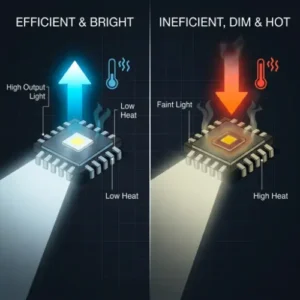
Thermal Management: LEDs lose efficiency as they heat up. Without proper heat sinks, a “100W” light may dim by 30% within twenty minutes of operation.
-
Battery and Controller Bottlenecks: A light might have 100W worth of LED chips, but if the battery cannot discharge enough current or the controller limits output to save power, you will never see 100W worth of light.
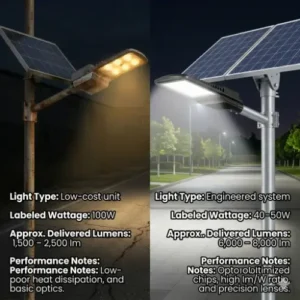
1.2 Comparison
| Light Type | Labeled Wattage | Approx. Delivered Lumens | Performance Notes |
|---|---|---|---|
| Low-cost unit | 100W | 1,500 – 2,500 lm | Low-efficiency LEDs, poor heat dissipation, and basic optics. |
| Engineered system | 40–50W | 6,000 – 8,000 lm | Optimized chips, high ratio, and precision lenses. |
2. Performance Trinity
To move beyond wattage, buyers must focus on three core technical pillars: Efficacy, Autonomy, and Optics.
2.1 LED Efficacy
Efficacy is the measure of how much light (lumens) is produced for every watt of electricity consumed.
-
Low-end LEDs: Often hover around 80–100 .
-
High-performance LEDs: Can reach 170–200 or higher.
When you buy a high-efficacy light, you need a smaller battery and a smaller solar panel to achieve the same brightness. This reduces the wind load on the pole and the overall system weight, often lowering the total project cost despite a higher “per unit” price.
2.2 Battery Capacity
Solar lights are only as good as their storage. A common failure in Southeast Asia and the Middle East is the lack of Autonomy Days—the ability of the light to function through consecutive cloudy or rainy days.
In professional specifications, a system should offer 3 to 5 days of autonomy. Furthermore, in high-heat environments like Saudi Arabia, batteries must be “derated.” High temperatures accelerate chemical degradation; a battery that works in London will fail in Riyadh if it hasn’t been engineered for thermal resilience.
2.3 Optical Design
Brightness is useless if it’s pointing at the sky or concentrated in a single “hot spot” directly under the pole. This is where Type II, III, or IV light distributions come into play. Professional solar lights use secondary optics (lenses) to stretch the light along the roadway, ensuring uniform illumination (Lux) and reducing “spill light” that contributes to light pollution.
3. Lessons from the Field
3.1 Philippine Road Projects
The Department of Public Works and Highways (DPWH) in the Philippines has seen various attempts at solar integration on secondary highways. Early projects that relied on “high-wattage” budget units often resulted in “black holes” between poles because the light didn’t spread effectively. Success was only achieved when the specifications shifted to average maintained Lux levels (8–12 Lux) rather than wattage. This forced contractors to provide IES files and proof of LED efficiency.
3.2 Saudi Aramco Project
In industrial zones associated with Saudi Aramco, reliability is non-negotiable for safety. The environment presents extreme challenges: ambient temperatures and heavy dust. Low-cost “100W” units often suffered from “premature dimming” as their controllers throttled power to prevent the battery from exploding in the heat. Engineered systems with Grade-A LiFePO4 batteries and specialized heat-dissipating aluminum housings maintained a steady 15 Lux throughout the night, proving that thermal engineering is more important than a wattage sticker.
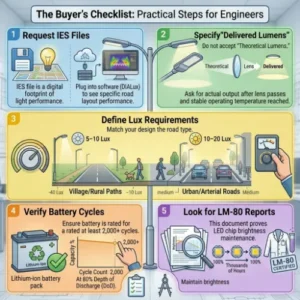
4. The Buyer’s Checklist
If you are responsible for procurement or design, follow these steps to ensure you get what you pay for:
-
Request IES Files: An IES file is a digital footprint of a light’s performance. Plug this into lighting software (like DIALux) to see exactly how the light will perform on your specific road layout.
-
Specify “Delivered Lumens”: Do not accept “Theoretical Lumens.” Ask for the actual output after the light passes through the lens and reaches a stable operating temperature.
-
Define Lux Requirements: Match your design to the road type.
-
Village/Rural Paths: 5–10 Lux.
-
Urban/Arterial Roads: 10–20 Lux.
-
-
Verify Battery Cycles: Ensure the battery is rated for at least 2,000+ cycles at 80% Depth of Discharge (DoD).
-
Look for LM-80 Reports: This document proves how well the LED chips maintain their brightness over thousands of hours.
5. Conclusion
The “cheapest” solar street light is often the most expensive over a five-year period. When a low-quality 100W light fails after 18 months, the cost of the replacement unit, the bucket truck rental, and the labor quickly dwarfs the initial savings.
By shifting the focus from Watts (power in) to Lumens (light out), you ensure that your project is safe, sustainable, and truly illuminated.
The bottom line is simple: Buy lumens, not watts.
6. International Resources
-
International Energy Agency (IEA) – Global benchmarks for lighting and energy efficiency.
-
Illuminating Engineering Society (IES) – The world’s leading technical authority on lighting specifications.
-
International Dark-Sky Association (IDA) – Resources for minimizing light pollution through smart optics.
-
Global Off-Grid Lighting Association (GOGLA) – Industry standards for off-grid solar performance.
Hashtags: #SolarLighting #RenewableEnergy #SmartCity #StreetLighting #Sustainability #Engineering #LEDLighting #SolarEnergy #GreenInfrastructure #LumensNotWatts