




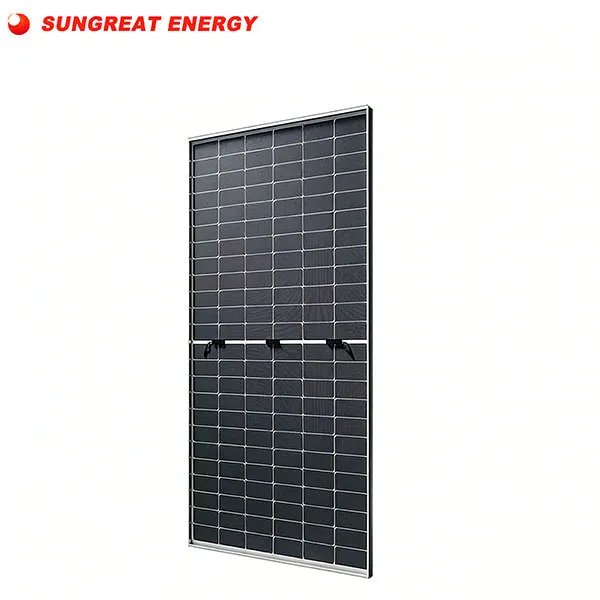
Solar street lights at the forefront of urban and rural development as an eco-friendly alternative to traditional grid-powered lighting, these systems offer independence, cost-savings, and a significantly reduced carbon footprint.
Whether you are a municipal planner, a business owner, or a homeowner looking to illuminate your driveway, understanding the nuances of solar lighting technology is essential. This comprehensive guide addresses the most frequently asked questions and dives deep into the technical components that make these systems work.

1. What is a Solar Street Light?
A solar street light is not merely a lamp attached to a panel; it is a sophisticated, off-grid power plant. Because these units operate independently of the centralized grid, each component must be precisely calibrated to ensure 365 days of reliable operation.

1.1 Solar Panel
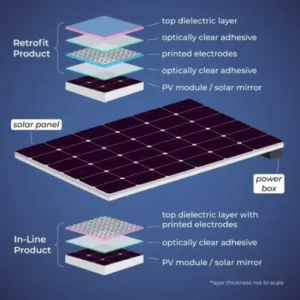
The solar panel is the starting point of the energy chain. In the professional sector, the choice of silicon is the primary determinant of system footprint and performance.
-
Monocrystalline Silicon (17- 23.5 % Efficiency): These panels are sliced from a single, pure crystal of silicon. The high purity allows electrons more room to move, resulting in the highest conversion rates available. This is crucial for street lights because the surface area on top of a pole is limited; you need the most “power per square inch.”
-
The Photovoltaic Effect: When photons from sunlight strike the solar cell, they knock electrons loose from their atoms. As these electrons flow through the cell, they generate Direct Current (DC) electricity.
-
Industrial Durability: To survive 25+ years outdoors, panels are encased in low-iron tempered glass. This glass is designed to be “self-cleaning” (hydrophobic) and must withstand structural loads, such as wind or heavy snow, up to 2400 Pa (Pascal).
1.2 The Battery
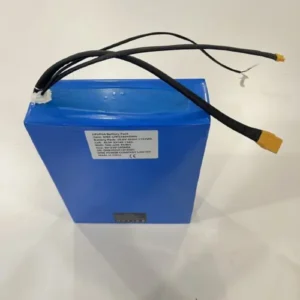
Since the sun only shines during the day, the battery is the lifeblood of the system at night.
-
Lithium Iron Phosphate (LiFePO4): The industry standard has shifted from heavy Lead-Acid to LiFePO4 . These batteries are prized for their thermal stability (they don’t catch fire easily) and their cycle life.
-
Depth of Discharge (DoD): While a car battery shouldn’t be drained past 50%, a solar LiFePO4 battery can be drained to 90% nightly without significant degradation.
1.3 The Smart Controller
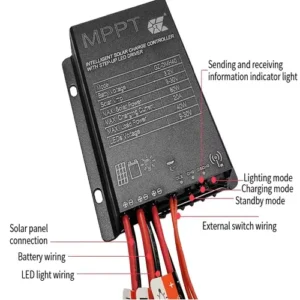
Without the controller, the panel would overcharge the battery during the day, and the battery would destroy itself by over-discharging at night.
-
Regulation: It manages the voltage and current coming from the PV module to ensure the battery charges at the optimal rate.
-
Dusk-to-Dawn Sensing: Using the solar panel itself as a light sensor, the controller detects when the voltage drops (indicating sunset) and automatically triggers the LED.
-
Protection Suites: Modern controllers include protection against short circuits, reverse polarity, and lightning surges.
1.4 LED Light Source
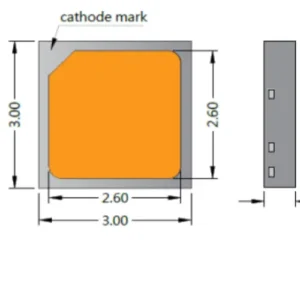
The transition to Light Emitting Diodes (LEDs) is what made solar street lighting viable.
-
Luminous Efficacy: High-end solar LEDs produce between 150 and 200 lumens per watt (lm/W). For comparison, old incandescent bulbs produce about 15 lm/W.
-
Heat Dissipation: LEDs are sensitive to heat. Professional fixtures include aluminum “heat sinks” to pull warmth away from the chips, ensuring they reach their promised 50,000-hour lifespan.
1.5 The Structural Backbone
The pole must do more than just hold a light; it must act as a lever against high winds while supporting the weight of the panel and battery.

-
Materials: Usually made of Q235 galvanized steel, which is treated to prevent rust for 20+ years, even in salty coastal air.
-
Wind Resistance: The brackets are engineered with a specific “tilt angle” (usually between 15 degree and 35 degree. This angle is a calculation based on the latitude of the installation site to maximize solar gain while minimizing wind resistance.
Technical Summary Table
| Component | Material Standard | Critical Metric | Role in Independence |
| Solar Panel | Monocrystalline Silicon | Wp (Watt Peak) | Energy Generation |
| Battery | LiFePO4 | Ah (Ampere Hours) | Energy Continuity |
| Controller | MPPT / PWM | Efficiency % | System Logic & Safety |
| LED | Bridgelux / Cree Chips | lm/W (Efficacy) | Efficient Illumination |
| Pole | Hot-dip Galvanized Steel | Wind Load (km/h) | Structural Integrity |
2. Solar Street Lights Operate?
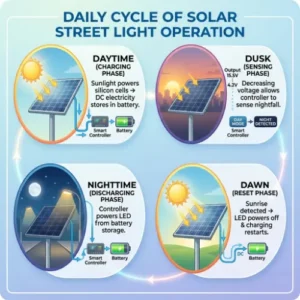
The operation relies on the photoelectric effect. The process is a daily cycle of energy transformation:
-
Charging Phase (Daytime): Sunlight hits the solar panel. The silicon cells generate direct current (DC). The smart controller directs this current into the battery.
-
Sensing Phase (Dusk): As the sun sets, the voltage from the solar panel drops. The controller senses this change and realizes it is night.
-
Discharging Phase (Nighttime): The controller draws stored energy from the battery to power the LED lamp.
-
Reset Phase (Dawn): When the panel detects sunlight again, the controller cuts power to the LED and restarts the charging cycle.
3. Technical Deep Dive
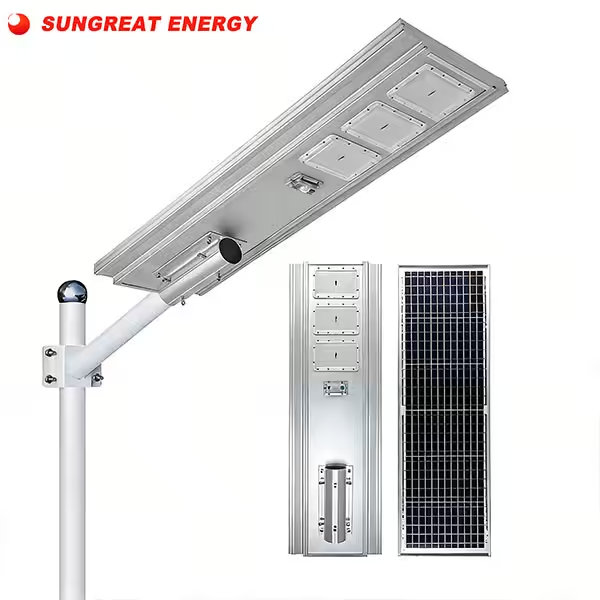
Modern innovation has led to the All-in-One (AIO) Solar Street Light. In these units, the panel, battery, and controller are integrated into a single sleek casing.

3.1 The Role of the Solar Panel
Panels are typically rated between 20W and 400W. Efficiency is key; a higher-wattage panel ensures the battery charges fully even during shorter winter days. Most systems utilize Monocrystalline panels for the highest conversion efficiency.
3.2 The Math Behind the Battery
To ensure reliability, engineers must calculate battery capacity (Ah) based on energy needs (Wh).
For example, a 30W LED running for 10 hours consumes 300Wh. To survive 3 rainy days without sun, you need 900Wh of storage.
At a 12V system, this equals 900 / 12 = 75Ah. To account for safety margins and battery health, a 100Ah battery would be the professional choice.
4. All-in-One vs. Split-Type
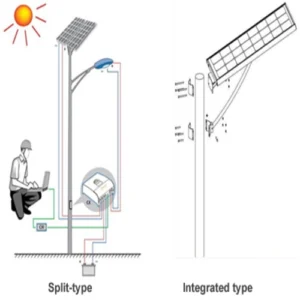
When choosing a system, you must decide between two primary configurations:
| Feature | All-in-One (Integrated) | Split-Type Solar Light |
| Components | Panel, Battery, LED in one shell. | Separate panel, battery box, and lamp. |
| Installation | Extremely fast (5–10 mins). | Complex; requires wiring and assembly. |
| Panel Tilt | Fixed (limited by light orientation). | Adjustable (can be aimed perfectly South). |
| Maintenance | Easy to swap the entire unit. | Parts can be replaced individually. |
| Best Use Case | Parks, walkways, residential streets. | Highways, high-latitude regions (snow). |
5. Frequently Asked Questions
How long do they stay on at night?
Standard designs target 8 to 12 hours. However, “Smart Dimming” profiles allow lights to run at 100% brightness during peak traffic hours and 30% during the quiet hours of 2 AM to 5 AM, drastically extending battery life.
What happens if it rains for a week?
This is known as “Autonomy.” Most professional systems are designed with 3 to 5 days of autonomy. High-end industrial units can be customized for up to 7 days of backup power to ensure the streets never go dark.
Do they require maintenance?
They are low-maintenance, not “no-maintenance.”
-
Cleaning: Rain does most of the work, but in dusty regions, panels should be wiped every 6 months.
-
Battery Life: While panels last 20+ years, batteries (usually Lithium LiFePO4) typically need replacement every 5 to 8 years.
6. Industry Resources
To learn more about the international standards and the global push for solar integration, explore these resources:
-
International Energy Agency (IEA): Tracking the progress of renewable energy technologies.
-
International Renewable Energy Agency (IRENA): Global statistics on solar adoption.
-
Solar Power World Magazine: The latest trends in PV technology and outdoor lighting.
7. Conclusion
Solar street lights are more than just a trend; they are a vital component of the “Smart City” of the future. By combining energy efficiency with ease of installation and high durability, they provide a reliable lighting solution that respects both the environment and the bottom line.
As battery technology continues to improve and LED efficiency climbs, the “all-in-one” solar solution is set to become the standard for every road and pathway across the globe.
#SolarStreetLight #RenewableEnergy #SmartCity #SustainableLighting #SolarPower #CleanEnergy #GreenTechnology #GoSolar #SolarEnergy