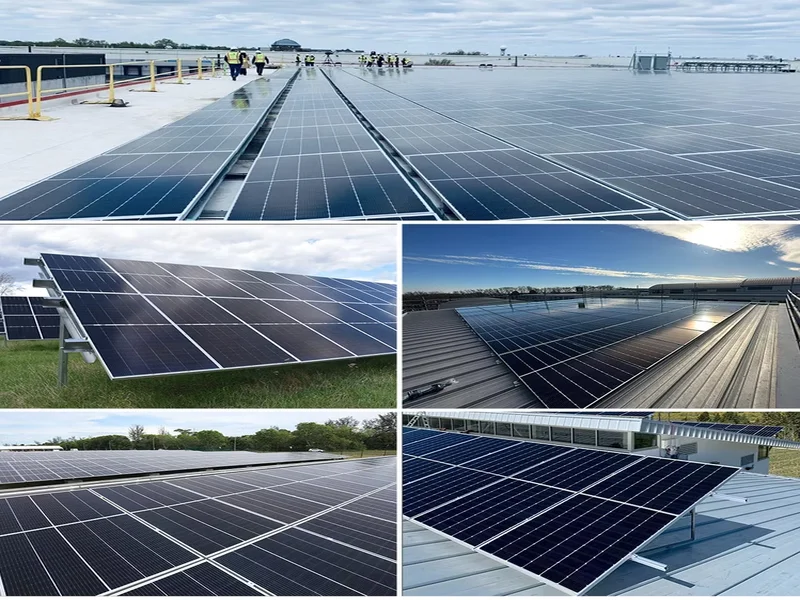
In the global shift toward sustainable infrastructure, “All-in-One” solar street lights have emerged as the gold standard for efficiency. They are sleek, easy to install, and promise “free” energy from the sun. However, walk through any major city that adopted solar five years ago, and you will likely see a common sight: rows of dark fixtures.
The solar panels are usually still fine. The LEDs are often still functional. The failure almost always lies in the “heart” of the system—the battery.
When we consult with municipal engineers at Sungreat Energy, we always emphasize that the “Low vs. High Quality” divide isn’t just a technical debate; it is a financial one. If you choose the wrong battery, your “green” investment can become a maintenance nightmare in less than 24 months. Here is why battery quality is the single most important factor in your project’s Return on Investment (ROI).
1. Battery Chemistry
1.1. LiFePO4 vs. Ternary Lithium
The first thing to look at is the chemistry inside the cell. In the budget market, many manufacturers still use Ternary Lithium (NMC) or, worse, recycled lead-acid variants.

- High Quality (LiFePO4): Lithium Iron Phosphate is the industry benchmark for a reason. It offers incredible thermal stability and a high safety profile. More importantly, it delivers a cycle life of 2,000 to 5,000+ cycles. When managed correctly, this translates to 7 to 10 years of daily, reliable service.
- Low Quality (Ternary/Recycled): These are often used in “bargain” units because they are lighter and cheaper. However, they are incredibly sensitive to heat. They typically offer only 500–1,000 cycles. In a real-world setting, this means the light begins to dim or fails entirely after just two years.
1.2. Grade A vs. Recycled Cell
Even when a manufacturer claims to use LiFePO4, there is a hidden hierarchy in cell quality. Not all cells coming off a production line are equal.
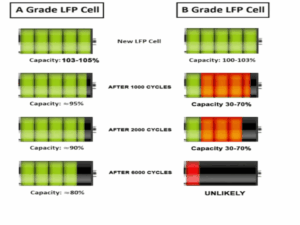
- Grade A Cells: These are brand-new cells that meet 100% of their capacity and internal resistance specifications. Because the cells are consistent, the Battery Management System (BMS) can balance the pack effectively. This prevents “dead cells” from dragging down the entire fixture.
- B-Grade or Recycled Cells: To hit ultra-low price points, some vendors use “recycled” cells salvaged from electric vehicles or power tools. These cells have inconsistent discharge curves. Have you ever seen a solar light that stays bright until midnight and then suddenly dies? That is often the result of an unbalanced, low-grade battery pack that can no longer hold a steady voltage.
2. Environmental Impact
2.1. Temperature Resilience
Street light housings are essentially metal boxes sitting in direct sunlight. During a peak summer day, internal temperatures can easily soar to 60°C or 80°C.
- High-Quality Systems: At Sungreat, we utilize advanced BMS logic and heat-reflective internal coatings. High-quality LiFePO4 can safely handle discharging up to 65°C without entering “thermal runaway.”
- Low-Quality Systems: Cheap batteries lack sophisticated thermal protection. The physics are brutal: for every 10°C increase in temperature above 25°C, a low-quality battery’s lifespan is cut by roughly 50%. This is exactly why “cheap” solar lights often “die” during their second summer—the heat literally cooks the battery’s ability to store energy.
2.2. Depth of Discharge (DoD)
In solar engineering, we talk about “Autonomy”—the number of days a light can stay on if the sun doesn’t shine.
A high-quality battery allows for a Depth of Discharge (DoD) of 80% to 90% without damaging the chemical structure. When paired with an intelligent controller, this gives the light enough “reserve” to survive 3 to 5 consecutive rainy or cloudy days.
Low-quality batteries simply don’t have the stability to handle deep cycles. If they are pushed to 90% discharge during a “dark week,” they often suffer permanent capacity loss. You might get through the storm, but your battery will never return to 100% health again.
3. Economic Impact
3.1. Upfront vs. Lifecycle Cost
The most dangerous trap in infrastructure procurement is focusing solely on the upfront cost.
A “low-cost” solar street light usually requires a full battery replacement every 2 to 3 years. When you factor in the cost of a bucket truck rental, technician labor, and the replacement part itself, that “bargain” light becomes 3x more expensive than a high-quality unit over a 10-year period.
Engineering Tip: Before you approve a vendor, look past the glossy brochure. Always ask for the documented Cycle Life @ 80% DoD and the BMS Thermal Cut-off specifications. If they can’t provide that data, they are likely hiding a low-quality battery.
3.2. Industry References
To understand the standards for battery safety and lifecycle, we recommend these external resources:
- U.S. Department of Energy (DOE) – Battery Technologies: Insights into the development of high-performance lithium-ion and LiFePO4 systems.
- NREL (National Renewable Energy Laboratory) – Storage Research: Technical data on energy storage reliability and the impact of temperature on cycle life.
- Battery University – Li-Fe-PO4: A deep technical dive into why Iron Phosphate is the safest and longest-lasting chemistry for stationary applications.
- PV Magazine – Energy Storage: Stay updated on the latest shifts in global battery supply chains and manufacturing standards.
3.3. Let’s Build Future
Are you seeing early failures in your solar projects, or are you ready to make the switch to high-cycle LiFePO4? At Sungreat Energy, we pride ourselves on engineering the “heart” of the light to last as long as the city it illuminates.
Ready to discuss your next project?
#SolarEnergy #RenewableEnergy #StreetLighting #LiFePO4 #SmartCities #Sustainability #ElectricalEngineering #SungreatEnergy