





Before study of lifepo4 battery we should know as the global shift toward renewable energy accelerates, reliable electricity cannot always be taken for granted. In regions plagued by frequent brownouts, unstable grid supplies, or limited utility infrastructure, power interruptions severely disrupt lighting, refrigeration, communication networks, household appliances, and small commercial enterprises. In remote and rural communities, many homes operate entirely off-grid with little to no access to conventional power lines.
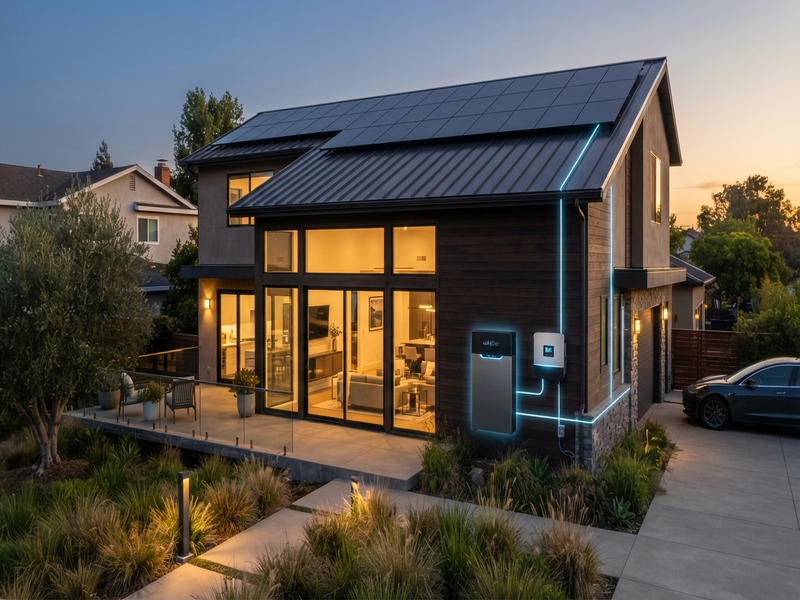
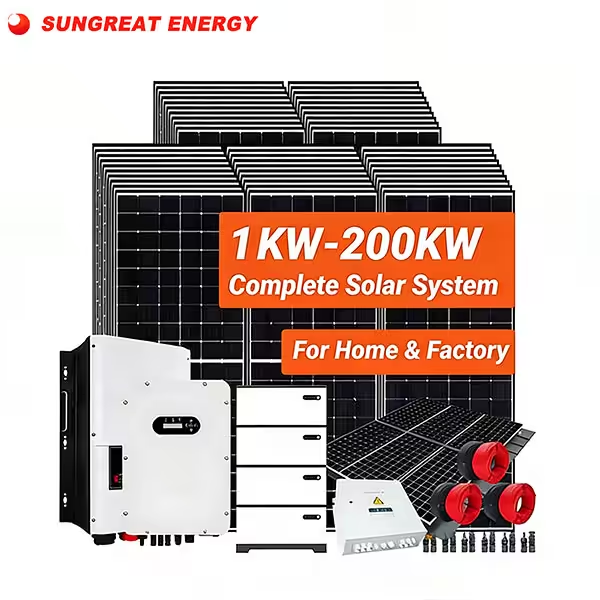
This reality has made residential solar systems an indispensable tool for achieving true energy independence. By seamlessly combining solar panels, a hybrid inverter, and advanced battery storage, a household can generate green energy during peak sunlight hours, store surplus generation, and utilize it reliably after dark or during unexpected grid blackouts.
1. Quick Takeaways
- Start with the Load, Not the Battery: Rigorously calculate daily energy consumption, identify critical loads, and determine required backup autonomy before sizing your battery bank.
- Compare Usable Capacity, Not Just Nominal kWh: Account for depth of discharge (DoD) limits, round-trip efficiency, and system losses to understand how much energy the battery can actually deliver.
- Verify Both Energy and Power Requirements: Ensure your chosen battery can deliver sufficient continuous and peak kilowatts (kW) to support high-surge appliances like air conditioners and water pumps.
- Confirm Battery-Inverter Compatibility Early: Cross-check voltage ranges, charge/discharge current ceilings, and communication protocols (CAN/RS485) prior to placing equipment orders.
- Evaluate the BMS as a Core System Component: A battery is only as reliable as its Battery Management System (BMS)—cell quality alone does not guarantee performance or safety.
- Look Beyond Upfront Price per kWh: Evaluate long-term total cost of ownership by factoring in cycle life, warranty conditions, round-trip efficiency, and manufacturer support.
- Plan for Future Scalability: Verify whether additional battery modules can be connected in parallel and confirm that your inverter firmware supports system expansion.
- Choose a Trusted Supplier: Technical engineering support, compatibility testing documentation, and responsive after-sales service are critical to project success.
2. LiFePO4 Batteries Popularity
Lithium iron phosphate—commonly abbreviated as LiFePO4 or LFP—has established itself as the premier chemistry for stationary energy storage systems. According to international engineering literature and grid standards such as the IEEE Guide for Battery Energy Storage Systems, LFP technology offers exceptional thermal stability, high round-trip efficiency, and an extended operational cycle life that far outperforms legacy lead-acid alternatives.
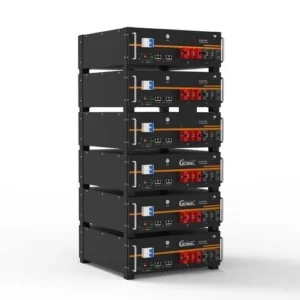
As residential solar installations increasingly integrate energy storage to combat the depreciation of feed-in tariffs and grid instability, installers face an expanding market of wall-mounted, rack-mounted, and modular battery solutions. While this variety provides flexibility, it also introduces complexity. Two separate energy storage units may both advertise identical sticker ratings—such as 51.2V, 100Ah, and 5.12kWh—yet exhibit completely different usable capacities, thermal ratings, BMS communication parameters, and warranty terms.
For EPC contractors, deploying an incompatible or poorly matched battery can result in persistent field issues long after commissioning, including chronic inverter alarms, communication dropouts, premature capacity degradation, and costly warranty disputes. Treating battery selection as a rigorous system-design decision is essential for professional installers.
3. Battery Capacity ?
Accurate sizing must originate from an analytical assessment of the customer’s electricity consumption and backup expectations. Installers must investigate several operational variables:
- What is the total daily energy consumption in kilowatt-hours (kWh)?
- Which essential appliances must remain powered during a grid outage?
- How many hours or days of autonomy (backup duration) are required?
- Is the system configured for self-consumption, grid-tied backup, or complete off-grid operation?
3.1. Sizing Example
Consider a household that consumes approximately 12 kWh of usable energy per day and requires 1.5 days of autonomous backup. Without accounting for efficiency losses, this creates a baseline requirement of 18 kWh of usable energy.
If the system design incorporates an 80% usable Depth of Discharge (DoD) to protect cell longevity and an overall system round-trip efficiency of 90%
Thus, instead of procuring an 18 kWh bank, the installer must deploy a nominal battery capacity of approximately 25 kWh.
3.2. Capacity
- Nominal Capacity: The total rated energy stored within the battery cells under laboratory conditions.
- Usable Capacity: The actual energy delivered to home loads under real-world operating temperatures and discharge thresholds without violating BMS safety parameters.
4. Battery Power Deliver?
A common pitfall in system design is confusing energy capacity (kWh) with power output capability (kW):
- kWh measures how much total energy the battery can store.
- kW measures how much instantaneous power the battery can discharge at any given second.
This distinction is vital for homes operating high-surge or continuous high-power loads, such as central air conditioning units, water pumps, refrigerators, and induction cooktops. For example, a standard 51.2V 100Ah LiFePO4 battery provides a nominal energy storage capacity of 5.12 kWh. If a household’s simultaneous appliance loads exceed this threshold, a single battery will trigger an overcurrent protection shutdown. Installers must verify continuous discharge limits, peak surge capabilities, and parallel scaling potential to prevent power bottlenecks.
5. Verifying Compatibility
Establishing physical and electrical compatibility between the hybrid inverter and the battery BMS is a mandatory prerequisite before finalizing procurement. Relying strictly on nominal voltage matching (such as pairing a “48V-class” inverter with a 51.2V LFP battery) is insufficient.
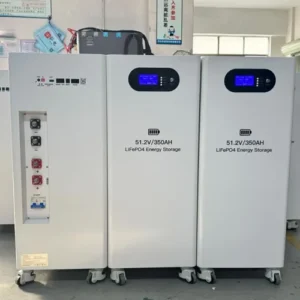
Field engineers must verify:
- Operating voltage windows and DC cut-off thresholds of both devices.
- Maximum allowable charging and discharging current limits.
- Closed-loop communication protocols (e.g., CAN bus or RS485 pinout configurations).
- Approved inverter manufacturer compatibility lists and firmware version requirements.
Failure in BMS communication typically results in unacknowledged battery modules, incorrect state-of-charge (SoC) reporting, erratic charging restrictions, and nuisance protection alarms.
6. The Critical Role of the (BMS)
The LFP cells represent only the physical storage medium; the Battery Management System (BMS) acts as the cognitive core governing safety, balancing, and longevity. A high-performance BMS provides continuous protection against:
- Overcharge and over-discharge conditions.
- Excessive continuous and surge overcurrents.
- Short-circuit events.
- Thermal anomalies (high-temperature and low-temperature charging blocks).
- Dynamic cell voltage monitoring and active or passive cell balancing.
Selecting a battery featuring robust BMS engineering ensures that individual cell discrepancies do not compromise the safety or operational lifespan of the entire residential storage array.
7. Specification Sheets
Datasheets from competing manufacturers often appear identical on the surface. Two distinct 51.2V 5.12kWh batteries can feature vastly different internal build qualities. When conducting a technical evaluation for EPC projects, professional installers must look deeper into:
- Cell grade consistency and manufacturing pedigree.
- Thermal design and internal busbar construction.
- Comprehensive international safety certifications (e.g., UL 9540, UL 9540A, IEC 62619).
- Real-world operating temperature tolerances and round-trip efficiency metrics.
8. Depth of Discharge (DoD)
Academic research published in materials science journals (such as studies from RWTH Aachen University and Nature Energy) highlights that LFP batteries typically experience a natural capacity fade of 2% to 3% per year under normal residential cycling regimes, reaching an 80% State of Health (SoH) threshold over a multi-year service life.
When evaluating cycle-life specifications, installers must review the exact testing parameters provided by the manufacturer:
- At what Depth of Discharge (DoD) was the cycle life measured (e.g., 80% DoD vs. 90% DoD)?
- What were the standardized charge and discharge C-rates?
- What ambient operating temperature was maintained during testing?
- What final capacity-retention percentage defines the end of the warranty period?
A nominal “10-year warranty” requires careful scrutiny of throughput energy caps, maintenance stipulations, and capacity retention clauses to ensure genuine long-term asset protection.
9. Future Energy Expansion
Residential energy demands rarely remain static; growing households often add electric vehicle chargers, heat pumps, or expanded living spaces over time. When selecting an initial energy storage unit, verify:
- The manufacturer’s maximum specified parallel battery quantity.
- Whether the hybrid inverter firmware supports the expanded kWh capacity.
- Long-term product availability to ensure future modules match existing firmware and voltage profiles.
10. Site Environmental Factors
The operational reliability of a battery is heavily influenced by its physical deployment environment. Installers must account for:
- Physical dimensions, weight distribution, and structural wall-mounting versus floor-standing rack requirements.
- Ingress protection (IP) ratings for dust and moisture resistance if installed in garages or outdoor utility enclosures.
- Ambient temperature control to prevent extreme thermal stress, which accelerates battery aging.
- Proper cable routing, secure terminal torque specifications, and adequate maintenance clearance.
11. Comparing Batteries by Price
While capital expenditure is a primary driver in EPC procurement, evaluating energy storage strictly on an upfront price-per-nominal-kWh basis is misleading. Two systems sharing identical purchase prices can exhibit drastically divergent total costs of ownership when factoring in usable efficiency, cycle longevity, BMS reliability, warranty enforceability, and technical support overhead. Selecting a robust, fully compatible, and certified battery minimizes costly truck rolls, field troubleshooting, and premature replacements.
12. LiFePO4 Battery Checklist
- ☑ Calculate exact daily usable energy consumption and peak load profiles.
- ☑ Verify nominal versus usable capacity based on recommended DoD limits.
- ☑ Confirm continuous and peak power (kW) delivery capabilities.
- ☑ Check inverter voltage compatibility and communication protocol (CAN/RS485).
- ☑ Validate BMS protection features and cell-balancing capabilities.
- ☑ Review safety certifications (UL, IEC) and thermal performance.
- ☑ Analyze cycle-life test conditions and capacity-retention warranty terms.
- ☑ Confirm maximum parallel expansion limits for future scalability.
13. Frequently Asked Questions
Is a 10kWh battery sufficient for an average home?
It depends entirely on the household’s aggregate power consumption, essential load requirements, and desired backup duration. While a 10kWh storage unit easily covers essential nighttime loads (such as lighting, refrigeration, and Wi-Fi routers), high-consumption homes with air conditioning will require a larger capacity bank.
Can any 51.2V LiFePO4 battery work with any hybrid inverter?
No. Voltage matching alone does not ensure system functionality. Complete interoperability requires closed-loop BMS communication, synchronized firmware protocols, and verified current limits.
How many LiFePO4 batteries can be linked in parallel?
Parallel scalability is strictly determined by the manufacturer’s BMS architecture and the inverter’s maximum supported capacity. Exceeding specified parallel limits can cause uneven current distribution and communication faults.
14. Conclusion
For households facing grid instability, power brownouts, or remote isolation, deploying a solar home system integrated with advanced energy storage delivers essential energy security and independence. For EPC contractors and professional installers, however, choosing the optimal LiFePO4 battery demands a disciplined engineering approach that transcends basic brand recognition or superficial pricing.
By meticulously evaluating load profiles, calculating accurate energy capacities, validating inverter-BMS compatibility, and reviewing long-term warranty and cycle-life metrics backed by recognized industry standards, installers ensure maximum project viability.
Ready to elevate your renewable energy projects? Explore the comprehensive catalog of high-efficiency photovoltaic modules, intelligent hybrid inverters, and high-capacity LiFePO4 energy storage solutions at Sungreat Energy today. Contact our technical engineering team now to design a custom, reliable clean energy ecosystem for your next installation!
References & International Publications
- IEEE Standards Association: IEEE Guide for Design, Operation, and Maintenance of Battery Energy Storage Systems (BESS). Available via IEEE Xplore.
- ScienceDirect / Journal of Energy Storage: Aging behavior of LiFePO4-based battery cells at stack level: A second-life cycling study. Available via ScienceDirect.
- MDPI Energies: Optimal Sizing of Residential PV and Battery Systems Under Grid Constraints. Available via MDPI Open Access Journals.
- Nature Energy: Field-based capacity degradation analysis and state-of-health estimation of residential battery storage systems (Figgener et al.). Available via Nature Energy.
- MDPI Batteries: Optimizing Energy Management and Sizing of Photovoltaic Batteries for Distributed Generation. Available via MDPI Batteries.