






Solar Powered CCTV PTZ Camera 4G WiFi Security System Y5 Series
Solar-powered 4G/WiFi PTZ CCTV camera with dual 4MP lenses, local recording and wire-free deployment for EPC and remote-site security.
- Dual 4MP lenses combine wide view with 355° pan, 90° tilt and optional 4×/10× zoom
- 4G LTE or stable 2.4GHz WiFi enables remote access where coverage is available
- Human and vehicle recognition helps reduce unnecessary motion alerts
- 5–40m infrared night monitoring for low-light outdoor surveillance
-
Local TF/microSD recording supports up to 256GB storage
Y5 Dual-Lens Solar CCTV PTZ Camera with 4G LTE or WiFi
The Y5 is designed for farms, construction sites, warehouses, parking areas and remote properties where running power cables or fixed internet is difficult. Its dual 4MP camera system combines a wide-angle lens for the overall scene with a controllable PTZ lens for checking gates, vehicles, equipment and other selected areas in more detail. The PTZ lens supports up to 355° pan, 90° tilt and optional 4× or 10× optical zoom. Human and vehicle recognition can help reduce unnecessary alerts, although outdoor conditions may still affect detection. Select the 4G LTE version for sites with usable mobile coverage and a compatible SIM card, or choose WiFi where a stable 2.4GHz signal reaches the camera position. The built-in 20,000mAh battery and solar charging support wire-free installation. Local TF card recording up to 256GB allows customers to store basic footage locally instead of relying on a monthly cloud plan. The mobile app supports live viewing, PTZ control, playback and remote alerts when the network connection is available.
Solar Powered CCTV PTZ Camera 4G WiFi Security System Y5 Series Technical Specifications & Datasheet
| Model | Y5 |
| Video resolution | 4 million + 4 million dual high-definition sensors |
| Video encoding | H.265 |
| White light | 50 square |
| Wide-angle lens | 2.5mm/120° wide-angle lens (manual 180° horizontal rotation/15° vertical rotation) |
| Shell material | Metallic paint plastic |
| PTZ parameters | Automatic pan rotation 355°/vertical rotation 90° 30°/sec |
| Onboard storage | Maximum support 256G |
| Cloud storage | Maximum support 30 days storage |
| Audio output | 8 ohms 3 watts |
| PTZ lens | 6mm lens/2.8-12mm 4X optical zoom/5-50mm 10X optical zoom optional |
| Infrared night vision distance | 5-40 meters |
| Video mode | All day recording, motion detection recording |
| Audio input | Built-in 38db microphone |
| System Configuration | IOS 7.1 Android 4.0 and above |
| Operating temperature | 15°-55° |
| Insight | 2T computing power supports humanoid vehicle recognition |
| Solar panels | 6W ETFE |
| Battery | 20000mah (21700-5000mah*4pcs) |
| Warranty | 1/2/3 Years |
| Charger | 5V2A |
| Wireless module | 4G version: LTDFDDWCDMA (refer to the parameters of each version for the specific frequency) |
| WIFI version: 2.4GHz wireless 802.11b/q/n wireless network |
Get Your Y5 Off-Grid Solar Security Solution
Dual 4MP + 355°/90° PTZ + 4G LTE or WiFi + 20,000mAh Battery — Built for farms, construction sites, warehouses and remote security monitoring.
Y5 Dual 4MP Solar PTZ Security Camera with 4G LTE or WiFi Video
Solar Powered CCTV PTZ Camera 4G WiFi Security System Y5 Series Project & Application Cases
The Y5 is designed for outdoor locations where extending grid power, network cabling or fixed broadband is difficult. Solar charging supports off-grid deployment, while customers can select the 4G LTE or WiFi version according to the network available at the camera’s installation point.
The following examples are representative application scenarios for EPC contractors, distributors and installers. Final suitability depends on solar exposure, target distance, recording requirements, network coverage and the required monitoring layout.
| Application scenario | Why the Y5 may fit | Points to confirm |
|---|---|---|
| Farms and remote properties | The 4G version can monitor gates, livestock areas, storage zones and rural buildings without fixed broadband | Local 4G coverage, SIM/data plan, panel shading and camera-to-target distance |
| Construction sites | Solar power and wireless connectivity can reduce the need for temporary power and network cabling | Temporary mounting position, construction progress, network signal and relocation requirements |
| Warehouses and industrial yards | The wide-angle lens can provide an overview while the PTZ lens checks entrances, vehicles and equipment areas | WiFi coverage, lighting conditions, viewing distance and required zoom level |
| Mining and infrastructure areas | Off-grid operation can be considered for remote entrances, equipment zones and perimeter points | LTE frequency bands, solar exposure, maintenance access and environmental conditions |
| Large rural or commercial properties | Dual-lens monitoring allows general-area viewing together with closer inspection of selected locations | Camera placement, target direction, recording mode and local storage requirements |
For farms, remote properties and temporary project sites, the 4G LTE version is more suitable when there is usable mobile coverage but no nearby router or fixed internet connection. A compatible SIM card, mobile data plan and local network-band confirmation are required before ordering.
The WiFi version can be considered when a stable 2.4GHz wireless network already reaches the camera’s final mounting position. WiFi available inside a house, office or warehouse does not necessarily cover a distant gate, fence or equipment area, so the signal should be checked at the actual camera location.
For project planning in parts of Africa, the Middle East and Southeast Asia, the Y5 may be considered where solar exposure and remote-monitoring requirements match the system configuration. These regions represent potential application markets, not confirmed Y5 installation locations. Country-level suitability still requires a local network and site assessment.
The wide-angle lens is used for general scene monitoring, while the PTZ lens and optional 4× or 10× optical zoom can be aimed at important areas such as gates, roads, vehicles or equipment. PTZ movement does not mean that all directions are recorded simultaneously, so the camera position and target area should be defined before installation.
For an accurate project proposal, customers should provide:
- Installation country and mobile operator, if the 4G version is required
- WiFi signal availability at the planned camera position
- Camera mounting location and approximate target distance
- Areas that require overview monitoring or closer inspection
- Expected recording mode and storage requirements
- Available sunlight, shade conditions and access for future maintenance


Solar Powered CCTV PTZ Camera 4G WiFi Security System Y5 Series Production Process
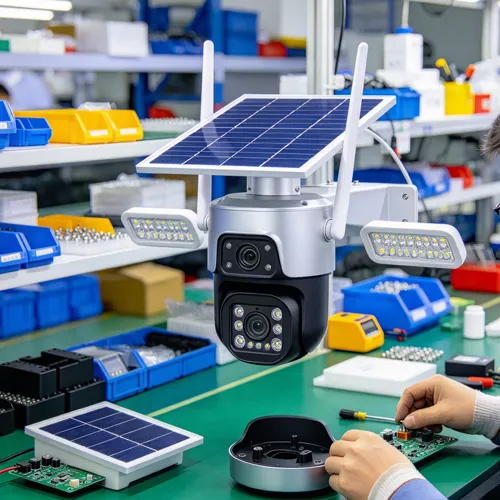
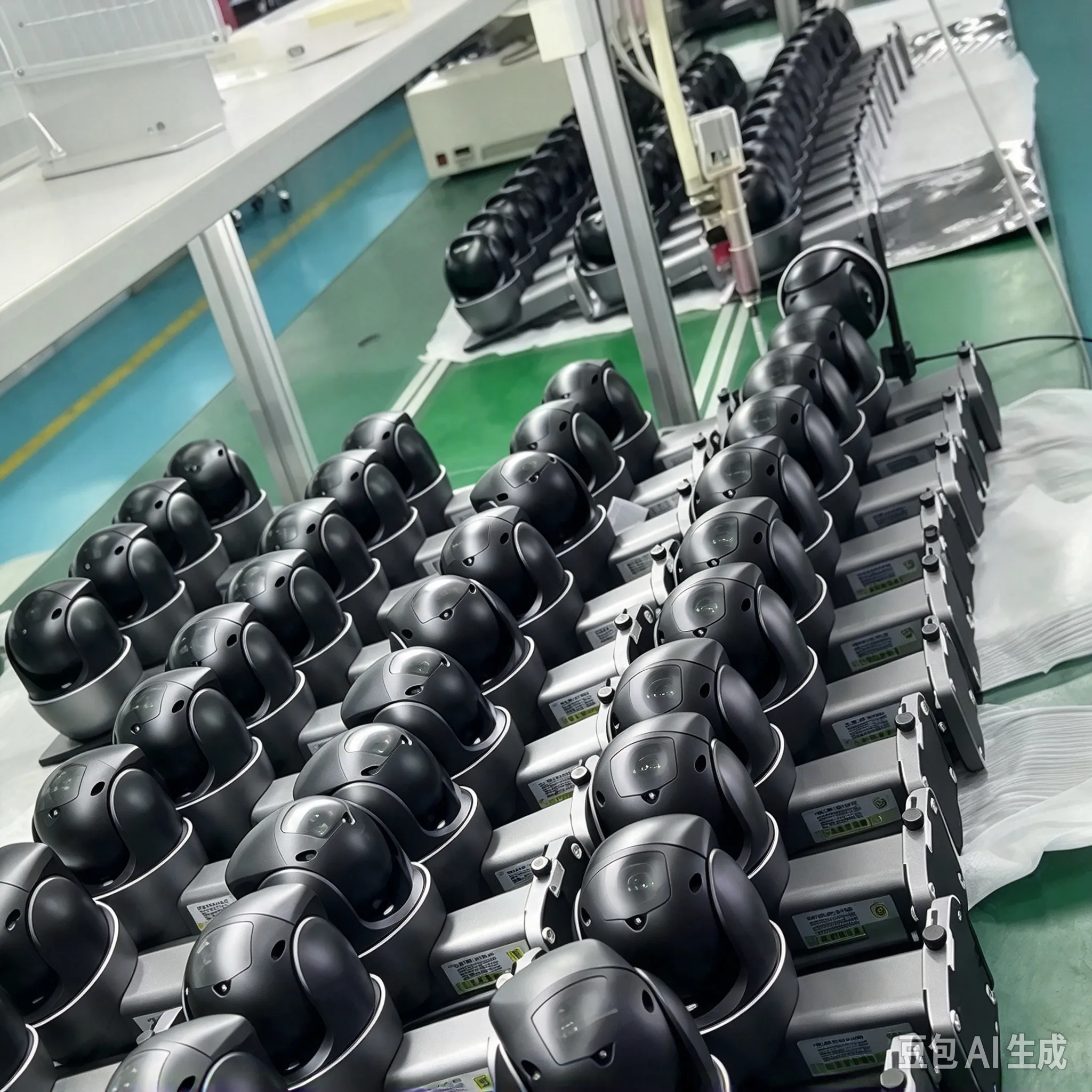
Incoming Component Inspection: Before assembly, the camera modules, PTZ mechanism, selected 4G LTE or WiFi communication board, solar charging components, 20,000mAh battery and order-specific accessories are checked against the confirmed Y5 configuration. This helps prevent network-version, battery or accessory mismatches within the same shipment.
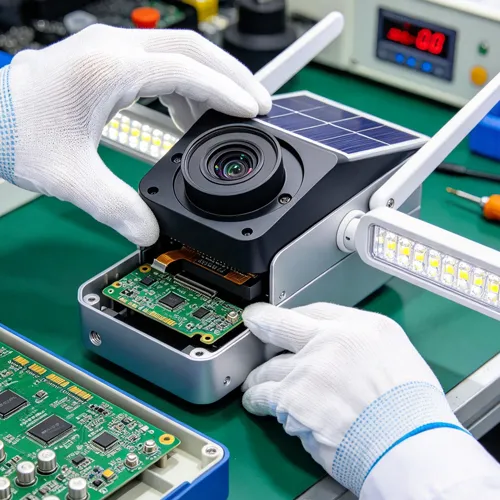
Component Matching & Assembly: The components are matched to the selected Y5 model and assembled as one complete camera system. The dual-lens unit, PTZ structure, power system, mounting parts and related cables are fitted according to the confirmed order configuration.
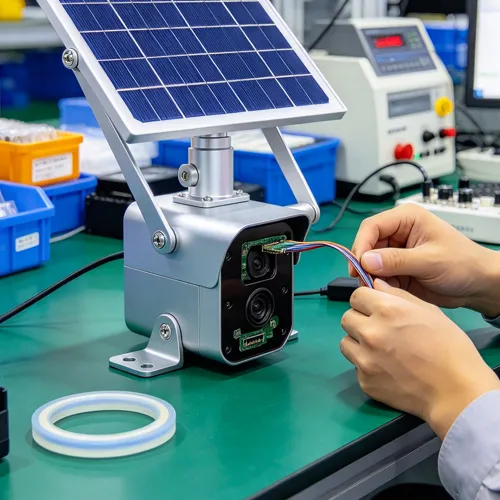
System Integration: Technicians connect the camera, PTZ mechanism, communication board and solar charging system while routing the internal wiring in an organized way. Weather-resistant connectors are fitted where required, and cable routing is checked before the housing is closed to support outdoor installation.
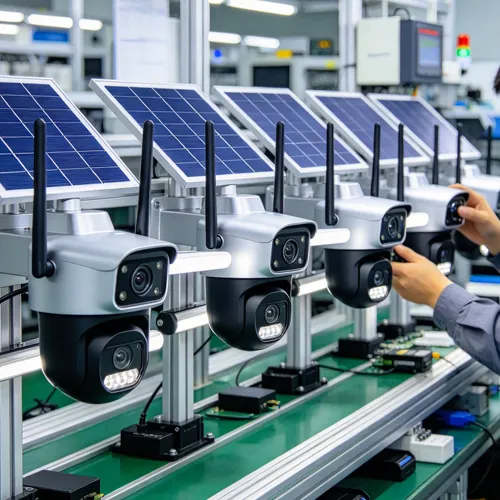
Function & Communication Check: Each completed unit is checked according to its ordered configuration, including:
- PTZ pan and tilt response
- Image output from both 4MP sensors
- Local microSD/TF card recording
- Solar charging response
- 4G LTE or WiFi connection function
- Basic remote viewing and communication functions
For 4G models, actual remote performance still depends on the local SIM card, data plan, compatible network bands and signal at the installation site. WiFi models require a stable 2.4GHz signal at the camera position, so an on-site network check is recommended before installation.
Final Review: Before packing, the camera version, battery, solar panel, antennas, mounting brackets, cables and other order-specific parts are reviewed against the confirmed order. Product labels and accessory packs are also checked so that 4G and WiFi units can be separated correctly during warehouse handling and installation.


Solar Powered CCTV PTZ Camera 4G WiFi Security System Y5 Series Overview & Details
The Y5 is designed for farms, construction sites, storage yards and other locations where a camera needs to operate away from fixed power and wired internet. Its dual-lens design combines a wide-angle view with a controllable PTZ lens, allowing users to monitor a general area and check specific points when needed.
The camera can pan up to 355° and tilt up to 90°. Optional 4× or 10× optical zoom can be selected according to the distance between the camera and the target area. This is useful for checking gates, access roads, equipment and storage areas. PTZ movement helps users inspect different directions remotely, but it does not mean that every direction is recorded at the same time. The final installation angle and camera-to-target distance still need to be confirmed for each project.
Connectivity depends on what is available at the site. The 4G LTE version uses a SIM card and requires suitable cellular coverage, a compatible network band, an active data plan and the correct APN settings. The WiFi version requires a stable 2.4GHz WiFi signal at the camera’s mounting position. Internet access inside an office or house does not necessarily mean that the signal will reach the camera.
The solar panel charges the built-in 20,000mAh battery for off-grid operation. Local microSD/TF card storage supports up to 256GB, allowing customers to keep recordings locally when they do not want to depend entirely on cloud storage. For solar-only installations, motion-triggered or adaptive recording normally uses less energy than continuous live viewing or full-time recording.
Smart human and vehicle recognition can help reduce unnecessary alerts caused by branches, rain, insects or changing light. It should be treated as an alert-filtering function rather than a guarantee that every environmental trigger will be removed. Detection performance also depends on the camera angle, target distance, lighting and selected sensitivity.
Site selection checklist:
| Project requirement | Recommended Y5 configuration |
|---|---|
| Wide-area monitoring with close-up inspection | Dual-lens camera with PTZ and suitable 4× or 10× optical zoom |
| No wired broadband at the site | 4G LTE version with compatible SIM card and data plan |
| Stable local internet is available | WiFi version with a stable 2.4GHz signal at the camera |
| Record without relying on cloud storage | Local microSD/TF card, up to 256GB |
| Solar-only operation | Motion-triggered or adaptive recording with good solar exposure |
| Monitoring gates, roads or equipment | Confirm camera height, viewing distance and target direction before installation |
Before placing an order, the project team should confirm:
- The distance from the camera to the gate, road, equipment or other target
- Whether 4G coverage and supported LTE bands are available at the exact site
- Whether the WiFi signal can reach the final camera position
- The required recording mode and expected storage period
- Available sunlight, possible shade and the seasonal weather conditions
- The mounting surface, panel direction and access for future inspection or cleaning


Solar Powered CCTV PTZ Camera 4G WiFi Security System Y5 Series Packaging & Delivery
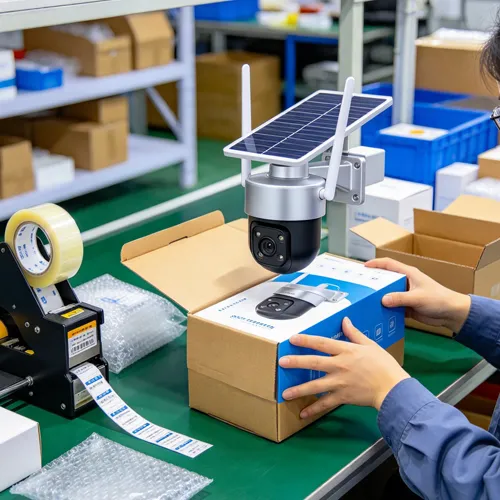
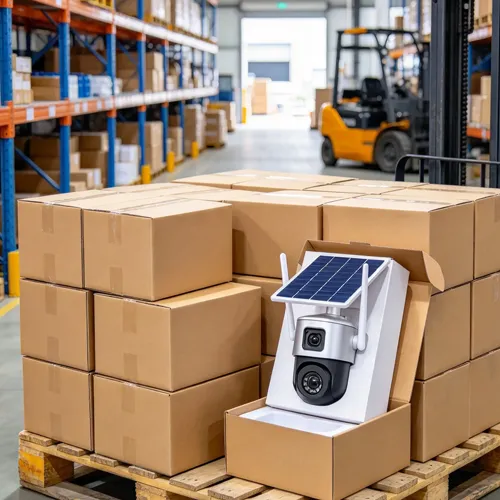
When a Y5 camera is shipped to a farm, construction site or remote project, the lens and PTZ mechanism need extra protection during handling. Each camera, solar panel and mounting bracket is wrapped with protective foam and packed in a reinforced export carton. Additional padding is placed around the lenses, PTZ mechanism and panel edges to reduce the risk of scratches or impact damage.
Each shipment is packed according to the ordered network and accessory configuration. Cartons are marked with the relevant details, including 4G LTE or WiFi. Antennas, brackets and cables specified for the order are grouped in the accessory pack, making it easier for installers to identify the right parts after delivery.
Typical lead time before dispatch:
| Order type | Typical lead time |
|---|---|
| Sample order | 2–3 days |
| Standard bulk order | 10–15 days |
| Custom project order | 20–25 days |
The final schedule depends on order quantity, network version, accessory configuration and customization requirements. We confirm the production and dispatch plan before the order is arranged.
For orders containing both 4G and WiFi models, each version is separated and labeled by batch. This helps distributors organize warehouse stock and allows project teams to distribute the correct units by site or installation phase.
For distributor and project orders, Sungreat Energy can prepare packing lists, product tags and loading plans according to the shipment arrangement. These documents help customers check the goods more efficiently during receiving and on-site distribution.


FAQ of Solar Powered CCTV PTZ Camera 4G WiFi Security System Y5 Series
Yes, provided the camera location has usable 4G coverage. Choose the 4G LTE version and insert a compatible local SIM card with an active data plan. You can then use the mobile app to view live video, review recorded events, receive motion alerts and control the PTZ lens remotely.
The important point is the signal where the camera will be installed, not the signal inside your home, office or main building. Live viewing, remote playback and app notifications use mobile data, so the required data plan depends on how frequently the camera is accessed.
Before ordering, confirm the installation country, local mobile operator and required LTE frequency bands. The SIM card and mobile data plan are not included. If there is no usable 4G or WiFi signal at the site, the camera may still record locally, but remote viewing and instant notifications will not be available until the network connection returns.
The Y5 can save video to a local TF or microSD card, so a monthly cloud plan is not required for local recording and playback. The current Technical Specifications list support for up to 256GB. When the card is full, the oldest footage is automatically overwritten by new recordings. Cloud storage remains optional for customers who need off-site video backup.
The recording mode affects battery consumption:
| Recording mode | How it works | Practical use |
|---|---|---|
| Normal low-power mode | The camera stays on standby and records for about 15 seconds when motion is detected, continuing while the person remains in the monitored area | Suitable for solar-only sites with occasional activity |
| Adaptive mode | The camera can record continuously while the battery level is above 50%, then switches to motion-triggered recording as the battery falls | Useful when recording needs change during the day |
| Full-time mode | Continuous recording is available, but a continuous charging source is recommended for long-term use | Better for sites with stable external charging |
According to the current user guide, a fully charged 20,000mAh battery can provide approximately 36 hours of full-time recording without solar or external charging. Frequent detections, long live-view sessions, repeated PTZ movement and weak 4G signal can increase energy consumption, so normal or adaptive mode is generally more practical for solar-only installations.
The Y5 uses 2T AI computing to support human and vehicle recognition. When motion recording is enabled, it can help identify supported people and vehicles and make event notifications more relevant.
This function can reduce unnecessary alerts, but it cannot eliminate every false trigger. Outdoor detection is still affected by the installation position, target distance, movement direction, lighting and recording mode.
| Site event | Possible result |
|---|---|
| A person enters the monitored area | A human event may be recognised and recorded |
| A vehicle approaches a gate or parking area | A vehicle event may be recognised and recorded |
| Moving branches, rain or changing shadows | AI recognition may reduce alerts, but some false triggers may still occur |
| Insects or spider webs close to the lens | Unnecessary detection may still occur |
| Poor camera angle or a distant moving target | Detection accuracy may decrease |
For a new project, aim the camera at the gate, entrance, road or equipment area that needs protection. Avoid constant movement from trees or direct vehicle headlights, then test the camera by walking and driving through the monitored area during both daytime and nighttime.
The Y5 combines dual 4MP sensors with infrared night monitoring from approximately 5m to 40m. The wide-angle lens gives an overall view of the site, while the PTZ lens can use optional 4× or 10× optical zoom to inspect a gate, road, vehicle or other important area more closely. A white-light colour mode can also be enabled when colour detail is preferred.
The 5–40m figure describes the visible night-monitoring range. It is not a guaranteed distance for identifying every face, item of clothing or license plate. Actual detail depends on the target distance, camera angle, movement speed, available light and selected lens.
For better results:
- Use the wide-angle lens for general coverage of a farm, yard or warehouse
- Aim the PTZ lens toward the entrance, road or equipment area requiring closer observation
- Avoid mounting the camera too high or pointing it directly downward
- Test a person walking and a vehicle approaching at the actual working distance
- For evidence-grade license-plate capture, use a controlled vehicle angle and speed; a dedicated license-plate camera may be more appropriate
There is no fixed number of days that applies to every installation. Under good sunlight and with normal motion-triggered or adaptive recording, the solar panel can usually replenish the energy used by the Y5 and greatly reduce the need for manual charging.
The result changes with the way the camera is used:
| Operating condition | Expected battery situation |
|---|---|
| Good sunlight with normal event recording | Solar charging can usually replace the energy used by motion detection, short recordings, alerts and occasional live viewing |
| Several cloudy or rainy days | The camera can continue using stored battery energy, but the battery percentage may gradually decrease |
| Continuous recording or frequent activity | Daily consumption may exceed the energy collected by the solar panel |
| Long live viewing, repeated PTZ movement or weak 4G signal | Power consumption can increase and manual charging may become necessary |
For better performance, place the panel in direct sunlight and keep it clear of shade, dust, leaves and bird droppings. Fully charge the battery before installation and check the battery level at approximately the same time during the first 3–7 days. If the level continues to fall, adjust the panel position or change from full-time recording to adaptive or motion-triggered recording. A 5V/2A charging option is available when temporary external charging is required.
Choose the network version according to the signal available at the exact camera position, not simply according to whether the property has internet access.
| Installation condition | Recommended version | What should be confirmed |
|---|---|---|
| Farm, construction site, mine or remote road without a nearby router | 4G LTE | Local 4G coverage, compatible SIM card, data plan and LTE bands |
| House, warehouse or yard with stable wireless coverage | WiFi | Reliable 2.4GHz WiFi signal where the camera will be mounted |
| Large property where WiFi only reaches the main building | 4G LTE or additional WiFi access points | Test the signal at every planned camera location |
| Temporary project requiring fast deployment | 4G LTE | Mobile coverage is available and the local data plan is suitable |
| Site with weak cellular and weak WiFi signals | Improve network coverage first | Remote viewing and instant alerts may be unreliable |
The 4G version is normally more practical when there is mobile coverage but no fixed broadband or local router. The WiFi version can be a better choice where a stable local network already reaches the camera and the customer wants to avoid ongoing SIM data charges. A 5GHz-only network should not be assumed to connect directly because the current page specifies 2.4GHz WiFi.
Solar Powered CCTV PTZ Camera 4G WiFi Security System Y5 Series Specification
Related Products

Related News
Key Takeaways: Solar-powered CCTV street lights provide 24/7 off-grid illumination and security monitoring across urban and rural Nigeria. Combining high-efficiency […]
Sungreat Energy recently completed a landmark security infrastructure project in Nigeria, deploying 500 integrated solar-powered CCTV units. This project addresses […]
In recent years, the demand for integrated solar street light with camera solutions across Nigeria has surged. ☀️ Driven by […]