




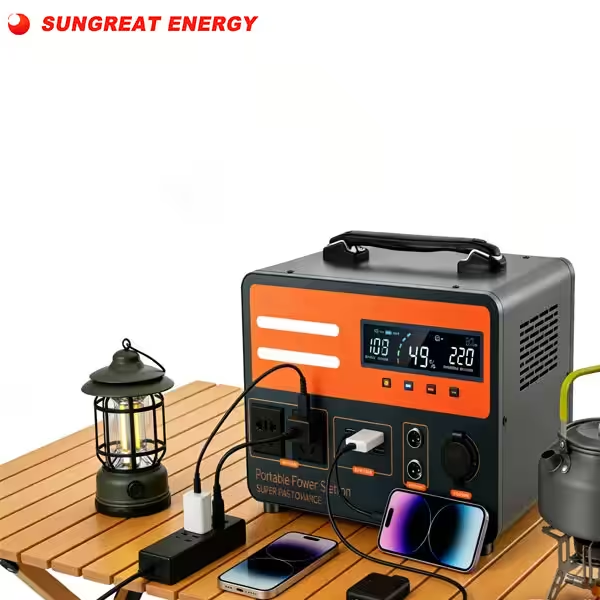

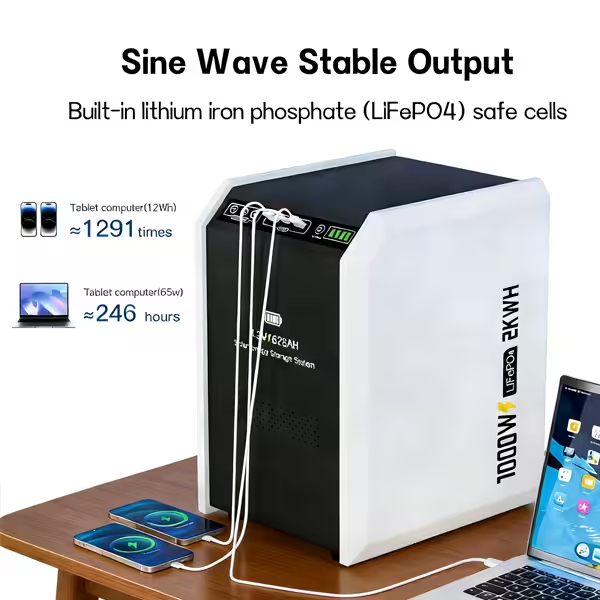
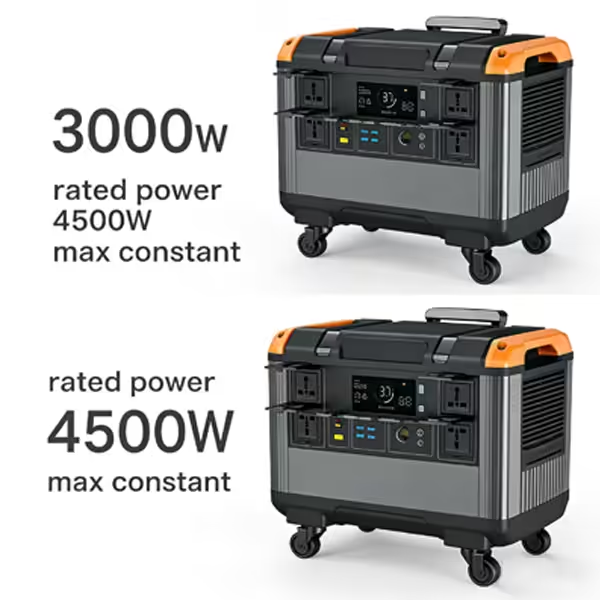

LiFePO4 Portable Solar Power Station DL Series 300W–3000W
LiFePO4 portable power station platform for EPC projects and distributors, with selectable AC output, battery capacity and solar charging options.
- G500–G2000 models provide 500W–2000W rated AC output
- 1000W–4000W peak output for startup demand, subject to device requirements
- 461.7Wh–1920Wh LiFePO4 capacity supports different backup needs
- 100W–300W maximum MPPT solar input within a 12V–28V range
- Pure sine wave AC output with model-dependent DC, USB, Type-C and 12V ports
Portable Power Station for Backup and Off-Grid Use
The DL Series is a LiFePO₄ portable power station platform for household backup, power outages, camping, RV travel, outdoor work, and temporary off-grid use. The current range includes the G500, G600, G1200, G1500, and G2000, with battery capacities from 461.7Wh to 1920Wh, rated AC output from 500W to 2000W, and peak power up to 4000W.
Model selection depends on the running wattage of connected devices, startup power requirements, desired backup time, and portability. Pure sine wave AC output supports compatible electronics and appliances, while AC, DC, USB, Type-C, and 12V interfaces vary by model.
Solar recharging uses a 12V–28V input range, with maximum solar input from 100W to 300W depending on the model. A compatible foldable solar panel can be used for camping, remote work, or extended outages. Confirm the panel’s electrical limits, connector, polarity, and the required 110V/60Hz or 220V/50Hz version before ordering.
LiFePO4 Portable Solar Power Station DL Series 300W–3000W Technical Specifications & Datasheet
| Model | DL | ||||
| Type | G500 | G600 | G1200 | G1500 | G2000 |
| Material | Fireproof PC/V0 | Fireproof PC/V0 | Fireproof PC/V0 | Stell | Steel |
| Dimensions (L×W×H) | 230*160*180mm | 290*200*230mm | 290*200*230mm | 375*250*284 mm | 420*230*230mm |
| Package(L×W×H) | 270*185*245mm | 345*255*350 mm | 345*255*350 mm | ||
| Package | neutral packaging or customized | ||||
| Net Weight | 5KG | 6.4KG | 9.7KG | ||
| packaging including accessories | 5.5KG | 7.7KG | 11.2KG | ||
| LiFePO₄ Battery | 18650/2600mah, 6 series 8 parallel | 32140/15000mah, 7 series 2 parallel | 32140/15000mah, 7 series 3 parallel | 12.8V 100Ah | 12.8V 150Ah |
| Battery capacity | 461.7WH /20.8AH/124800MAH | 672WH /30AH/210000MAH | 1008WH /45AH/315000MAH | 1280Wh | 1920Wh |
| Output | USB, 2*5V3A/9V2A/12V1.5A | USB, 2*5V2A | USB, 2*5V2A | ||
| Output | TYPE-C1,5V3A/9V2A/12V1.5A | ||||
| Input/Output | TYPE-C2,5V3A/9V3A/12V3A/15V3A/20V3A (65W max) | TYPE-C2,5V3A/9V3A/12V3A/15V3A/20V3A (100W max) | TYPE-C2,5V3A/9V3A/12V3A/15V3A/20V3A (100W max) | ||
| Output | DC-5521, 2*12V/10A/120W (max) | DC-5521, 2*12V/5A/60W (max) | DC-5521, 2*12V/5A/60W (max) | DC-5521, 2*12V/10A/120W (max) | DC-5521, 2*12V/10A/120W (max) |
| Output | Car charger, 12V/10A/120W (max) | ||||
| LED | 1W-3W | 1W-2W-5W | 1W-2W-5W | 1W-3W | 1W-3W |
| Input | DC-5521, 100W (adapter) | DC-7909, 180W (max adapter) | DC-7909, 180W (max adapter) | DC-5521, 120W (adapter) | XT60, 360W (adapter) |
| Input | DC-5521, 100W (12V-28V solar) | Anderson, 180W (12V-28V solar) | Anderson, 180W (12V-28V solar) | DC-5521, 300W (12V-28V solar) | XT60, 300W (12V-28V solar) |
| AC output | 500W*1 | 600W*2 | 1200W*2 | 1500W*2 | 2000W*2 |
| AC voltage/frequency | 110V/60Hz or 220V/50Hz (select one) | ||||
| Output power | 500W, overload power 650W, peak power 1000W | 600W, Overload power 680W, Peak power 1200W | 1200W, Overload power 1300W, Peak power 2400W | 1500W, Overload power 1700W, Peak power 3000W | 2000W, Overload power 2200W, Peak power 4000W |
Get Your DL Series Project Quote
G500–G2000 | 500W–2000W AC Output | 461.7Wh–1920Wh | 100W–300W Solar Input
LiFePO4 Portable Solar Power Station DL Series Product Video
LiFePO4 Portable Solar Power Station DL Series 300W–3000W Project & Application Cases
Publicly available information currently supports the following as representative application scenarios and potential market references, not as confirmed completed DL Series installations.
The DL Series includes the G500, G600, G1200, G1500 and G2000 models, covering 461.7Wh–1920Wh battery capacity, 500W–2000W rated AC output and 1000W–4000W peak power. These figures provide a first screening point for household backup, small-business loads, field work and temporary off-grid use. Final selection should also consider running wattage, startup surge, required backup time, solar input and portability.
For potential markets in Kenya, Tanzania, Uganda, Nigeria and Ghana, a 220V/50Hz configuration may be considered where local electrical requirements match. Representative uses include household backup, small-business equipment, communications devices, lighting and field operations within the selected model’s limits. Confirm the local voltage and frequency, load list, startup demand, placement conditions and target backup time before ordering.
In potential markets such as Kuwait, the UAE, Iraq, Vietnam, Thailand and Indonesia, the DL Series may be considered for emergency backup, mobile work, camping and temporary off-grid setups. The selected model provides 100W–300W maximum solar input within a 12V–28V solar input range, depending on model. Solar-panel voltage, connector, polarity and charging conditions should be checked against the selected station.
Pure sine wave AC output and model-dependent AC, DC, USB, Type-C and 12V interfaces can support compatible electronics and appliances. Peak power up to 4000W is intended for short startup demand, not continuous operation. For fixed residential, commercial or EPC projects that need a larger PV array, inverter and battery package, review the SY Series 1–50kW complete hybrid solar power system. It is a separate project-matched system rather than a direct accessory for the DL Series. Project or bulk orders should confirm the model, AC version, load profile, startup surge, required runtime, solar configuration and included accessories. No country or application listed above should be read as a confirmed DL Series installation without project records.


LiFePO4 Portable Solar Power Station DL Series 300W–3000W Production Process
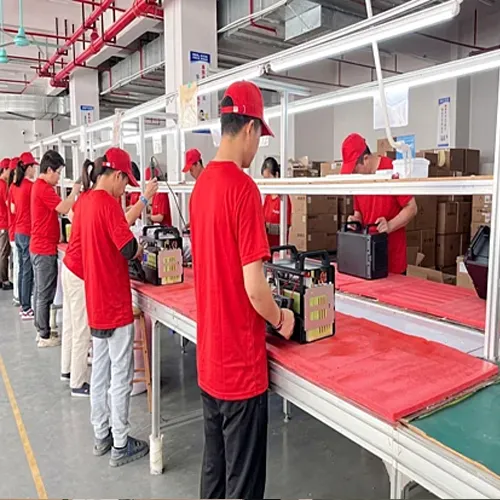
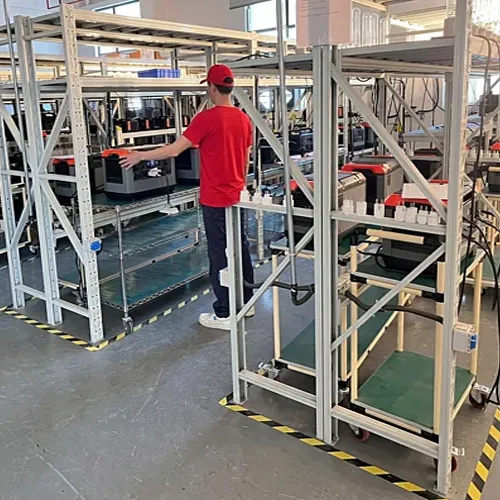
Production begins with order and model configuration. The selected G500, G600, G1200, G1500 or G2000 is matched with the required battery capacity, rated AC output, peak power, solar input and AC voltage/frequency version. The range covers 461.7Wh–1920Wh battery capacity, 500W–2000W rated AC output, 1000W–4000W peak power and 100W–300W MPPT solar input. Available versions are 110V/60Hz and 220V/50Hz. This step helps reduce the risk of model, regional version or accessory mismatches.
Assembly integrates the LiFePO₄ battery pack, pure sine wave inverter, MPPT charging section and the applicable AC, DC, USB, Type-C and 12V interfaces. The connection layout follows the selected model. G500, G600 and G1200 use PC/V0 housings, while G1500 and G2000 use steel enclosures. Port availability, connector type and output limits vary by model and are checked against the approved configuration.
Functional inspection covers the charging and discharging functions, inverter output, solar charging input and the relevant output interfaces listed for the ordered model. The 110V/60Hz or 220V/50Hz version is checked against the order configuration, together with the specified input and output limits. The purpose is to identify abnormal charging, output behavior or configuration mismatches before shipment. Detailed test methods and acceptance limits should follow the approved technical records for the order.
Before packing, the model label, accessories, manuals and main output configuration are compared with the order record. This final review separates series-wide specifications from order-specific requirements, helping distributors, installers and project buyers receive the requested DL Series setup.


LiFePO4 Portable Solar Power Station DL Series 300W–3000W Overview & Details
The DL Series is organized around two practical questions: how much power the connected load needs at one time, and how much stored energy is required during the planned backup period. The current range includes G500, G600, G1200, G1500 and G2000, with 461.7Wh–1920Wh battery capacity, 500W–2000W rated AC output and 1000W–4000W peak power. Rated output determines whether the inverter can run the load, while battery capacity affects the available runtime.
Motors, compressors and other inductive devices may require additional startup power. For model selection, compare the running wattage, startup surge, expected operating hours and available charging method. Smaller models suit lighter loads and shorter backup periods, while higher-output models provide more capacity for demanding equipment. Actual runtime also depends on conversion losses, standby consumption, temperature and the operating cycle of connected devices.
Before use, confirm the model label, AC version and input/output limits. The DL Series is available in 110V/60Hz and 220V/50Hz versions. Solar charging uses a 12V–28V input range, with maximum solar input from 100W to 300W depending on the model. For portable recharging, compare the selected station with the FP Model portable ETFE foldable solar panel. Confirm the panel’s Voc, Vmp, connector and polarity against the selected station before ordering, and use the specified adapter or cable for other charging methods.
Place the unit on a dry, stable and ventilated surface with air inlets and output connections clear. Start with the essential load connected, then check the display, charging status and output behavior before adding more devices. Peak power is intended for short startup demand, not continuous operation. The combined load must remain within the model’s rated output and individual port limits.
For routine care, keep the enclosure and ports dry and free from blockage. Inspect the cables, connectors and housing before deployment, especially after transport or outdoor use. Stop operation if the unit shows damage, swelling, abnormal heat, unusual odor or irregular output, and follow the product manual for charging, storage and service handling.


LiFePO4 Portable Solar Power Station DL Series 300W–3000W Packaging & Delivery
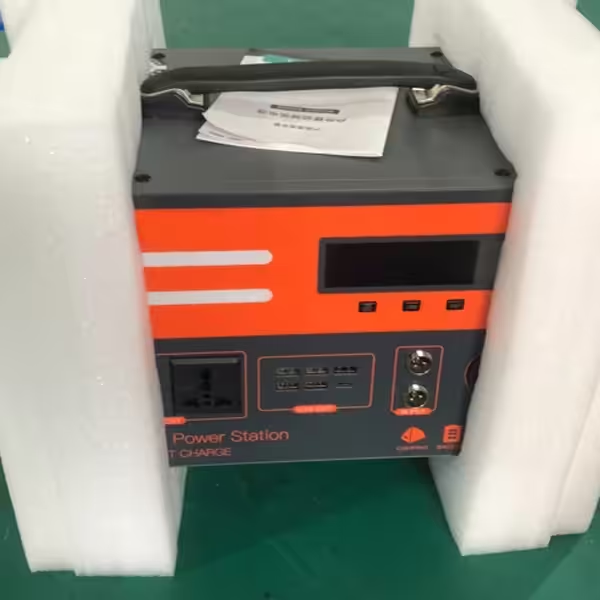
Packaging starts after the selected DL model and order configuration are confirmed. Protective materials and reinforced outer cartons are used to limit movement and impact during storage and transport, with attention to the battery enclosure, inverter and output interfaces.
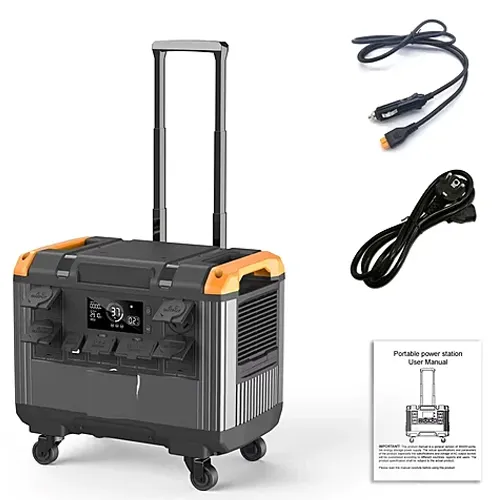
Charging accessories and product manuals are packed with the ordered configuration. Standard orders use neutral packaging, while customized packaging can be arranged according to order requirements. For bulk and export orders, the selected G500–G2000 model, 110V/60Hz or 220V/50Hz version and included accessories are checked against the order record before sealing.
A final functional inspection is completed before packing and shipment, covering the relevant charging and output functions for the selected model. Model labels, accessories, manuals and package condition are reviewed before dispatch. Shipment timing and loading details depend on the confirmed model mix, packaging requirements, destination and shipping arrangement.


FAQ of LiFePO4 Portable Solar Power Station DL Series 300W–3000W
Start with four points: running power, startup surge, required backup time and local AC voltage/frequency.
The DL Series includes the G500, G600, G1200, G1500 and G2000 models, covering 461.7Wh–1920Wh battery capacity, 500W–2000W rated AC output and 1000W–4000W peak power.
G500 and G600 suit lighter loads and shorter backup periods. G1200 provides a mid-range balance of output and capacity. G1500 and G2000 provide more output and stored energy for higher loads or longer backup periods.
Peak power is intended for short startup demand, not continuous operation. For project orders, confirm the target country, 110V/60Hz or 220V/50Hz version, load list, startup demand, backup time, solar configuration and included accessories.
If the required load or backup period exceeds the portable DL range, compare it with the SIB Series all-in-one solar inverter battery system. It provides 1–5kW inverter options and 2.56–15.36kWh storage for indoor backup, but it is a separate system rather than an expansion battery for the DL unit.
Use this theoretical estimate first:
Theoretical runtime ≈ battery capacity (Wh) ÷ continuous load (W)
At a constant 100W load, the estimated runtime before conversion losses and standby consumption is:
G500: about 4.6 hours
G600: about 6.7 hours
G1200: about 10.1 hours
G1500: about 12.8 hours
G2000: about 19.2 hours
Actual runtime is usually lower and depends on connected load, inverter losses, standby consumption, temperature and operating conditions. Refrigerators, freezers, fans and other motor-driven devices also cycle on and off, so daily energy consumption is more useful than nameplate wattage alone.
The DL Series uses LiFePO₄ battery technology, but the current DL information does not provide one verified cycle-life figure or fixed service-life period for all five models.
A fair comparison with lead-acid batteries requires the same depth of discharge, charging method, temperature, load and end-of-life definition. Avoid publishing a fixed claim such as 10,000+ cycles, 20 years or a specific lead-acid multiplier unless the approved datasheet for the selected model confirms it.
For longer service, use the specified charger and input range, keep the unit away from excessive heat and moisture, and follow the product manual for storage and maintenance.
It may, but the appliance data must be checked before model selection.
Confirm these four points:
- Running wattage stays within the selected model’s rated AC output
- Startup demand stays within the model’s short-term peak limit
- Appliance voltage and frequency match the power station version
- Other connected loads are included in the total calculation
The DL Series provides 500W–2000W rated AC output and 1000W–4000W peak power, depending on model. Compressors and motors may require much more power when starting, so a refrigerator, freezer or power tool cannot be approved by running wattage alone.
A third-party panel can be considered after its electrical specifications are matched with the selected station.
Check the panel’s Voc, Vmp, operating current, connector and polarity against the station’s 12V–28V solar input range and model-specific maximum input. Maximum solar input varies from 100W to 300W. Connector types also vary by model, including DC-5521, Anderson and XT60 configurations.
Theoretical solar charging time can be estimated as:
Battery capacity (Wh) ÷ actual solar input (W)
For example, under ideal maximum-input conditions, the calculation is approximately 4.6 hours for G500 at 100W and 6.4 hours for G2000 at 300W. Actual charging takes longer because of sunlight intensity, panel angle, temperature, conversion losses and charging control.
Indoor charging can be considered only in a dry, stable and ventilated location. Keep the unit away from water, heat sources and flammable materials, and leave air inlets and output connections clear. Use the specified charger and input range.
Do not charge or operate a unit that is wet, swollen, damaged or unusually hot. Stop use if there is abnormal odor, noise, smoke or temperature.
There is no fixed device count for the complete series. AC, DC, USB, Type-C and 12V outputs, port availability and port limits vary by model. Check the combined load and the limit of every selected port. Some configurations provide Type-C output up to 65W or 100W, while DC output limits may be 60W or 120W depending on model.
Related Products


Related News
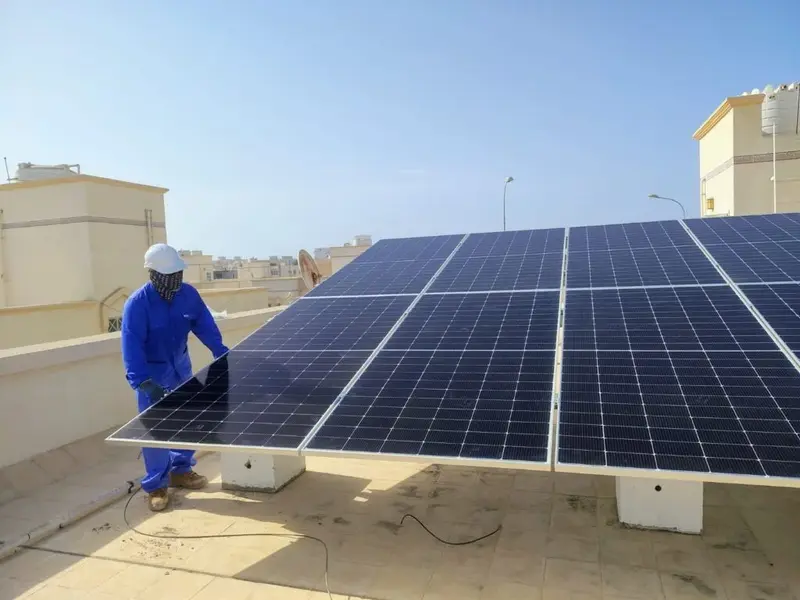
Engineering resilient solar-storage infrastructure to eliminate grid volatility and power remote industrial-rural corridors in the Sultanate of Oman. 1. Project […]
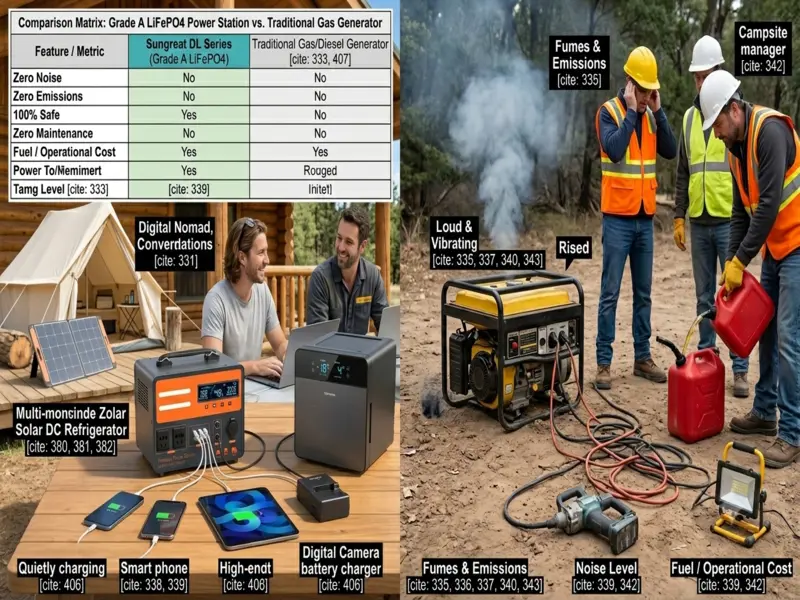
Before portable power stations, the usual solution was simple: grab the gas generators carry it out, pull the cord a few […]
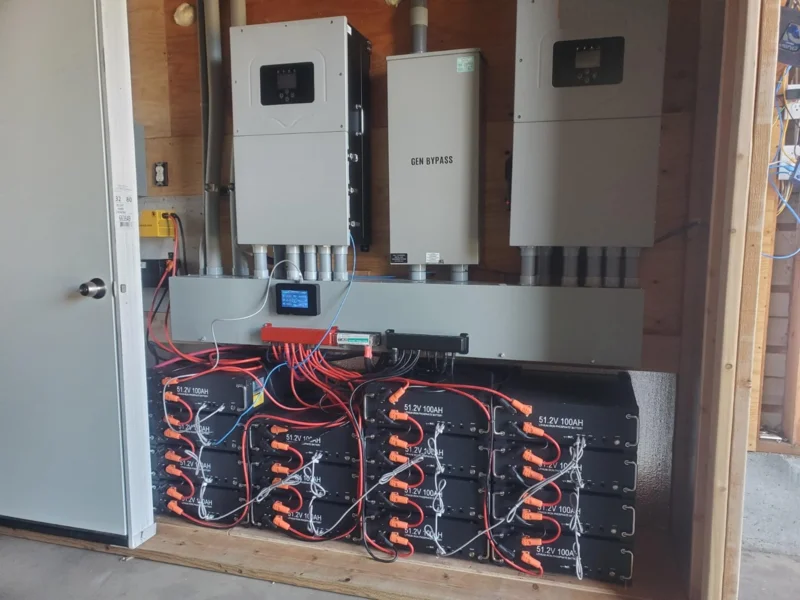
Multi-Site Decentralized Infrastructure & Grid Resiliency Network Client Location: Philippines (Multi-Site Decentralized Setup) Technology Partner: Sungreat Energy Sole Distributor & […]