




Meta Description: Discover how a hybrid solar air conditioner works to slash daytime cooling costs by up to 100%. Explore ACDC hybrid types, LiFePO4 battery integration, sizing guides, and technical FAQs from Sungreat Energy.
1. Why Pay for Cooling ?
Are rising electricity costs making you hesitate every time you turn on your air conditioner? In regions with high electricity tariffs and hot climates, space cooling can account for 40% to over 60% of total monthly energy bills.
As electricity prices continue to rise, homeowners, MEP contractors, distributors, and commercial project developers are actively searching for smarter, more sustainable cooling solutions.
Enter the AC/DC Hybrid Solar Air Conditioner.
Unlike standard cooling systems, a hybrid solar AC seamlessly integrates direct solar PV power, battery storage, and utility grid electricity into a single intelligent system. This makes it significantly more cost-effective than a traditional air conditioner and far more reliable than a single-source solar setup.
Whether you are looking to lower operational expenses for a commercial building or secure 24/7 power independence for an off-grid home, the Sungreat SA Series Hybrid Solar AC delivers high-efficiency cooling without compromise.

2. Hybrid Solar Air Conditioner ?
A Hybrid Solar Air Conditioner is a multi-source climate control system engineered to run on more than one power input simultaneously.
Depending on real-time operating conditions, the system dynamically prioritizes:
- Direct Solar PV Input (DC): Free energy generated by rooftop solar panels during daylight hours.
- Battery Energy Storage System (DC): Stored power for nighttime operation or grid outages.
- Utility Grid Power (AC): Automatic backup power when solar or battery levels are low.
The Sungreat Advantage: Built-In Hybrid Control
Traditional solar setups require costly, high-capacity off-grid inverters that suffer energy conversion losses (DC➡AC➡DC).
The Sungreat SA Series features direct AC/DC hybrid technology without an external inverter. Solar panel DC power plugs directly into the outdoor unit’s internal controller, maximizing system efficiency, simplifying installation, and lowering upfront equipment costs.
3. Types of Solar Air Conditioners
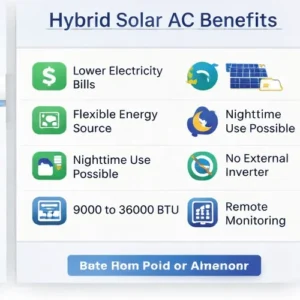
When evaluating solar-powered cooling, buyers typically compare three primary configurations. Understanding these differences ensures you select the optimal solution for your project requirements.
| Feature / Criteria | 1. On-Grid Solar AC | 2. Off-Grid Solar AC | 3. AC/DC Hybrid Solar AC (Sungreat SA Series) |
| Primary Power Input | Solar PV + Utility Grid | Pure Solar PV + Battery Storage | Solar PV + Battery + Utility Grid |
| Grid Power Dependency | Required as primary backup | 0% (Fully Independent) | Optional (Plug-and-play grid backup) |
| Battery Bank Required? | No | Yes (Mandatory for night/clouds) | Optional (Flexible configuration) |
| External Inverter Needed? | Yes (Standard Solar Inverter) | No | No (Integrated internal ACDC drive) |
| Operation During Outages | System shuts down | Full operation | Full operation with battery option |
| Best Suited For | Urban homes with stable grid | Remote farms, cabins, islands | Homes, offices, schools, villas, weak-grid areas |
4. Solar Air Conditioner Working?
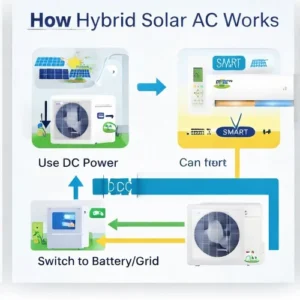
The working principle is easier to understand when broken into steps:
- Solar Energy Capture: High-efficiency photovoltaic (PV) solar panels absorb sunlight and generate Direct Current (DC) electricity.
- Direct DC Utilization: The hybrid controller routes this DC power directly into the DC inverter compressor motor, eliminating conversion losses.
- Intelligent Auto-Balancing: If solar power is not sufficient, the unit can switch to battery storage or grid electricity depending on the configuration.
- Sunny Peak Hours: If cooling requires 2,000W and solar panels generate 2000W , the grid draw is 0W .
- Cloudy Conditions: If solar generation drops to 1400W, the smart internal drive automatically supplements the remaining 600W from the battery storage or AC grid seamlessly.
4. The built-in hybrid control system manages the energy flow automatically for stable cooling and heating.
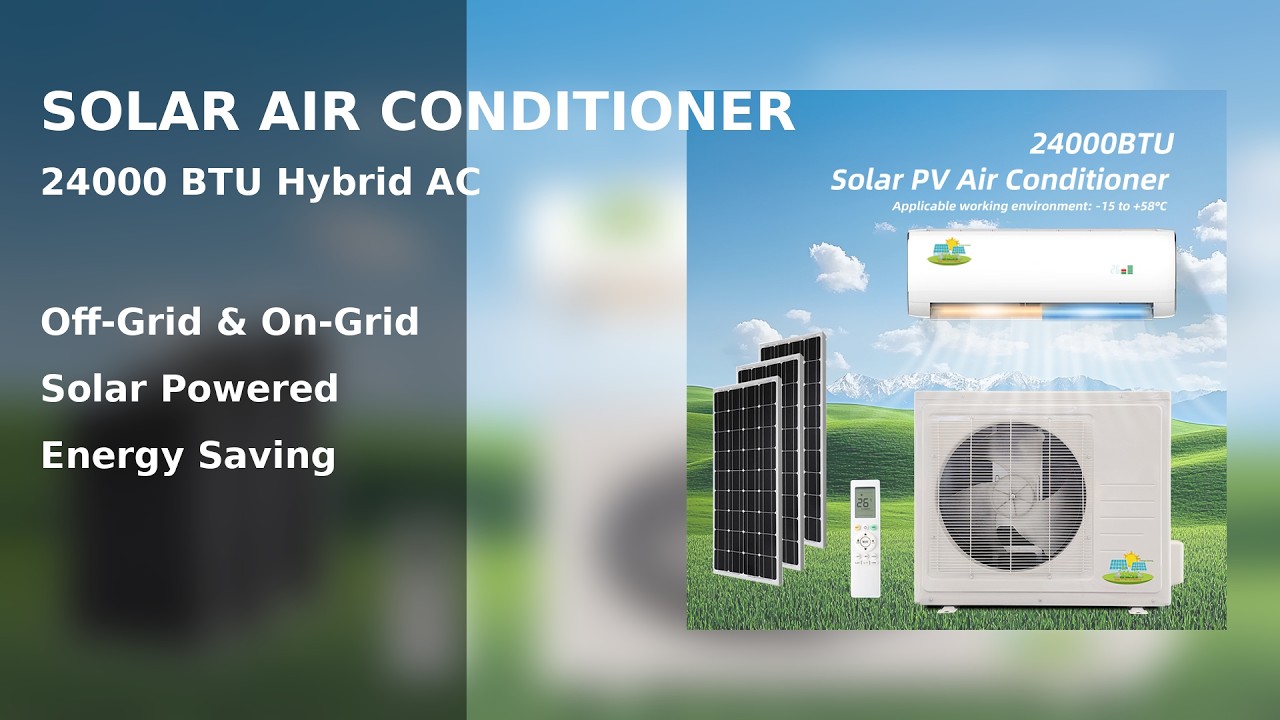
For many buyers, this means the system is easier to install, easier to manage, and more attractive for residential and light commercial projects.
5. Why LiFePO4 Batteries Matter
Can a solar air conditioner work at night? Yes—provided the system is paired with proper energy storage.
While batteries are optional for daytime-only grid-tied operations, adding battery storage unlocks full 24/7 off-grid cooling independence. Sungreat strongly recommends LiFePO4 (Lithium Iron Phosphate) technology over traditional Lead-Acid or Gel batteries.
LiFePO4 vs. Lead-Acid / Gel Batteries
LiFePO4 (Lithium) = 6000+ Cycles (10+ Yrs)
Lead-Acid / Gel = 1200-1500 Cycles (2-3 Yrs)
Key Advantages of LiFePO4 Battery Systems:
- High-Temperature Thermal Safety: LiFePO4 chemistry will not experience thermal runaway, making it exceptionally safe for tropical climates and high ambient outdoor temperatures.
- Deeper Depth of Discharge (DoD): Supports up to 80%–90% DoD without accelerating battery degradation.
- Extended Cycle Life: Offers 4,000 to 6,000+ charge cycles (lasting 10+ years), compared to 1,200 cycles for gel batteries.
Sizing Tip: A 10 kWh LiFePO4 lithium battery bank can typically run a 12,000 BTU (1 Ton) Sungreat AC unit continuously for 6 to 8 hours overnight under standard load conditions.
6. Room Sizing by BTU Capacity
Selecting the correct unit capacity prevents short-cycling and guarantees optimal energy performance. Refer to the standard room size recommendations below:
| Capacity | Common Unit Name | Suggested Area |
|---|---|---|
| 9000 BTU | 0.75 Ton / 1 HP | 8–15 m² |
| 12000 BTU | 1 Ton / 1 HP | 12–20 m² |
| 18000 BTU | 1.5 Ton / 2 HP | 18–25 m² |
| 24000 BTU | 2 Ton / 3 HP | 30–40 m² |
| 30000 BTU | 2.5 Ton / 3.5 HP | 35–50 m² |
| 36000 BTU | 3.3 Ton / 4 HP | 35–50 m² |
📌 Engineering Note: For high-occupancy commercial projects (such as schools, churches, clinics, or restaurants) or spaces with high solar heat gain/poor insulation, upsize by one capacity level to maintain peak cooling efficiency.
7. Key Benefits
- Slashing Energy Bills (80%–100% Daytime Savings): Maximizes direct self-consumption of solar energy during peak cooling hours.
- No External Inverter Required: Simplifies installation, eliminates equipment purchasing costs, and removes conversion efficiency bottlenecks.
- Unmatched SEER Performance: Engineered for seasonal efficiency ratios (SEER) up to 6.6, meeting international ultra-low energy standards.
- Weak-Grid & Off-Grid Resilience: Perfect for regions facing load-shedding, power surges, or complete off-grid status.
- Smart Ecosystem Management: Integrated mobile app support for real-time monitoring of solar output, grid consumption, and operating status.
- Ultra-Quiet Operation: Noise-reduction blower and insulated compressor housing keep operating sound below for indoor units.
8. Frequently Asked Questions
Q1: Can a hybrid solar air conditioner work at night?
Yes. The system seamlessly transitions power sources. If you have connected a battery bank, the AC will draw from stored solar power overnight. If connected without batteries, the unit automatically switches to drawing power from the utility grid.
Q2: Does the system require batteries
Not always. Your current product page says batteries are not required for normal operation, because the hybrid unit can run directly on solar power during the day and switch to the grid when needed. However, batteries are recommended if the user wants nighttime operation or backup during outages.
Q3: How many solar panels are required to run a hybrid AC?
Depending on BTU capacity and regional peak sunlight hours (kWh/㎡/day), standard requirements include:
- 9,000 – 12,000 BTU: 3 to 4 High-Efficiency PV Panels.
- 18,000 – 24,000 BTU: 4 to 6 High-Efficiency PV Panels.
- 30,000 – 36,000 BTU: 6 to 8 High-Efficiency PV Panels.
Q4: Where can a hybrid solar air conditioner be used
This type of system is suitable for homes, offices, villas, schools, churches, and many remote or power-unstable areas. Both your uploaded draft and the current product page support these applications.
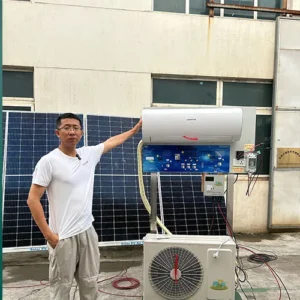
9. Ready to Upgrade ?
A hybrid solar air conditioner is no longer just an eco-friendly option—it is a high-return strategic investment in operational cost reduction and energy resilience. Whether you are equipping a luxury residential villa or specifying HVAC systems for a large commercial project, the Sungreat SA Series provides the performance, longevity, and support you need.
10. Contact Our Engineering Team
Looking for a customized solar cooling quote for your next project?
-
Email: [email protected]
-
WhatsApp/WeChat: +86-15776467829