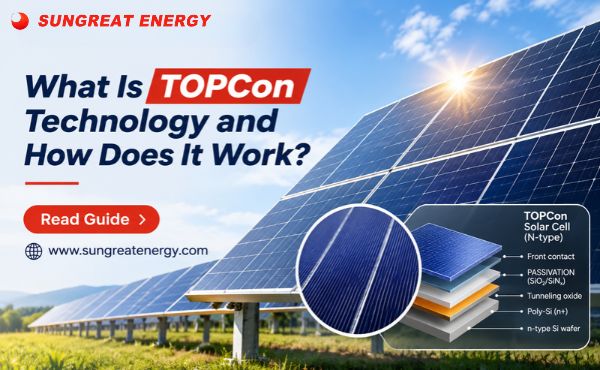





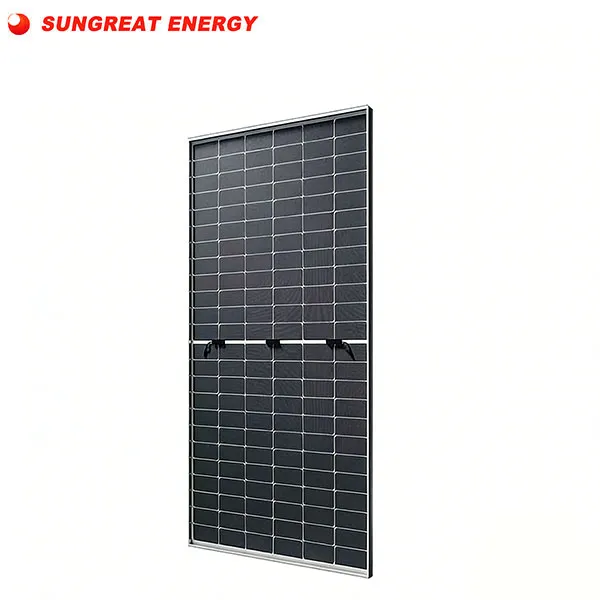

TOPCon stands for Tunnel Oxide Passivated Contact, a high-efficiency crystalline silicon solar cell technology designed to improve carrier passivation and selective charge transport. Most commercial TOPCon cells use n-type crystalline silicon wafers together with a thin silicon oxide layer and doped polysilicon contact.
The core of TOPCon technology is its passivated contact structure. The ultra-thin oxide layer helps control recombination at the silicon surface, while the doped polysilicon layer provides a selective path for charge carriers. This structure supports high open-circuit voltage, strong electrical performance, and high solar cell efficiency.
What Does TOPCon Stand For?
TOPCon stands for Tunnel Oxide Passivated Contact.
Each part of the name describes an important part of the cell structure:
- Tunnel Oxide: An ultra-thin silicon oxide layer separates the silicon wafer from the doped polysilicon.
- Passivated: The oxide helps reduce electrically active defects at the silicon surface and limits carrier recombination.
- Contact: The doped polysilicon forms a selective electrical contact for charge collection.
The tunnel oxide is extremely thin, typically measured on the nanometer scale. Its thickness and interface quality are carefully controlled to provide effective surface passivation while allowing the required charge carriers to pass through the contact structure.
This combination of passivation and selective carrier transport forms the technical foundation of TOPCon solar cells.
How Does TOPCon Technology Work?
A typical n-type TOPCon cell uses an n-type crystalline silicon wafer as the main light-absorbing layer. The rear contact contains a thin silicon oxide layer followed by doped polysilicon.
A simplified structure can be represented as:
N-type silicon wafer → tunnel oxide → doped polysilicon → metal contact
When sunlight reaches the silicon wafer, photons generate electron-hole pairs. The internal electrical structure of the cell separates these charge carriers and directs them toward their respective contacts.
At the TOPCon contact, the tunnel oxide provides surface passivation while allowing majority carriers to cross through the thin layer by quantum tunneling. The doped polysilicon then transports these carriers toward the metal contact.
The two layers perform complementary functions:
Tunnel oxide → surface passivation
Doped polysilicon → selective carrier transport
This contact architecture allows TOPCon cells to combine low recombination with efficient charge collection.
How Does TOPCon Reduce Carrier Recombination?
Carrier recombination affects how much of the sunlight-generated charge can contribute to electrical output. When electrons and holes recombine before reaching the contacts, the available electrical current decreases.
TOPCon addresses this loss at the silicon-contact interface through its passivated contact structure.
The thin silicon oxide reduces the number of electrically active defects at the silicon surface. The doped polysilicon layer provides carrier selectivity and supports charge transport.
For an n-type TOPCon contact, the structure favors electron transport while limiting the movement of holes toward the contact. This selective behavior reduces recombination at the contact region and preserves more photogenerated carriers for electrical generation.
The resulting reduction in recombination supports higher open-circuit voltage and contributes to the high efficiency associated with TOPCon cells.
How Does TOPCon Improve Solar Cell Efficiency?
TOPCon improves efficiency through better control of surface and contact losses.
Higher open-circuit voltage
Lower recombination allows a greater proportion of photogenerated carriers to remain available within the cell. This supports higher open-circuit voltage, which contributes directly to conversion efficiency.
The quality of the tunnel oxide and polysilicon contact therefore plays an important role in achieving high-voltage cell performance.
Improved fill factor
The contact structure also affects the fill factor, which reflects how effectively a solar cell converts its voltage and current into usable power.
A well-engineered TOPCon contact combines strong passivation with low electrical resistance. This supports efficient current collection and a high fill factor.
Lower contact losses
The passivated contact separates the crystalline silicon from the main metal contact structure. This reduces recombination at the contact interface while maintaining an efficient electrical pathway.
The combination of lower recombination, strong voltage, and efficient carrier collection gives TOPCon its high-efficiency potential.
What Are the Main Advantages of TOPCon Solar Cells?
TOPCon technology offers several performance advantages for modern photovoltaic modules.
High conversion efficiency
TOPCon cells can achieve high conversion efficiency through strong surface passivation, selective carrier transport, and reduced contact losses. Research laboratories have demonstrated cell efficiencies above 26%, while commercial module efficiency varies according to the cell architecture, manufacturing process, and module design.
Strong bifacial performance
TOPCon technology is widely used in bifacial solar modules. Bifacial modules can generate additional electricity from light reaching the rear surface.
The actual bifacial energy gain depends on installation conditions, including ground reflectivity, mounting height, row spacing, and rear-side irradiance.
Favorable temperature performance
Solar cell power output changes with operating temperature. TOPCon cell designs generally offer favorable temperature coefficients, helping maintain power production as module temperature increases.
The exact temperature coefficient should always be checked on the manufacturer’s product datasheet.
N-type silicon architecture
Most commercial TOPCon cells use n-type silicon. This architecture provides a strong foundation for high-efficiency cell designs and helps reduce certain degradation mechanisms associated with conventional p-type silicon.
Compatibility with established PV manufacturing
TOPCon production can use many established crystalline silicon manufacturing processes and equipment. This compatibility has helped manufacturers scale TOPCon production while building on existing production capabilities.

What Is the Difference Between TOPCon and PERC?
TOPCon and PERC are both crystalline silicon solar cell technologies, but their contact structures are different.
| Feature | TOPCon | PERC |
|---|---|---|
| Common wafer type | N-type | Traditionally p-type |
| Contact structure | Tunnel oxide + doped polysilicon | Passivated rear surface + localized contacts |
| Contact passivation | Passivated contact | Rear surface passivation |
| Bifacial applications | Widely used | Available |
| Efficiency potential | High | Mature technology |
| Manufacturing | Builds on many established PV processes | Highly mature production platform |
The key difference is the electrical contact architecture. TOPCon uses a thin oxide and doped polysilicon layer to create a passivated contact with selective carrier transport.
PERC uses a dielectric passivation layer on the rear surface and localized electrical contacts. TOPCon therefore provides an additional route to reduce contact recombination and improve cell voltage and efficiency.
The actual performance difference between commercial TOPCon and PERC modules depends on the specific products, cell design, manufacturing quality, and operating conditions.
Why Is TOPCon Suitable for Bifacial Solar Modules?
Bifacial solar modules generate electricity from both the front and rear surfaces. Rear-side light can come from ground reflection, surrounding surfaces, and diffuse solar radiation.
TOPCon cells are well suited to bifacial module designs because their contact architecture supports efficient rear-side electrical collection while maintaining strong surface passivation.
This can be particularly useful in ground-mounted solar projects, elevated installations, and locations with reflective surfaces.
The additional energy generated from the rear side depends on site conditions rather than cell technology alone. Ground albedo, module height, row spacing, shading, and mounting configuration all affect the final bifacial gain.
What Should You Consider When Choosing TOPCon Solar Panels?
TOPCon technology provides an important indication of cell architecture, but module selection should consider the complete product specification.
Module efficiency: Higher efficiency provides greater rated power within a given installation area.
Temperature coefficient: This indicates how module power changes as operating temperature increases.
Bifaciality: This becomes important when the installation provides useful rear-side irradiance.
Power degradation: Review first-year and annual degradation specifications to understand expected long-term performance.
Mechanical load: Check snow and wind load ratings against the installation environment.
Warranty: Compare product and performance warranties together with the manufacturer’s support capabilities.
Manufacturing quality: Cell processing, metallization, encapsulation, testing, and quality control all influence long-term module reliability.
Project economics: Compare module cost with expected energy yield, installation area, balance-of-system costs, and operating conditions.
A TOPCon module with higher efficiency can be particularly valuable where installation space is limited, while bifacial TOPCon modules can provide additional benefits in installations with strong rear-side irradiance.
Conclusion
TOPCon, or Tunnel Oxide Passivated Contact, is a high-efficiency crystalline silicon solar cell technology based on a thin silicon oxide layer and doped polysilicon contact.
The tunnel oxide passivates the silicon surface, while the doped polysilicon provides selective carrier transport. Together, these layers reduce recombination and contact losses, supporting higher voltage, fill factor, and conversion efficiency.
Most commercial TOPCon cells use n-type silicon, and the technology is widely applied in high-efficiency and bifacial solar modules. Its combination of electrical performance, bifacial capability, and compatibility with established PV manufacturing has made TOPCon an important technology for modern solar power generation.