




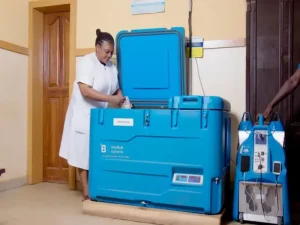
For medical facilities and rural communities across Sub-Saharan Africa and Latin America, solar refrigeration is not a luxury—it is a matter of life and death. In remote villages spanning countries like Nigeria, Kenya, Tanzania, Colombia, or Peru, centralized power grids are either entirely absent or plagued by unpredictable, multi-day blackouts.
Meanwhile, ambient outdoor temperatures in these regions routinely soar past 40°C, with internal warehouse or clinic temperatures sometimes reaching a staggering 80°C under uninsulated corrugated iron roofs.
Under these extreme conditions, a standard household refrigerator fails within hours of a power cut. When the cold chain breaks, tens of thousands of dollars worth of vital pediatric vaccines, maternal serums, antivenoms, and antibiotics spoil, rendering them useless and leaving vulnerable populations unprotected. For EPC contractors, humanitarian NGOs, and United Nations procurement officers, selecting an off-grid refrigeration system requires hardware engineered far beyond standard residential specifications.
The Sungreat Energy SF Series (Solar Freezer) and SDR Series (Solar DC Refrigerator) are built specifically to survive these exact climate challenges. Here is how they maintain an unbreakable cold chain when the grid fails.
1. The 48-Hour Thermal Shield
The most critical baseline metric for any off-grid medical refrigerator is its holdover time—how long the interior can maintain safe, freezing temperatures after all power inputs (both the grid and solar PV generation) are completely severed.
During heavy seasonal monsoons or extended dust storms—common in the rural plains of Tanzania and Kenya—solar panels might yield zero power for days at a time. To combat this, Sungreat utilizes a military-grade, high-density micron polyurethane foaming layer packed tightly within the chassis walls.
1.1 Thermal Preservation
This ultra-thick insulation layer acts as a premium thermal barrier, preventing ambient exterior heat from penetrating the storage core and safeguarding delicate biomedical payloads.
1.2 48-Hour Holdover
Testing and field deployments prove that even when subjected to extreme 45°C ambient conditions, Sungreat SF and SDR units can keep contents frozen (dropping down to -18°C) for over 48 hours without a single watt of electricity, giving rural workers ample time to restore power.
2. Native (DC) Compressors
A common engineering mistake in remote project deployment is purchasing a standard alternating current (AC) refrigerator and pairing it with a standalone solar inverter. This configuration introduces a massive hidden point of failure.
Inverters generate significant heat and are highly prone to internal component blowouts when exposed to the 40°C+ ambient temperatures common in tropical stations. Furthermore, the process of converting Direct Current (DC) from solar panels/batteries into Alternating Current (AC) for the appliance creates a 15% to 20% energy loss due to heat dissipation.
2.1 Direct-Wire Energy Efficiency
Sungreat’s refrigeration systems utilize top-tier, commercial-grade 12V/24V native DC compressors that wire directly into the solar charge controller or battery bank with zero inversion loss.
2.2 Radical Capex Reductions
By removing the 20% power drain, the entire system operates with extreme efficiency, allowing your project to specify fewer solar panels and smaller battery banks to lower upfront hardware and shipping costs.
3. Maximizing Utility
In a compact rural clinic or field hospital, space and budget are highly constrained. Deploying one dedicated refrigerator for liquids and an entirely separate deep freezer for ice packs is often economically unfeasible.
The Sungreat SDR Series addresses this through an intelligent Dual-Zone layout, separating the appliance into distinct freezing and refrigeration compartments powered by individual thermostat sensors.
3.1 The Freezing Zone
Safely stores temperature-sensitive vaccines, blood samples, and ice packs used for mobile field immunization coolers.
3.2 The Refrigeration Zone
Ideal for general medicines, saline bags, oral liquids, and the personal food or water rations of on-site medical staff.
4. Secure Global Tenders
Manufactured within Sungreat Energy’s automated 7,000㎡ production facility, our off-grid cooling units span from compact 68L mobile units to high-capacity 1688L storage systems. Built to comply with rigorous international quality standards, including CE, RoHS, and ISO9001, they feature robust anti-vibration structures to survive transport over unpaved, rugged rural terrain.
5. Support Your Civil Bid
If you are currently drafting a technical proposal or bidding on an institutional tender for off-grid healthcare, rural schooling, or remote community development, partner with a manufacturer that understands extreme environments.
Contact Sungreat Energy today. Our technical division will provide you with full engineering datasheets, system sizing calculations, and compliance documentation required to secure your contract.
Ready to find the right capacity for your project?
- 📧 Get a Custom Quote: [email protected]
- 💬 WhatsApp Us: +86 157 7646 7829
References & Industry Publications
- World Health Organization (WHO) – Guidelines on the Cold Chain and Vaccine Management in Remote Settings
- International Renewable Energy Agency (IRENA) – Off-Grid Renewable Energy Solutions for Healthcare Facilities
- UNICEF – Solar Direct Drive (SDD) Refrigeration Technical Specifications and Field Testing Reports
- Solar Power World – DC Appliance Integration and Efficiency in Off-Grid Photovoltaic Systems
- PV Magazine – Thermal Performance and Insulation Standards for Tropical Solar Energy Storage