





| Engineering Parameter | Project Specification Value | Operational Scope |
|---|---|---|
| Execution Timeline | March 2023 – August 2023 | 6 Months Total Project Duration (Supply, Field Civil Works & Commissioning) |
| Supply & Logistics | Turnkey Modular Supply | 1,000 Complete Integrated Lighting Units, Mounting Hardware & Heavy-Duty Structural Poles |
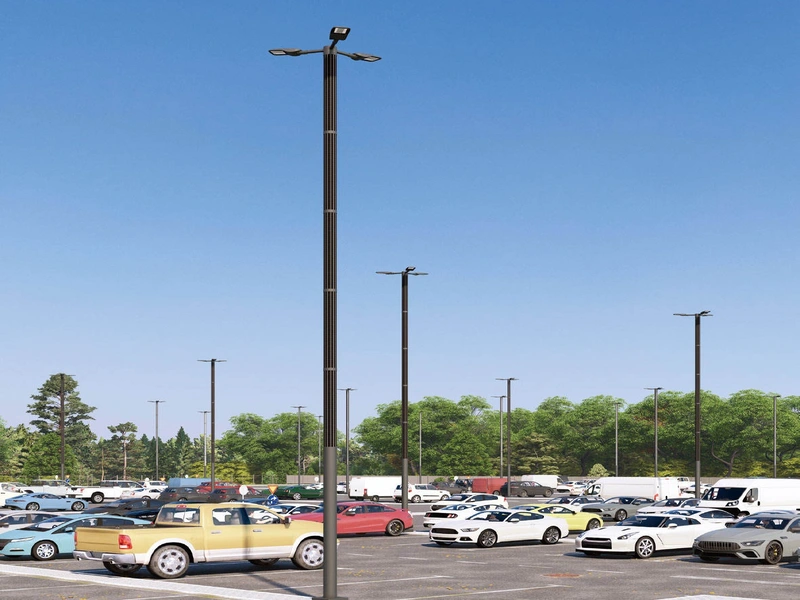
| Mounting Pole Height | 8.0 Meters (Q235 Steel) | Hot-dip galvanized, anti-corrosion powder-coated conical structural poles |
| Lighting Pole Spacing | 30 – 35 Meters Space | Optimized inter-distance spacing across main campus arterial roads & pedestrian paths |
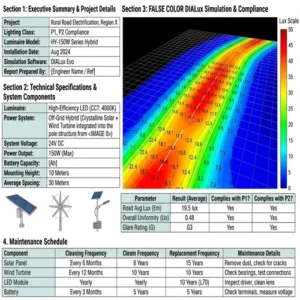
| DIALux Simulation | Class P2 / M4 Compliance | Photometric design achieving average lux > 25 Lux with High Uniformity (U0 ≥ 0.40) |
| Deployment Volume | 1,000 Nodes | Complete high-altitude infrastructure footprint coverage |
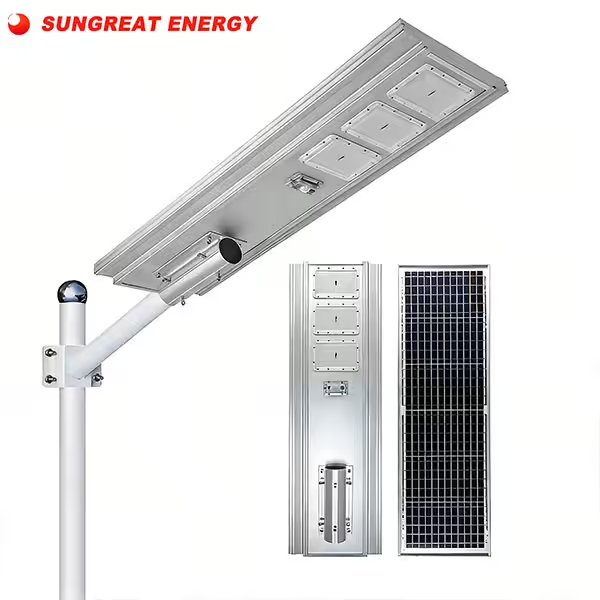
| System Architecture | HY-150W Series | Integrated wind-solar smart micro-grid generation topology |
| Luminance Output | 33,000 LM Max | Solid-state industrial-grade LED arrays (180–220 lm/W) |
| Grid Consumption | 0.00% Zero-Grid | Fully autonomous system independence with zero electrical overhead |
1. The Challenge
Educational institutions located in remote mountainous terrains encounter severe infrastructure vulnerabilities. Cut off from main public utility lines by geographic barriers, this extensive foothill campus struggled through dark nights with inadequate power generation. For years, students and faculty had to walk down pitch-black paths, relying on flashlights or unpredictable moonlight to travel between dormitories, lecture halls, and labs.
Traditional solar lights were evaluated but ultimately dismissed by engineers because the local climate brings prolonged heavy cloud cover, mountain mists, and seasonal monsoons. This causes standard solar streetlights to quickly run out of power. The solution demanded a rugged, reliable system that can capture ambient energy around the clock—even when the sun disappears behind the peaks.
“The transformation is hard to overstate. What used to be dangerous, pitch-black walkways across our campus are now brightly lit corridors of safety. This renewable hybrid energy flows reliably every single night, giving our students the security they need to focus entirely on their education.”
1.1. Project Execution
Initiated in March 2023 and fully completed in August 2023 (a total project duration of 6 months), the campus lighting overhaul followed a rigorous turnkey execution framework encompassing engineering design, global supply, civil installation, and photometric verification.
1.2. DIALux Simulation
- Illuminance Level: Computerized DIALux calculations achieved an average horizontal lux level of 25 to 32 Lux on ground level, exceeding international campus roadway safety standards.
- Uniformity Ratio: Batwing optical lenses delivered an impressive glare-free light distribution uniformity ratio of U0 ≥ 0.42, eliminating dangerous dark patches between fixtures.
- Lighting Layout & Spacing: Designed for an optimal inter-distance lighting space of 30 to 35 meters between poles, minimizing total pole count while maximizing path coverage.
1.3. Supply & Field Installation
- Turnkey Equipment Supply: Sungreat Energy coordinated the end-to-end manufacturing and containerized transport of 1,000 HY-150W hybrid fixtures, MPPT controllers, and LiFePO4 battery storage banks.
- Structural Pole Height: Engineered with 8.0-meter high Q235 steel poles (hot-dip galvanized with a 100μm anti-corrosion layer to resist severe mountain humidity).
- Civil Installation: Features reinforced concrete cage foundations (1.2m depth) designed to handle 50 m/s wind loads without trenching for AC power cables.
2. The Solution
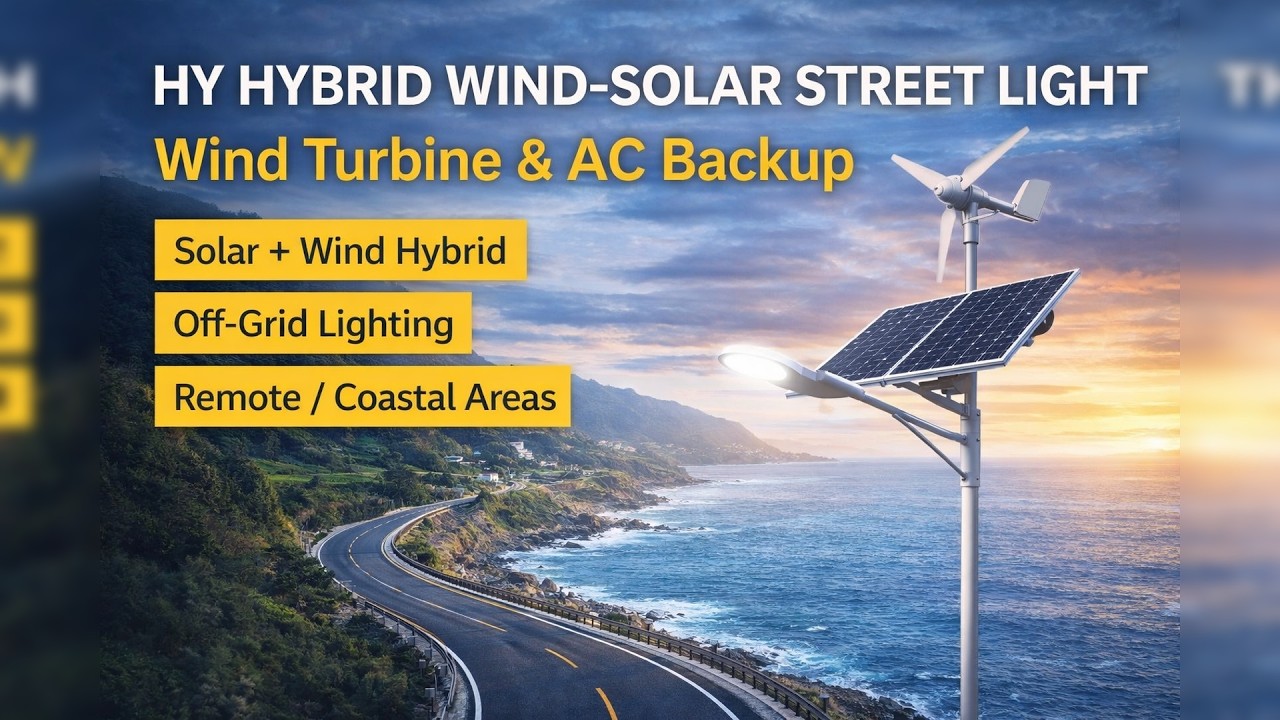
To solve this problem, Sungreat Energy designed and deployed 1,000 integrated units of the HY Series 150W Hybrid System. This setup takes full advantage of mountain pass wind drafts and high-altitude solar exposure to deliver steady, off-grid power.


2.1. Generation Matrix
- HY-150W Core: High-lumens solid-state LED (27,000–33,000 LM).
- PV Array: 18V 100W High-yield N-Type Monocrystalline panel.
- Wind Engine: Aerodynamic turbine with a 2.0 m/s low-wind startup.
2.2. Severe Weather Physics
- Energy Storage: Industrial-grade 12.8V 60AH LiFePO4 Battery pack.
- Weather Protection: IP65 Waterproof & IK09 Impact certified.
- Wind Resistance: Rigid frame withstands storm winds up to 50 m/s.
When seasonal monsoons bring thick mountain clouds, the micro wind turbine picks up the slack—capturing the kinetic energy of mountain breezes to continuously charge the high-capacity LiFePO4 battery bank. Managed by a smart internal MPPT hybrid controller, the system features an automated light-sensing switch that requires zero human intervention. It ensures a stable 5 to 7 days of autonomous backup power, completely eliminating weather-induced blackouts.
3. Impact & Performance
By avoiding miles of deep underground cabling and electrical trenching through tough mountain soil, the institution saved over 45% in upfront construction costs. The campus now benefits from an autonomous lighting grid with zero electricity bills and minimal routine maintenance.
More importantly, it provides reliable student safety. Walkways, study courtyards, and perimeter borders are completely illuminated at an ultra-efficient 180–220 lm/W, transforming the remote mountain site into a safe, modern environment for learning.
[PROJECT TIMELINE] Executed: March 2023 – August 2023 (6 Months)
[DIALUX DESIGN] Lux Target: 25.4 Lux Avg | Uniformity U0: 0.42
[GEOMETRY] Pole Height: 8.0m | Inter-Distance Spacing: 32m
[STATUS] Monocrystalline Array: Active Generation
[STATUS] Wind Turbine Output: 145W (Continuous Draft)
[BATTERY] LiFePO4 Cell Capacity: 98.4% (Stabilized)
[CONTROL] Smart MPPT Switch: Night Dimming Active
[OUTPUT] Zero-Grid Faults Detected across 1,000 Nodes
4. International Publications
-
- 4.1. Renewable and Sustainable Energy Reviews (Elsevier): “Optimizing Micro-Wind and Photovoltaic Structural Complementarity for High-Altitude Institutional Infrastructure.”
Source Registry - 4.2. IEEE Transactions on Sustainable Energy: “MPPT Control Dynamics for Isolated Micro-Grid Power Assemblies in Regions of Low Solar Insolation.”
Source Registry - 4.3. International Journal of Green Energy: “Aerodynamic Structural Evaluation and Load Mitigation of Pole-Mounted Vertical Axis Wind Turbines.”
Source Registry - 4.4. Journal of Applied Electrochemistry (Springer): “Cyclic Lifetime and Safety Indexes of Lithium Iron Phosphate (LiFePO4) Storage Under Extended Operational Stress.”
Source Registry - 4.5. PV Magazine International: “Decentralized Off-Grid Implementations: Eliminating Long-Distance Public Infrastructure Cabling Expenses.”
Source Registry - 4.6. Sungreat Energy Engineering Documentation (2026): “Industrial Field Operations Guide: Structural Integration Protocols for the HY Hybrid Series.”
Official Portal
- 4.1. Renewable and Sustainable Energy Reviews (Elsevier): “Optimizing Micro-Wind and Photovoltaic Structural Complementarity for High-Altitude Institutional Infrastructure.”
5. Corporate Procurement
For custom engineering layouts, system load footprint matching, and commercial container-load pricing tiers, reach out directly through our verified global access nodes: