Feu stroboscopique à LED rouge et bleue alimenté à l'énergie solaire, série TL de Sungreat Energy, avec panneau photovoltaïque intégré, pour la sécurité routière et la régulation du trafic.
Projecteur LED compact Sungreat Energy 60W-300W avec fixation par emboîtement réglable, boîtier dissipateur thermique en aluminium moulé sous pression, indice d'étanchéité IP65, éclairage extérieur haute luminosité pour parkings, routes et espaces commerciaux, certifié CE et RoHS.
Le lampadaire solaire intégré de la série FN de Sungreat Energy est doté d'un panneau solaire monté à l'arrière et d'un système d'éclairage routier à LED multimodules.
Système de congélation solaire Sungreat Energy série SF avec panneaux photovoltaïques, contrôleur MPPT et batteries gel pour refroidissement hors réseau
Coffret d'usine pour réfrigérateur solaire Sungreat Energy série SDR, comprenant panneaux solaires et batterie pour solutions de refroidissement hors réseau.
Système de climatisation solaire hors réseau de Sungreat Energy, comprenant une unité intérieure, un condenseur extérieur, une batterie Lifepo4 et trois panneaux photovoltaïques pour un refroidissement indépendant et écologique sans dépendance au réseau.
Système complet d'énergie solaire de 10 kW avec tous les accessoires
Gamme de batteries LiFePO4 de Sungreat Energy présentant des modèles muraux et sur pied avec affichage numérique
Batteries et onduleurs tout-en-un Sungreat Energy disponibles en trois tailles différentes =
Panneau solaire monocristallin Sungreat Energy
Panneau solaire pliable portable de 700 W, de couleur noire, partiellement déplié, avec cellules solaires visibles.
Panneau solaire monocristallin SunGreat Energy série SP, module photovoltaïque haute efficacité avec vue de la structure avant et arrière

What Is a Bifacial Double-Glass Solar Panel?

Table des Matières

What Is a Bifacial Double-Glass Solar Panel blog image

If you’ve ever stood inside a utility-scale solaire farm at mid-day, you’ve likely noticed something striking: the ground underneath the panels isn’t pitch black — it is brightly illuminated. Sunlight bounces off sand, gravel, concrete, white roofs, and grass.

A conventional monofacial panneau solaire ignores every photon of that reflected ground light because its rear face is opaque. A bifacial double-glass panel turns that reflected light into extra kilowatt-hours.

1. La réponse courte

A bifacial double-glass solar panel generates power from both sides. The front side absorbs direct sunlight coming from the sky, while the rear side captures reflected and scattered light (albedo) from the ground or mounting surface.
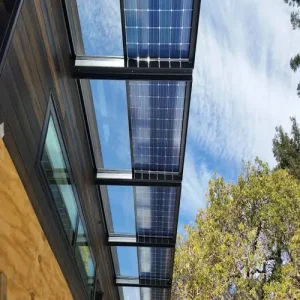
What Is a Bifacial Double-Glass Solar Panel blog extra effieciency

Instead of using a traditional polymer plastic backsheet (like TPT or PET), the rear of the module is sealed with a second sheet of tempered glass.

Concept clé: Bifacial (2 Active Generating Faces) + Double-Glass (Glass Sandwich Construction)

2. How It’s Built

When you strip away marketing buzzwords, a double-glass bifacial solar module is designed for maximum light exposure and extreme environmental endurance:
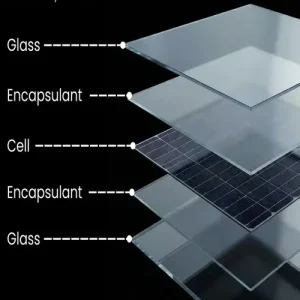
What Is a Bifacial Double-Glass Solar Panel blog How It's Actually Built

2.1. Front Glass

High-transmittance, anti-reflective tempered solar glass designed to maximize light penetration to the primary cell face.

2.2. Bifacial Solar Cells

High-efficiency N-Type cells (such as TOPCon or Heterojunction / HJT) featuring symmetrically grid-patterned contacts that generate power when struck by light from either direction.

2.3. Rear Glass

A second sheet of heat-strengthened glass replaces the opaque plastic backsheet. This protects the rear cell face while allowing incoming ground reflection to enter the cells.

2.4. Frame / Frameless

Available with lightweight aluminum alloy framing or as frameless modules. Frameless variants eliminate dirt accumulation along the edges and minimize Potential Induced Degradation (PID).

By replacing plastic backsheets with tempered glass, the panel loses the primary component prone to UV degradation, thermal cracking, and moisture intrusion over time.

3. Extra Power Comes From?

The amount of extra energy a bifacial panel produces — known as the bifacial gain — is not a fixed static number. It depends heavily on two engineering factors: Ground Albedo (reflectivity ratio) and Mounting Elevation.
What Is a Bifacial Double-Glass Solar Panel blog dubble power

According to field studies published by the Laboratoire national des énergies renouvelables (NREL) et des recherches du Institut Fraunhofer pour les systèmes d'énergie solaire (ISE), surface reflectivity directly dictates rear-side yield:

Surface Material Below Array Typical Surface Albedo Average Rear-Side Bifacial Yield Gain
Dark Asphalt / Dark Roofing 0.05 – 0.10 2% - 5%
Dark Soil / Bare Earth 0.15 – 0.20 5% - 10%
Green Grass / Vegetation 0.20 – 0.25 8% - 12%
Light Concrete / Weathered Gravel 0.25 – 0.40 12% - 18%
White Gravel / Light Sand (Desert) 0.40 – 0.60 18% - 25%
Reflective TPO Roof / Snow Cover 0.60 - 0.85+ 25% – 30%+

3.1 Why Racking Height Matters

NREL Performance Modeling demonstrates that elevating the panel array by 1.0 to 1.5 meters off the ground allows reflected light from a broader area to spread evenly across the rear cells, avoiding self-shading bottlenecks under the array.

4. Avantages

For engineering procurement contractors (EPCs) and equipment distributors, bifacial double-glass technology has shifted from a niche specification to the industry standard for commercial and utility applications.
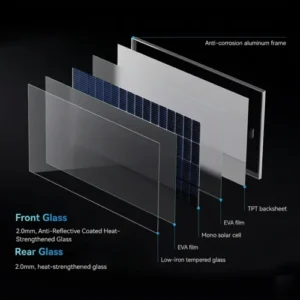
Vue éclatée d'un panneau solaire monocristallin bifacial à double vitrage montrant les couches de verre avant, de cellules solaires, de films EVA, de feuille arrière en TPT, de verre arrière et de cadre en aluminium.

4.1. Higher Lifetime Energy Density

Yielding 10% to 25% more energy from the exact same physical footprint significantly reduces balance-of-system (BOS) costs per watt (racking, cabling, inverters, and land lease expenses). Explore how this applies to complete turn-key builds on our Solar Power System page.

4.2. Durée de vie prolongée

Bifacial double-glass modules routinely offer 30-year linear performance warranties. They pass rigorous environmental qualification testing defined by the Commission électrotechnique internationale (CEI), en particulier IEC 61215 for design qualification and IEC 61730 for safety standards.

4.3. Résilience supérieure

Double-glass modules withstand high humidity, salt spray, ammonia exposure, and extreme desert temperatures far better than plastic backsheets. This makes them ideal for coastal, agricultural, and high-ambient-heat solar installations.

4.4. Reduced Levelized COE

Generating more kilowatt-hours over a 30-year operational period directly lowers the financial payback window and boosts internal rate of return (IRR) for project developers.

5. When NOT to Choose Bifacial

Bifacial double-glass panels are not a universal fit for every project. Understanding where they don’t pay off helps avoid wasted capital:

5.1. Key System Limitations

  • Flush Pitch Residential Roofs: A panel installed flush against a dark shingle or dark tile roof has virtually zero rear ground clearance and negligible reflectivity (~0.05 albedo). In these cases, standard monofacial modules are much more cost-effective.
  • Higher Module Weight: Dual-layer glass increases panel weight compared to single-glass modules. Roof structural loading must be verified before deploying on commercial roofs.
  • Slightly Higher Initial Module Price: Racking structure elevation and glass-glass materials carry a small upfront premium that requires reflective ground or carport settings to yield a rapid return on investment.

If you are unsure whether your project site supports viable biface gains, reach out to our engineering team via the Engineering & Technical Support page for customized irradiance modeling.

6. Bifacial vs. Monofacial Panel

Fonctionnalité / Métrique Standard Monofacial Panel Bifacial Double-Glass Panel
Power Generation Sides Front face only Front face + Rear reflective capture
Rear Encapsulation Opaque plastic backsheet Verre renforcé à la chaleur
Standard Performance Warranty 25 ans 30 Years (Linear)
Taux de dégradation annuel ~0.55 % par an ~0.40% – 0.45% per year
Application la mieux adaptée Residential pitched roofs Ground-mount, carports, flat commercial roofs
Conformité aux tests internationaux Normes IEC 61215 IEC 61215 & IEC 61730 Standards
Resistance to UV / Humidity Moderate (backsheet age risk) Superior (dual glass hermetic seal)

7. L'essentiel

A bifacial double-glass panel turns wasted ground reflections into usable clean energy. For ground-mount installations, desert projects, carports, and elevated commercial flat roofs, it offers one of the highest returns on investment in modern solar technology.

Curious to see how bifacial modules perform in active commercial solar deployments? Browse our real-world site data in our Project Case Studies.
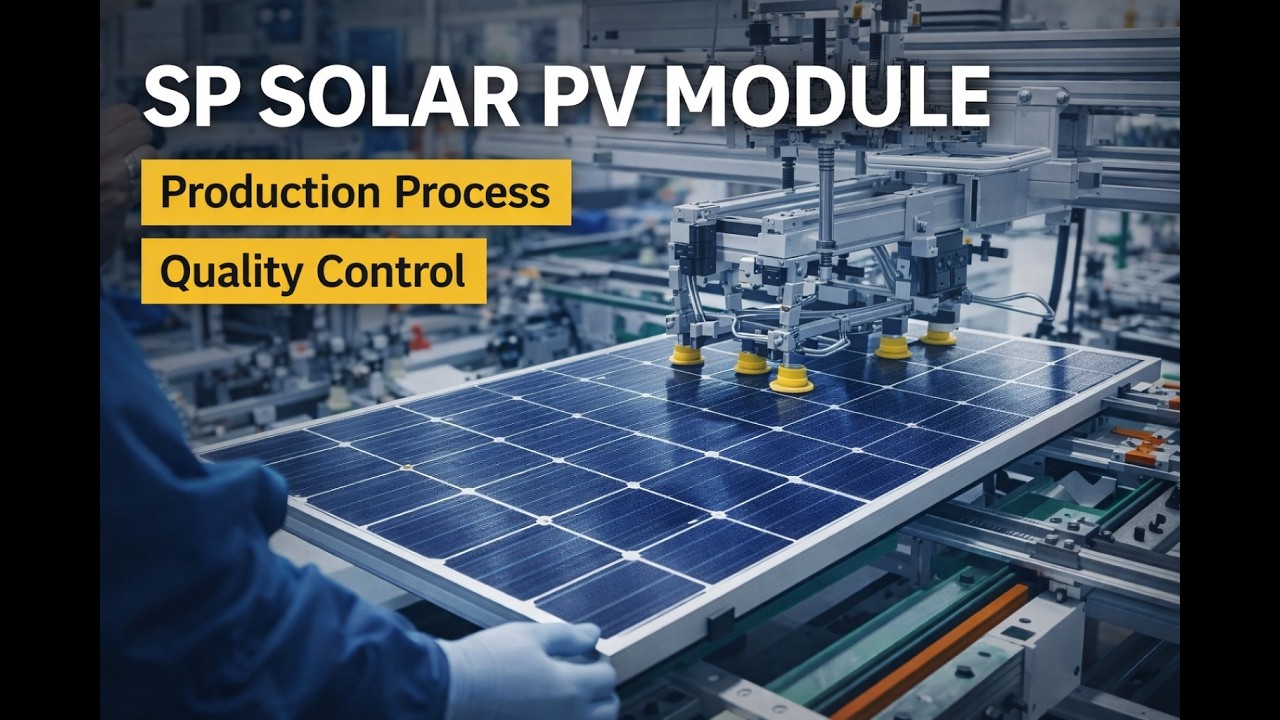
Lecteur vidéo YouTube

Ready to Spec Bifacial Double-Glass Panels for Your Next Project?

At SunGreat Energy, we supply high-efficiency TOPCon and PERC bifacial double-glass panels engineered for maximum yield and long-term durability.

Request Full Specifications & Wholesale Quotes from SunGreat Energy Today →

Image de SungreatenergyAdmin

SungreatenergyAdmin

Bienvenue pour partager cette page :
Catégories de Produits
Obtenez un devis gratuit dès maintenant !
FORMULAIRE DE CONTACT
Produits associés
Nouvelles connexes
What Is a Bifacial Double-Glass Solar Panel blog image

If you’ve ever stood inside a utility-scale solar farm at mid-day, you’ve likely noticed something striking: the ground underneath the […]

Comment fonctionne une batterie solaire avec des panneaux solaires et un onduleur ? Article complet du blog de Sungreat Energy.

Les panneaux solaires produisent de l'électricité lorsque la lumière du soleil est disponible, mais la production d'énergie solaire ne correspond pas toujours aux besoins en électricité. […]

Déploiement de systèmes de stockage d'énergie LiFePO4 de 100 Ah et 48 V aux Philippines

Avant d'étudier les batteries LiFePO4, il convient de noter que, face à l'accélération de la transition mondiale vers les énergies renouvelables, un approvisionnement en électricité fiable ne peut pas toujours être garanti.

Panneaux solaires Topcon de type N (photo principale), également installés dans le cadre d'un autre projet par Sungreat Energy.

Avant d'aborder les différents types de panneaux solaires Topcon, il est important de savoir que l'industrie solaire mondiale connaît une transformation technologique majeure. […]

Alors que la demande mondiale d'énergie propre continue de croître, les infrastructures renouvelables sont passées d'une alternative environnementale à une stratégie économique fondamentale.

Qu’est-ce qu’un panneau solaire et comment fonctionne-t-il ? Découvrez ce qu’est un module photovoltaïque et explorez les principaux composants d’un panneau PV […]

Déploiement d'infrastructures électriques à haute capacité (projet de 5 000 unités LB-200AH) au Bangladesh : le client a reçu

Pour pallier les fluctuations chroniques du réseau et les temps d'arrêt opérationnels des équipements commerciaux lourds, Sungreat propose un système de batteries LiFePO4 haute densité de 10.24 kWh […]

Remonter en haut

Obtenez un devis gratuit dès maintenant !

FORMULAIRE DE CONTACT
Si vous avez des questions, n'hésitez pas à nous contacter.
Sungreat Energy, contactez-nous