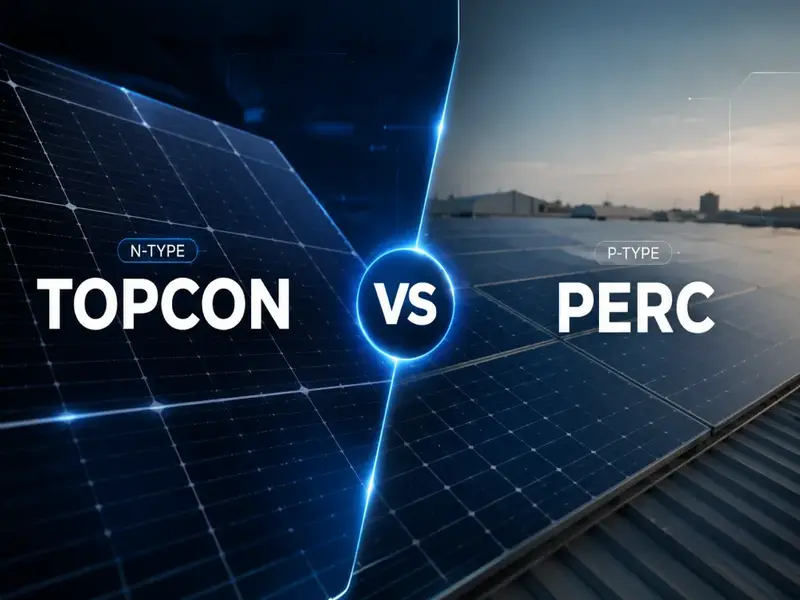
The global solar photovoltaic (PV) market is experiencing a massive technological shift. For over a decade, P-Type Passivated Emitter and Rear Cell (PERC) technology dominated commercial, residential, and utility-scale solar deployments. However, as PERC technology approaches its theoretical physical efficiency limit (~24.5%), the solar industry has rapidly transitioned to N-Type TOPCon (Tunnel Oxide Passivated Contact) technology as the new market standard.
For project developers, Engineering, Procurement, and Construction (EPC) contractors, and painel solar equipment importers, choosing between TOPCon and PERC modules directly impacts Levelized Cost of Electricity (LCOE), initial Balance of System (BOS) costs, and 30-year operational return on investment (ROI).
In this technical guide, we break down the key differences between TOPCon and PERC painéis solares, focusing on cell architecture, efficiency, thermal degradation, and total project economics.
1. Cell Architecture and Efficiency
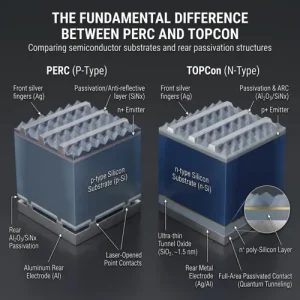
The fundamental difference between PERC and TOPCon lies in their semiconductor substrate and surface passivation structure.
1.1. P-Type PERC
PERC padrão painéis solares utilize a boron-doped silicon base. While cost-effective to produce, boron atoms react with trace oxygen under sunlight (a phenomenon known as Light-Induced Degradation or LID), creating recombination energy traps. This structural loss limits real-world PERC mass-production efficiency to approximately 20.0%–21.5%.
1.2. N-Type TOPCon
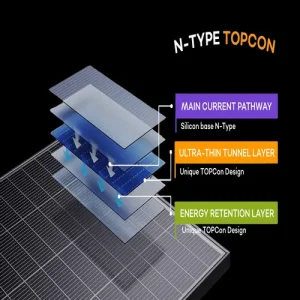
N-Type TOPCon utilizes a phosphorus-doped silicon base combined with an ultra-thin tunnel oxide layer (~1.5 nm) and a doped polycrystalline silicon passivation layer. This passivated contact design drastically suppresses surface electron recombination, enabling mass-production module efficiencies to surpass 22.5%–23.5%+.
1.3. Why Efficiency Matters
Higher module conversion efficiency allows installers to generate significantly more power per square meter. In commercial and utility installations, deploying high-power TOPCon painéis solares means fewer total modules are needed to hit a target megawatt (MW) capacity, directly reducing mounting racking, DC cabling, land footprint, and on-site labor expenses.
2. T and L Degradation:
Long-term energy generation over a 25-to-30-year operational period depends heavily on how a painel solar withstands environmental heat and light exposure.
2.1. Coeficiente de temperatura
Todas as painéis solares experience voltage drop as operating ambient temperatures rise:
- P-Type PERC: Typically features a temperature coefficient of -0.35% / ° C.
- N-Type TOPCon: Features an improved temperature coefficient of -0.30% / ° C.
In high-heat climate zones across the Middle East, Southeast Asia, and Africa, roof temperatures often exceed 50°C to 65°C. Under these demanding conditions, TOPCon modules suffer noticeably lower thermal power loss, delivering higher power output during peak afternoon hours.
2.2. Linear Degradation Rates
- First-Year Degradation: Because N-Type silicon contains no boron, TOPCon painéis solares are essentially immune to Boron-Oxygen Light-Induced Degradation (BO-LID). First-year power degradation for TOPCon is ≤ 1.0%, compared to ~2.0% for standard PERC.
- Annual Linear Degradation: Ao longo de um ciclo de vida de 30 anos, TOPCon degrades at ≤ 0.40% per year, whereas PERC degrades at ~0.55% per year. After 30 years, a TOPCon painel solar retains up to 87.4% of its rated power, delivering 10%–15% higher lifetime energy yield.
2.3. Bifaciality Rate
Vidro duplo TOPCon modules achieve a bifaciality factor of 80% –85%, em comparação com apenas 70% –75% for PERC. This allows TOPCon painéis solares to capture substantially more reflected ground irradiance (albedo) from sand, gravel, light concrete, or TPO roofing surfaces.
2.4. TOPCon vs. PERC
3. CAPEX vs. LCOE
While N-Type TOPCon painéis solares initially commanded a price premium, rapid manufacturing scaling has brought module prices close to parity with PERC. Looking strictly at initial module cost per watt (CAPEX) provides an incomplete financial picture.
3.1. BOS Cost Savings
Porque TOPCon painéis solares offer higher individual wattage ratings (e.g., 580W–710W+), project engineers require fewer modules per megawatt. This translates directly to fewer mounting rails, string combiner boxes, cabling runs, and reduced installation labor hours.
3.2. LCOE Reduction
LCOE measures the lifetime cost per kilowatt-hour generated over 30 years. Thanks to lower heat losses, higher bifacial gain, and reduced linear degradation, TOPCon technology delivers a 5%–7% lower LCOE over the operational lifetime of a commercial or utility project.
4. Our TOPCon Modules
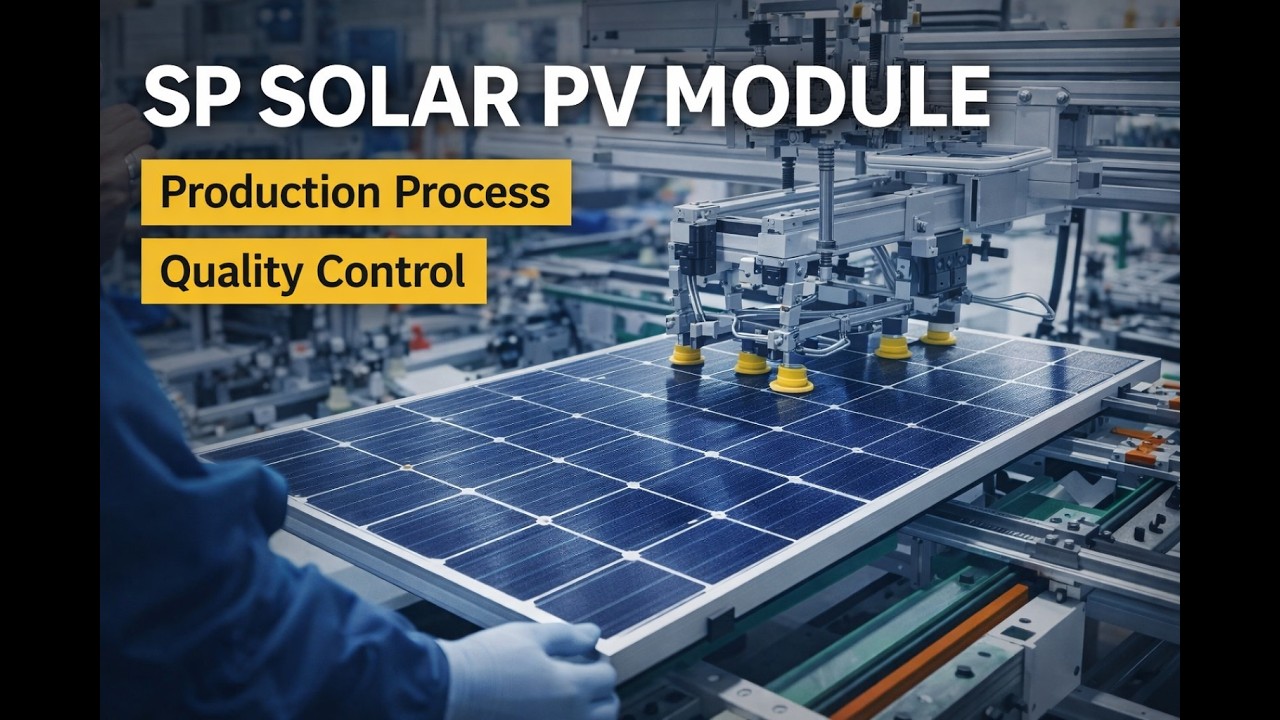
At Sungreat Energy, we have advanced our automated manufacturing hubs to produce premier N-Type TOPCon painéis solares tailored for commercial, industrial, and EPC deployments worldwide:
4.1. High-Efficiency SP Series
Our flagship N-Type TOPCon painéis solares achieve module efficiencies exceeding 22.5%, engineered with dual-glass encapsulation rated for ambient temperatures up to 65°C.
4.2. Industrial Scale & Speed
Operating a 7,000 m² modern manufacturing center equipped with 12 automated production lines, Sungreat Energy guarantees rapid order turnaround within 3 to 4 weeks.
4.3. Flexible B2B OEM/ODM Services
We collaborate with regional importers, equipment distributors, and EPC partners to supply customized module labeling, custom packaging, flexible MOQs, and tailored mounting hardware.
4.4. Comprehensive 30-Year Performance Guarantee
Todas as Sungreat Energy N-Type TOPCon modules are backed by a comprehensive 30-year linear performance warranty to guarantee bankability for utility-scale project tenders.
5. International References
To verify technical claims regarding silicon solar cell efficiency, passivation physics, and degradation metrics, consult these authoritative global research institutions:
- Laboratório Nacional de Energia Renovável (NREL):
Research on Photovoltaic Cell Efficiency & N-Type Passivated Contacts
Link: NREL Photovoltaic Research & Efficiency Benchmarks - Fraunhofer Institute for Solar Energy Systems (ISE):
Photovoltaics Report & Industrial TOPCon Cell Research
Link: Fraunhofer ISE Photovoltaics Report - International Energy Agency Photovoltaic Power Systems Programme (IEA-PVPS):
Trends in Photovoltaic Applications & Market Technology Shifts
Link: IEA-PVPS Global Trends Reports - Progress in Photovoltaics: Research and Applications (Wiley):
Silicon-Based Passivating Contacts: The TOPCon Route
Link: Progress in Photovoltaics Journal Publications - PV Tech / Solar Media Technical Publications:
TOPCon Module Reliability, UVID, and Degradation Benchmarks
Link: PV Tech Technical Reports & Industry Intelligence
6. perguntas frequentes
6.1. Is PERC technology obsolete in 2026?
While PERC painéis solares remain in use for budget-conscious legacy projects, major Tier-1 global manufacturers have transitioned new cell expansion lines almost exclusively to N-Type TOPCon due to its superior efficiency, low degradation, and lower overall LCOE.
6.2. Can TOPCon panels be integrated with standard inverters and mounting structures?
Sim. Travas deslizantes portáteis TOPCon painéis solares utilize standard physical dimensions, mounting frame profiles, and electrical specifications compatible with mainstream string inverters, central inverters, fixed racking, and single-axis trackers.
6.3. Why is N-Type TOPCon better suited for hot climate deployments?
N-Type TOPCon features a lower temperature coefficient (-0.30%/°C vs -0.35%/°C for PERC), meaning it suffers far less thermal power loss as temperatures rise, yielding significantly more energy in high-ambient desert and tropical environments.
7. Upgrade Your Solar Projects
Ao escolher entre TOPCon and PERC, N-Type TOPCon is the definitive choice for modern solar developments demanding lower LCOE, superior thermal performance, and 30-year long-term financial returns.
📩 Ready to evaluate N-Type TOPCon modules for your next commercial project or distribution network?